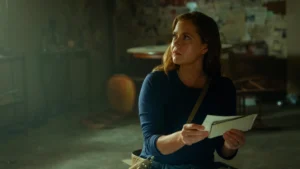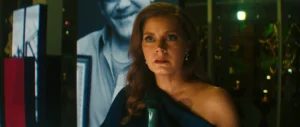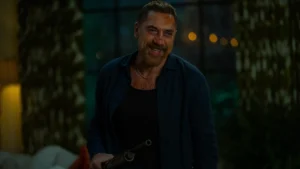
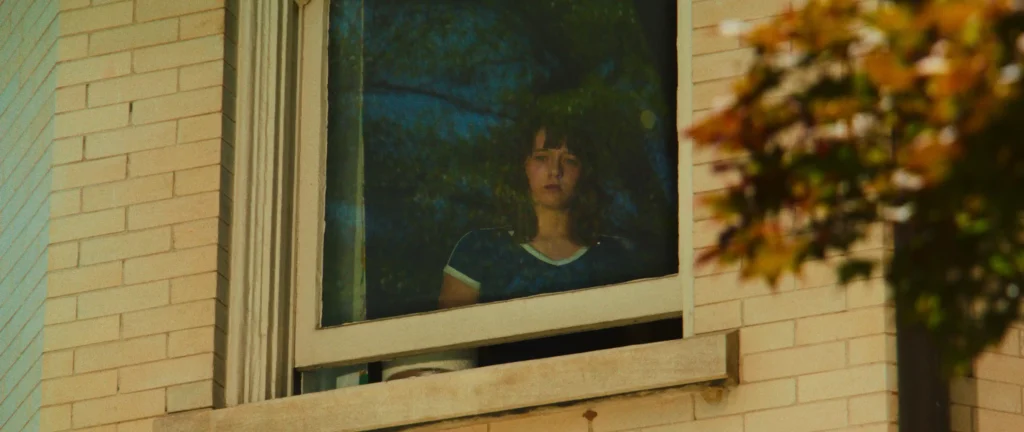
Apple TV’s Cape Fear is the third adaptation of John D. MacDonald’s 1957 novel The Executioners and has consistently referenced both the 1962 film and the 1991 Martin Scorsese remake in various ways. Reworkings of specific scenes, line readings, and score compositions, and reuse of stylistic flourishes like colour negatives, have all helped to make this latest version of the story feel familiar while also being distinct. But the latest episode has provided the biggest connection yet in the stunt-casting of Max Cady’s enigmatic stalker.
The stalker character is new for this version. We’ve glimpsed her a few times in Season 1; Anna bumped into her in the hospital, and in Episode 3, she pursues Cady and Anna all the way to Atlanta, where Anna is negotiating his reparations check after being assaulted by a white supremacist gang in prison. When they’re forced to spend the night in a hotel on account of a storm, the stalker, wearing a hood and a mask, creepily knocks on Anna’s hotel room door, believing it to be Max’s, and offers to sing him a song.
Max downplays the encounter as one of many female fans who took a shine to him while he was in prison. However, he obviously knows more than he’s letting on, since when he finally gets home, he finds a package waiting for him. It reads “Hi Max” and contains a video recording of the woman singing Butthole Surfers’s “Jingle of a Dog Collar”, which majorly triggers him, causing him to violently destroy his TV with a fireplace poker.
The reason this is significant is that the stalker is played by Juliette Lewis. In Martin Scorsese’s 1991 Cape Fear, Lewis played Danielle Bowden, the teenage daughter of Sam Bowden (Nick Nolte), the lawyer character whom Robert De Niro’s Max Cady was harassing. She was even nominated for a Best Supporting Actor Oscar in recognition of her work in the role.
Needless to say, this casting coup is a deep cut for fans of the Scorsese movie, but that doesn’t help to illuminate Lewis’s character in this version. Danielle is a close analogue for the character of Natalie, and, of course, Sam Bowden was basically this adaptation’s Tom. The stalker figure is completely new, but based on the available evidence seems to be connected to Max’s traumatic past.
As he already laid out in a previous episode, Max was sent to the U.S. after his mother, a woman from the Basque region of Spain, took her own life. He went to live with his American serviceman father, who didn’t want him either, and abused him – with his forms of torment seeming to have strong religious undertones – as a result. In snippets of flashbacks, the implication is that Max’s father kept him in a cage and treated him like a dog, including making him wear a collar.
This is supported by his stalker including a dog’s collar in the envelope, as well as waving one to Anna through the peephole of the hotel room door. This would also explain why Max had such a volatile reaction to the song, which also makes mention of a dog’s collar. She’s using his traumatic backstory to terrorise him, which shows a completely new angle to the character.
Since this version of the story is playing on the idea that Max might be innocent, Lewis’s character may well be the true villain of the story, the person who perhaps committed the crime he was convicted of. However, Javier Bardem’s performance is so exaggeratedly villainous that it seems almost incomprehensible that he isn’t a bad guy. However, both things could be true. It could even be that case that even if Max is guilty, this woman’s abuses of him – alongside his father – could be a very direct root cause of his psychopathy.
For now, Cape Fear is content to leave almost all of its biggest questions unaddressed, but the introduction of this character is doubly significant given the nature of the casting. It’s almost as if the show’s trying to tell us something, but quite what remains elusive for now.
RELATED: