Summary
Sugar‘s competing cases begin to overlap in relatively satisfying ways in “Unknowns”, a slower but engaging character-driven episode that leans into the underlying themes of loneliness and belonging.
Sugar is the rare show that gets better the more it slows down. Season 2 has always had a thematic point to make, one about loneliness and belonging obscuring the perils – or not – of assimilation, but it also has to be a neo-noir mystery and a sci-fi thriller at the same time, so sometimes it’s pulled in too many directions. With the mystery plot having reached a natural pause point, Episode 5, “Unknowns”, has the opportunity to fold in Sugar’s more personal investigation and lean more heavily into his burgeoning sense of isolation and need for connection. The overall effect is pretty compelling.
You’ll recall that in the previous episode, Sugar found Ji Moon. And he killed him, sort of, faking his overdose with a timely hot shot before reviving him. The ploy worked. Vega found his “corpse” and figured his problem had solved itself. The opening moments of “Unknown” find Sugar selling the illusion. He checks Ji into a discreet rehab facility, procures a fake death certificate, and punches Vega in front of witnesses to sell his anger at the apparent outcome. Vega buys it.
This is all good stuff. It upsells Sugar’s intellect and connections. It creates some humanity around Vega without making him seem like a complete idiot. And it highlights how easily people can slip through the cracks of a disinterested system in which people are constantly dying, being tagged and filed away, the sum total of their lives consigned to a pile of ash and a file marked “Unknown”. Ji might not really be dead, but the city would have only shrugged if he were.
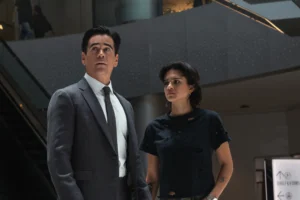
It also gives Sugar some spare time. He spends it selling the illusion he has moved on to Vega, going on tours of the Paramount lot so he can be regaled with stories about Hitchcock’s famous eccentricity, a neat parallel given that Sugar had earlier mentioned aloud that Vertigo has a fake death angle with a bit more drama than he’d like in his own case. But he also spends time working on his private case, spying on Pavich, and even on his love life when Charlotte returns to the hotel after their bickering earlier in the season.
Sugar’s angle with Pavich is Dr. Stanley Ondaajte, the academic he was meeting with. His function remains inscrutable for now. Sugar swots up on cacti so that he can bond with Stanley over his fondness for hardy plants, which is itself a metaphor for Sugar’s own predicament as the last remaining member of his race on a lonely planet, and pulls double-duty as a further way to throw Vega off his trail. Sugar investigating the B-plot as a function of the A-plot is smart, satisfying writing.
Not that Sugar has abandoned the A-plot entirely, obviously. He inquires with Tom about whether Ji could be put into Witness Protection in exchange for testifying that he saw Vega murder Chuy. Tom points out that he’ll need considerable evidence to make that case against a cop, and, more to the point, that there’s an element of what Vega’s doing and at whose behest that remains obscured. Sugar also gives Val her first job, which is returning to Downer Town to retrieve Chuy’s phone from his grandmother. Initially, it seems like Chuy didn’t have a phone, but Sugar later figures out he gave it to Sandra, who is now tragically dead of an overdose, another file in a long line of John and Jane Does with no families to notify of their demise.
Sugar Season 2, Episode 5 finds Sugar lonelier than ever, and thus closer to assimilation. The more downtime he has, the more he’s reminded that he’s totally on his own. His transmissions continue to go unanswered. Melanie picks up the phone, but she’s out of town, and their conversation is stilted. Sugar’s “tastes are changing”, and his room service veggie meal is unsatisfying. He finds himself craving a late-night cheeseburger in the hotel restaurant, a clear sign that he’s becoming dangerously American.
In the restaurant, he bumps into Charlotte, to whom he hastily apologises. The next evening, at the hotel bar, he sees her again, and this time she softens. They dine together and stay up all night talking. The connection is there, no doubt. But the dramatic question is whether Sugar giving in to the obvious attraction will give him what he needs, or complete the process of divorcing him from who he really is.
RELATED: