Summary
Mo Gilligan proves a great guide for a slick and entertaining documentary that still exposes some pretty alarming truths.
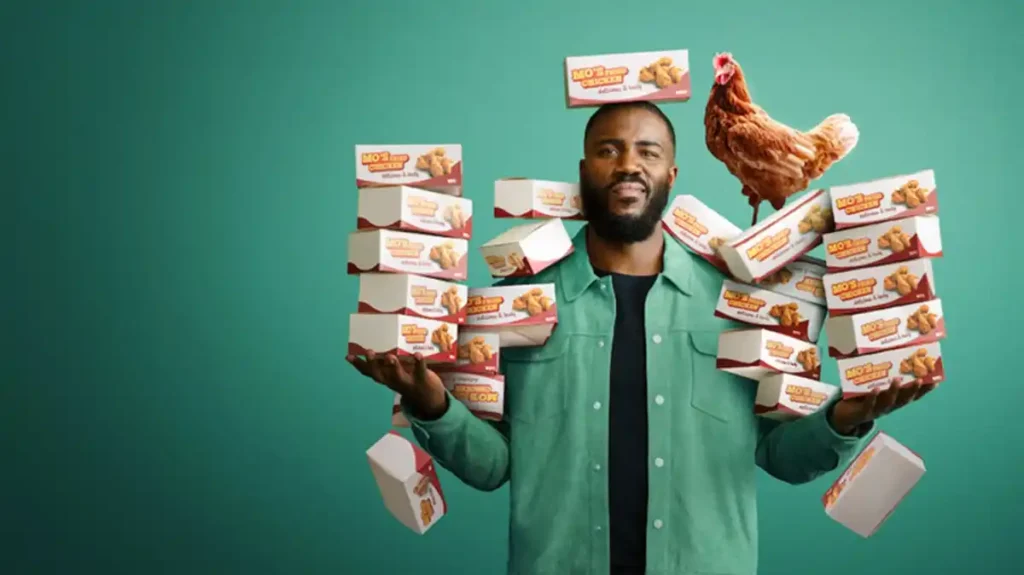
There’s nothing especially illuminating about the idea that eating fast food every day is bad for your health, but it’s still nice – and important – to be reminded. British comedian Mo Gilligan is also the right person to be reminded by, since his likeability and adjacency to the issue make him a better choice than a dry, overly serious doc-journalist, however ultimately serious Big Chicken: A Fast Food Conspiracy might end up being. And, spoiler alert, the industrialised poultry farming industry is pretty grim.
Gilligan’s close association with Netflix – his comedy specials, Momentum, There’s Mo to Life, and In the Moment have all streamed on the platform – has allowed him to use his relevance and style to draw attention to the secretive, potentially calamitous operations that allow KFC and its ilk to saturate Europe and America. As he makes clear himself, as both a once working-class Londoner and now a globally recognised celebrity, he has a strong connection to chicken. KFC buckets were his childhood treats; a lucrative Nando’s endorsement deal lined his pockets as an adult. He has been part of the problem on multiple levels, so he’s best-positioned to become part of the solution.
Initially, it isn’t clear what problem he’s solving. The hook of the documentary is that Mo is going to live entirely on fried chicken for a month to chart what happens to his body during that time. Needless to say, he gets heavier and unhealthier. But he also becomes tearful and depressed, which is a bit more unexpected, and then begins to disappear down a rabbit hole of industrial conspiracy as he realises how expansive and potentially harmful “Big Chicken” really is. It works as a dramatic throughline because it feels like a natural outgrowth of Mo’s experiences.
You’ll have noticed the problem. The issue with fried chicken isn’t that it’s chicken – it’s that it’s fried. Mo’s meal choices – for breakfast, lunch, and dinner – also tend to incorporate sides and sauces that aren’t factored into the documentary’s thesis. It isn’t as robust an argument against a particular fast-food product or chain as, say, Super Size Me was, but that matters less than you’d think as the point of the documentary gradually evolves throughout its runtime.
The turning point comes during a tour of the U.S., where Mo is exposed to the harsh realities of industrial chicken farming on the scale necessary to supply the amount of fried chicken that people in the West are consuming. He learns about horrendous employment conditions akin to modern-day slavery, with undocumented workers bearing the brunt. He learns about the treatment of the chickens, and how the handling of their waste is polluting the air and rivers. Eventually, he’s meeting up with animal welfare activists in balaclavas and trying to break into a Lincolnshire factory.
Mo’s burgeoning interest in and concern about the subject dovetails with his worsening mental and physical health as he consumes more and more fried chicken. At one point he cries in his hotel room, not because of any particular revelation, but simply because of how bad he feels. And yes, the obvious counterpoint is that nobody in their right mind would eat fried chicken three times a day. But they’ll eat any number of things that are equally ultra-processed, and that are procured through the same – or at least a similar – chain of dangerous, unethical practices.
There’s nothing in Big Chicken: A Fast Food Conspiracy that you didn’t know or haven’t seen before, but the delivery mechanism feels more organic and honest than they usually do. Mo doesn’t have the preachy, hand-wringing tone that serious journalists often do, and that makes him easier to relate to. It also makes his reactions more believable. Some scenes are clearly staged – there’s a bit where his friend comes around, and they just happen to call KFC while the cameras are running – but Mo’s perspective feels very authentic. He’s likely to educate a whole new audience about the harsh realities of a problem they might not have realised existed. And that can only be a good thing.