Summary
Trainwreck: Storm Area 51 doesn’t benefit from its elongated runtime. It’s an interesting story, but it touches on a lot of familiar themes that the series has already addressed.
Trainwreck: Storm Area 51 is essentially the final boss of Netflix’s uber-successful voyeuristic documentary series. It builds on several of the themes touched on by previous installments to recount the extremely silly and memeified “raid” of Area 51, this time in two episodes rather than a single standalone feature. The doubled runtime probably works to the story’s detriment, but it feels appropriately momentous, and if nothing else, the whole thing builds to a reasonably happy ending, its various points proved.
As interesting as the whole thing is on its own terms, though, it’s pretty weak as these things go. The snowballing impact of an unexpectedly viral social media post was already touched on — albeit rather ineffectively — by Trainwreck: The Real Project X, and when the documentary pivots at around the midpoint into a cautionary tale about the logistics of large-scale event planning, the sillier subject makes it less effective than Trainwreck: The Astroworld Tragedy, which dealt with similar ideas.
Likewise, this two-parter from director Jack Macinnes lacks the human interest angle of The Cult of American Apparel, Balloon Boy, and P.I. Moms, the latter of which remains the best one. The genesis of the story was initially a joke, then a determination to have a wild night out in the middle of nowhere, and then a joke again — the idea of really challenging ideas of governmental secrecy and extraterrestrial invasion aren’t really anything to do with it. This is, after all, the post-truth age of the internet, where a key question raised towards the very end of the series seems most relevant: How do you police a joke?
That joke, for what it’s worth, began as a Facebook event created by Matty Roberts, who features extensively in Trainwreck: Storm Area 51. Matty, a 20-year-old vape store employee, inspired by an episode of The Joe Rogan Experience that claimed, apparently from the horse’s mouth, that alien spacecraft were being housed inside Area 51, a highly classified USAF base in southern Nevada, created a Facebook group encouraging people to storm the facility in numbers. The logic was that the military wouldn’t be able to stop a large enough crowd. But it was a joke, a sh*tpost that became the most viral and disruptive of all time. The trouble was that once the internet got a hold of it, it became very real.
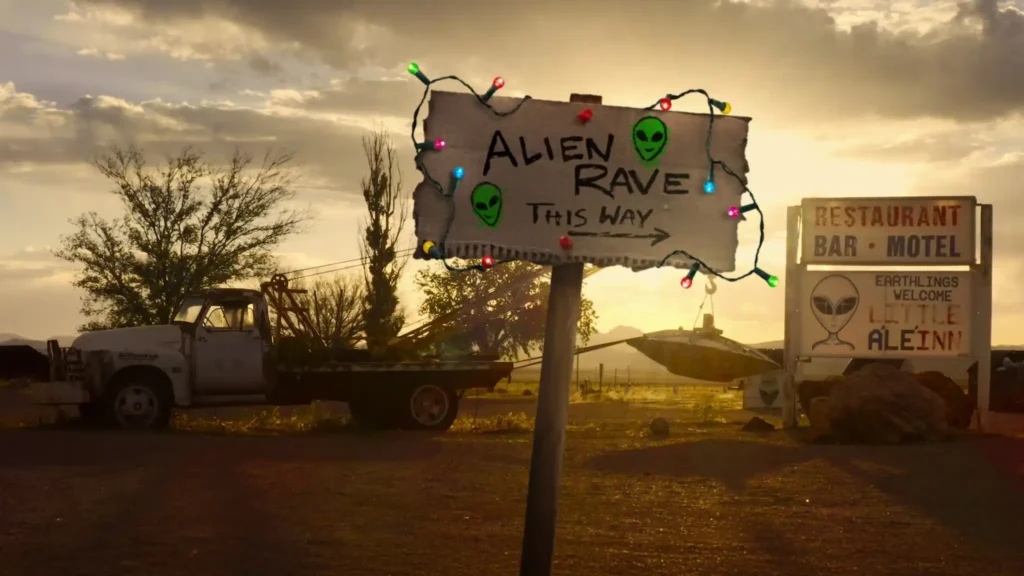
Area 51 has long been closely associated with conspiracies about aliens, but the idea that something sinister was being housed there quickly became a theme rather than the point. People wanted to dress up, kick-start YouTube careers, and have a good time. An EDM festival was planned to take place just outside the gates, and people travelled en masse to the middle of nowhere to be involved. This urge for voyeurism is at the heart of Trainwreck’s success. Human beings innately want to witness disaster, and the idea of the event becoming Fyre Festival 2.0 was not only floated but, on some level, actively sought.
Of course, none of this actually happened. Despite the military investing a lot of money in preventative measures and being quite unequivocal in their warnings that anyone who tried to breach the facility would be shot dead, the whole thing went by with a whimper. Most of the would-be attendees went to the relocated outdoor music festival instead, with only a handful turning up to Area 51 itself. The truest summary of the whole debacle was a “charge” at the gates that stopped as soon as it started, clearly intended to be a punchline. It works as one, and also a neat summary of the event overall. This is perhaps why Storm Area 51 running for two episodes was a mistake, especially with all of the first being devoted to the build-up to something that never actually happened.
This feels about right as a climax to Trainwreck, which in many ways has always been a series about things not going to plan. It’s a funny story that doesn’t warrant being twice as long as usual, especially not when most of the talking points it raises have been better explored in previous instalments. We still don’t know what’s inside Area 51, but what we do know is that most people are more interested in having a rave than finding out. Perhaps that’s for the best.