Summary
Twisted Metal Season 2 is bigger, better, and even more bizarre, leaning into the franchise’s madcap world while also delivering surprisingly engaging character drama.
Two years after Season 1 turned out to be surprisingly good, and thirty years after the debut of the long-abandoned PlayStation series on which it’s based, Twisted Metal returns for a bigger, better, and more outlandish Season 2 that finally makes good on the games’ central conceit of a madcap vehicular combat tournament. But anarchy aside, the Peacock original is full of surprisingly likable characters and adroit development, with showrunner Michael Jonathan Smith using the nutty setting as an excuse to deliver not just high-octane uber-violence but surprisingly engaging drama.
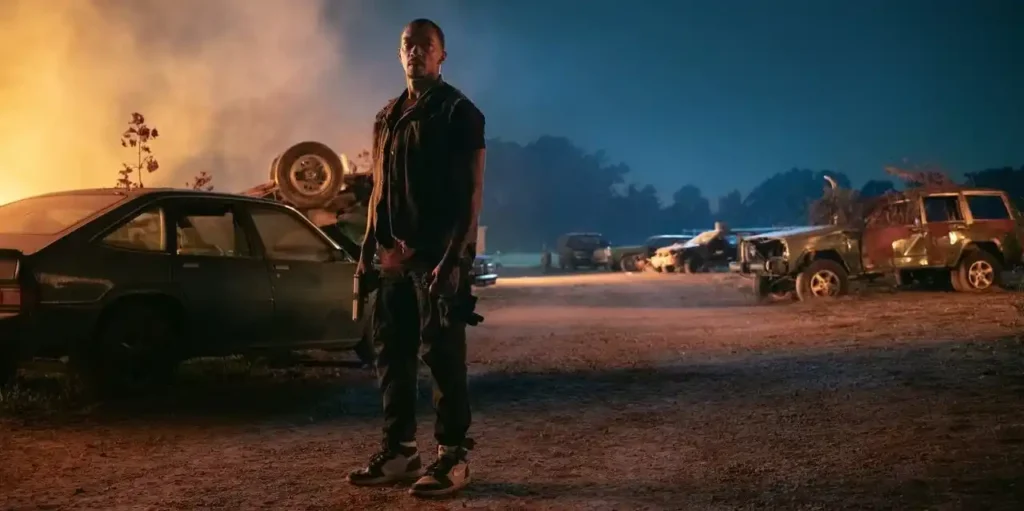
After the first season felt like a prologue that ended right when it was getting to the main event, it’s refreshing that Season 2 seems to be going out of its way not to waste time. John Doe (Anthony Mackie, seen recently in The Studio) begins the season where he left off, as a “guest” in New San Francisco at the pleasure of Raven (now Patty Guggenheim of She-Hulk fame, with an in-universe explanation for where Neve Campbell went), who is trying to force him to drive for her in the upcoming Twisted Metal tournament hosted by the enigmatic showman Calypso (Anthony Carrigan, Barry, Fatherhood). Within an episode, though, he’s free again, but having reunited with Quiet (Stephanie Beatriz, Creature Commandos) and met his sister, Dollface (Tiana Okoye), they quickly end up back at the tournament after all, this time for their own reasons.
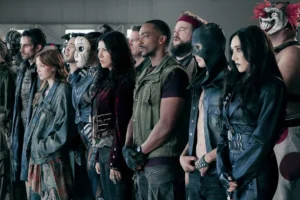
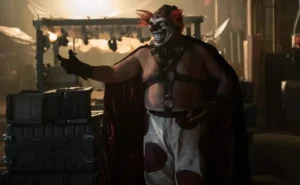
Joining them are a smattering of characters from the first season, including Sweet Tooth (played by Joe Seanoa, aka pro-wrestling’s Samoa Joe, and voiced by Will Arnett) and Stu (Mike Mitchell, Trolls), but also a host of new weirdos, which is where the central conceit of this season really bears fruit. Some newcomers like Mr. Grimm (Richard de Klerk), a potentially supernatural soul-eating, scythe-wielding reaper, and Vermin (Lisa Gilroy, also late of The Studio), a demented sexpot who never washes, are mostly present to add some colour, pay homage to the games, and fulfil specific plot functions, but some, like Mayhem (Saylor Bell Curda), fundamentally alter the texture of the entire show.
I love Mayhem. She’s an enormously enjoyable but surprisingly three-dimensional character, and Curda does a remarkable job of playing her so she’s never annoying. She’s one of the examples of how much better Twisted Metal is than it’ll ever get credit for, the other being Axel (Michael James Shaw, The Walking Dead), a human-car hybrid who guzzles gasoline for sustenance. The latter is such a fundamentally ludicrous concept that his very presence should raise more awkward questions than it answers, but this is a show that gets a tremendous amount of mileage out of its setting’s eccentric energy.
The fact that Twisted Metal as a game series doesn’t lend itself to a screen adaptation is, ironically, the show’s greatest strength. The iconography, vehicles, characters, and some of the lore are all here, but it has been extrapolated on in a way that’s in keeping with its essential spirit but also functional as a twelve-episode season of television. A lot of the fun lives in the space between dumb video game stuff and what might happen if it’s taken halfway seriously. The balance is handled pretty deftly, never devolving into po-faced seriousness, but also living up to the games’ goofy energy. I sometimes wish it would commit more openly to some of its ideas – whether or not Mr. Grimm is really supernatural, for instance, is deliberately ambiguous, but Calypso seems to be pretty unambiguously supernatural, so it kind of defeats the purpose of the tease – but it commits to so many so giddily that I can’t really complain.
It also makes some legitimately bold storytelling choices, including killing off key characters when you least expect it and allowing surprising dynamics to emerge within the group, some of which carry genuine pathos. It’s hard to imagine, given how ridiculous so many of these characters are, that you’ll come to earnestly care about several of them, including many of the less-obvious ones. John and Quiet remain the anchoring central pair, but the supporting cast doesn’t feel underserved, and many of the episodes devote good chunks of their runtime – usually around thirty minutes – to fleshing them out.
The only downside about introducing so many new characters but basing the season around an unavoidably deadly core concept is that several of them end up becoming cannon fodder before they can be adequately explored. The brief episodes don’t help with this either, especially when they sometimes tease backgrounds and relationships that could have benefited from more focus, and it seems like the show’s solution for this is often refusing to really commit to any particular narrative decision. There’s very often a contrivance that prevents certain things from sticking, almost as if the show’s waiting for audience feedback to determine whether to hone in on certain characters in a potential sequel season, which at this point feels inevitable.
But ultimately, Twisted Metal Season 2 is tons of fun, and it shouldn’t be understated how valuable that is in a deathly serious prestige TV landscape. The fact that it’s based on a video game series is just icing on the cake, another example in an increasingly long list of playful adaptations that capture a franchise’s spirit without sullying its legacy. It’s a profoundly silly show in many respects, but the question I’m compelled to ask is, simply, what’s wrong with that?