Summary
Eyes of Wakanda is an excellent, creative anthology boasting great art and action, but more importantly resonant themes and memorable characters.
For all its considerable flaws, the MCU is a bounty of creative riches. Something like Wakanda, a secretive Afrofuturist wonderland of preserved culture and advanced technology, could have only been sprung to life in the pages of comic books, and only brought into the mainstream by the comic book movie zeitgeist that Marvel – again, for better and worse – turned into a global phenomenon. There are an essentially infinite number of stories to be told about this concept alone, and in choosing just four, Eyes of Wakanda proves that incredibly capably.
It also proves, almost inadvertently, that there’s still a lot of mileage in this interconnected universe, despite several major missteps in recent years. Unlike a lot of Marvel’s animated output – especially What If…?, which can never seem to decide if it wants to be canon or not – this series is firmly entrenched in the established continuity and is the first TV entry of Phase Six. Far from feeling tokenistic, here the connection ends up becoming a powerful outgrowth of the collection’s underlying themes about Wakanda’s culture of secrecy and isolationism.
To explore these ideas, Eyes of Wakanda offers up four distinct half-hour stories set hundreds of years apart but united by a shared visual style and texture. Showrunner Todd Harris finds a killer throughline in the Hatut Zeraze, or War Dogs, which are essentially Wakanda’s secret police, who undertake highly clandestine missions to retrieve vibranium technology that has found its way outside of Wakanda’s borders. Ryan Coogler, meanwhile, who helped to develop the show, lends his affection for Wakanda’s essential tenets of duty and sacrifice, but also his thoughtful critique of what the nation’s withdrawal from wider geopolitics has to say about it – and what the consequences could be.
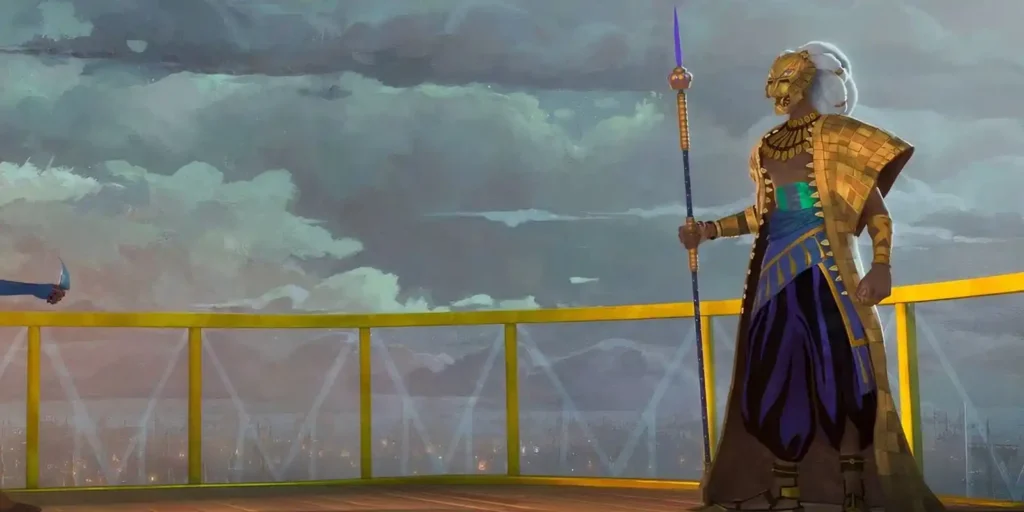
It’s a brilliant idea that takes viewers from 13th-century Crete to the Trojan War, and from 15th-century China back to Wakanda and then, finally, to Ethiopia at the tail end of the 19th Century and the first Italo-Ethiopian War. Immediately memorable characters, including a disgraced Dora Milaje warrior named Noni (Winnie Harlow) who goes on to become the director of the War Dogs, crop up across all four episodes, brought to life by a superb voice cast and striking art. The first episode, featuring Noni’s efforts to track down a Wakandan deserter who has used its advanced vibranium technology to reinvent himself as a God-king, also shows off the stylish, creative action that defines each individual installment.
But it’s the meat on the bones of each episode that really resonates. In the second outing, a deep-cover agent named Memnon (Larry Herron), embedded with the Myrmidons led by Achilles (Adam Gold), has to weigh up loyalty to his nation against that to his brothers in arms. In Episode 3, which is the lightest in tone and the only one featuring an MCU character not typically associated with Wakanda, a cavalier agent, Basha (Jacques Colimon), highlights how Wakanda’s approach to recovering lost property borders on cultural theft. And in Episode 4, arguably the best, a time-travelling adventure sets a young prince and his War Dog minder onto a path that leads directly to King T’Challa’s eventual decision to open Wakanda’s borders at the end of the first Black Panther movie.
It’s all thought-provoking stuff boasting an extremely high standard of narrative and aesthetic craftsmanship. But more than anything else, Eyes of Wakanda is a reminder of the value of the MCU in general, and what a seemingly frivolous interconnected superhero universe can provide in terms of creative storytelling, memorable characters, and valuable, complex ideas. Phase Five might have seemed like the end of the road, but thus far, Phase Six is suggesting that there might be life in Marvel yet.