
Summary
In Episode 4, The Twisted Tale of Amanda Knox effectively highlights how a good story is more powerful than the truth, even in a court of law.
The truth is a fluid thing, wriggly and uncertain. It’s time-sensitive, open to interpretation, and matters less than the story it’s wrapped in. When you understand this, it should be obvious how a person could be convicted of a crime they didn’t commit. The quiet genius of The Twisted Tale of Amanda Knox, which finally puts Amanda on trial in Episode 4, is that it not only understands all this but reworks the trappings of the crime genre to highlight it. Even if the story weren’t fact-based, the outcome would be obvious, despite the presence of a suspect whose DNA literally places him, and only him, at the scene of the crime. The facts don’t matter. It’s all theatre.
“All You Need Is Love” is blasé about the introduction of Rudy Guede, otherwise known as “The Baron”, the drug-dealing, burglary-prone, knife-wielding itinerant who is forensically guaranteed to have killed Meredith Kercher. Just like in real life, he’s a footnote in Amanda’s story. His unambiguous guilt has no bearing on Amanda’s involvement, even though at one point he says in earshot of the prosecution team that she had nothing at all to do with it. The Italian authorities have staked their reputations on Amanda’s guilt, and thus, Amanda’s guilt must be proven. Her innocence is the only obstacle.
And this is where the power of storytelling comes in. I don’t mean the storytelling of the show itself in this instance, although that’s impressive too; Episode 4 pinballs between timelines, showing Rudy’s gradual introduction to and then murder of Meredith, all tastefully presented, while Amanda and Raffaele have their time in court. I mean the storytelling around the case in general, a maelstrom of salacious gossip and deliberately misrepresented testimony. Rudy doesn’t really fit into that story, which is why most of his scenes are cordoned off in flashbacks, and he’s otherwise whisked through a separate trial and sentenced independently, away from the public eye.
The public eye instead turns directly onto Amanda, since the press have been invited to the trial. Her defense team thinks this might be a good thing, since it’s Amanda’s first opportunity to present her unvarnished self to the world and share her own side of the story, but it’s naive in hindsight because the world has already been fed a version of her that they will contort reality to fit. Amanda’s fighting a losing battle. Her every word is scrutinised. An ill-advised outfit choice is pilloried as an attack on Italy and Catholicism in general. Her tiny vibrator is evidence of a depraved sex-mad mind; her lacklustre toilet hygiene evidence of heathen Western ways. She couldn’t win even if she was able to make a compelling case for herself, but she can’t, both because she’s not very world-wise and because her lawyers can’t get a word in edgeways.
Some of this is to do with the nature of an Italian murder trial. A civil case is woven inside the criminal one, which means all the lawyers are pitted against each other in real-time, with some arguing for Amanda’s guilt, some her innocence, and some to seek damages for the reputation of Patrick Lumumba. Evidence that would be inadmissible in the murder case is nonetheless viable in the slander one, and since the jury isn’t sequestered, the press’s coverage shapes the narrative. Even for people who knew Amanda personally, the story filtered through the media becomes the one they remember. Her friends struggle to recall ever having liked her; her every minor quirk is reimagined as proof that she was a murderess.
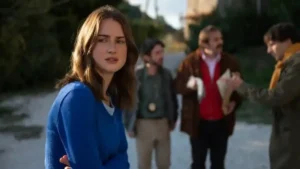
As she has been throughout, Grace Van Patten is very good here. She’s operating in a slightly different mode than the complete delirium of her interrogation, still confused, but now more resigned to the idea that whatever she says and does will be used against her. But Sharon Horgan’s performance as her mother, Edda, is also quietly excellent, since her aghast reactions in court emphasise both the egregiousness of the accusations and also how ill-suited Amanda is to combat them. This is a young woman with the entire world against her, having been detained and interrogated illegally in a foreign country under suspicion of a crime that evidence has proved she didn’t commit. I’d be a little shaken, too. The Twisted Tale of Amanda Knox works in Episode 4 by allowing us to feel the frustrating hopelessness of Amanda’s predicament. And it’ll only get worse from here.
RELATED: