Summary
Splinter Cell: Deathwatch is serviceable on its own terms and is rife with Easter eggs and ephemera for existing fans, but it also feels trapped between worlds and is likely to disappoint its potential audience in different ways.
Splinter Cell: Deathwatch is pretty good, and it’s also likely to annoy almost everyone who watches it. At this point, Ubisoft’s edging of long-time franchise fans — the last official release was 2013’s Splinter Cell: Blacklist, and Sam Fisher has only returned for cameos in other misguided efforts like the short-lived xDefiant since — has created a climate of feverish anticipation but impossible-to-meet expectations. Deathwatch is an official canon release, picking up story threads left dangling since the beloved Chaos Theory in 2005, but it has also leapt the media transom from video games to television, creating a whole new set of problems for itself.
Deathwatch‘s showrunner being Derek Kolstad, aka the creator of John Wick and writer of Nobody, is a bit of a clue. What made the Splinter Cell games at their best so compelling was their slow-paced, tense stealth gameplay, which would be utterly uninteresting in TV form. As a result, Deathwatch is more action-oriented, closer to the much-maligned Splinter Cell: Conviction than any of the other games. Narratively, it’s a quasi-sequel to the most beloved title in the franchise, which is also nothing at all like the game it’s connected to.
But Deathwatch is built on that game’s story and characters; it’s pitched at existing fans and doesn’t ease new ones in. Half-hearted explanatory flashbacks designed to reiterate Fisher’s relationship with a key character from Chaos Theory — albeit with some minor changes — don’t do a great job of putting that dynamic across, and broad concepts that are familiar to existing fans but not to a general audience are inadequately explained, in the few instances they’re explained at all. That’s not a problem for me, and won’t be for anyone else familiar with the basic premise, but it’ll be alienating to new adopters, which there are certain to be, given the global mainstream appeal of Netflix.
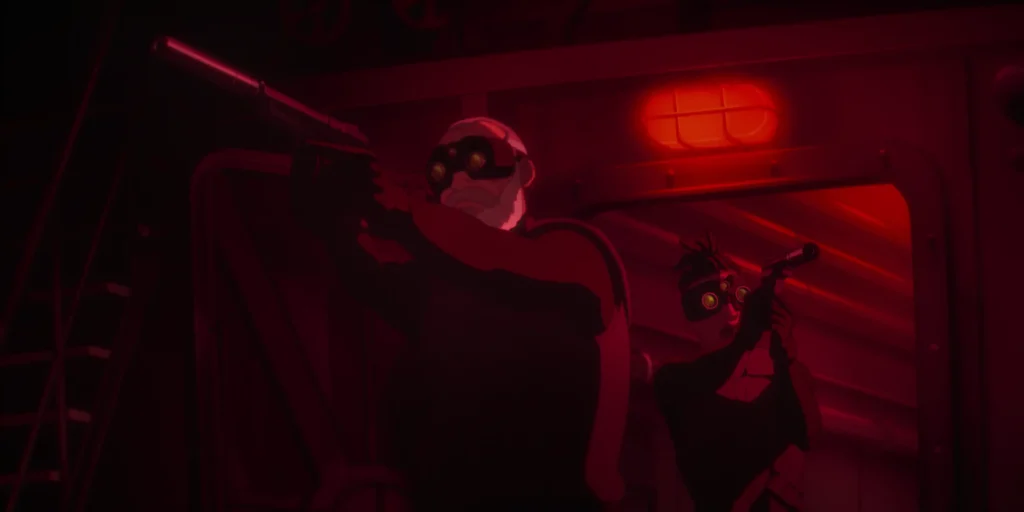
Anyway, specifics. Sam Fisher (here voiced by Liev Schreiber, doing his best Michael Ironside impersonation) has long since retired from Fourth Echelon, the Presidentially-sanctioned black ops outfit he worked for alongside his long-time colleague Anna Grimsdottir (Janey Varney, Platonic). Grim is still running things, but there’s a new agent in the field — Zinnia McKenna (Kirby Howell-Baptiste, Culprits, Dead Boy Detectives, The Sandman), a hotheaded young recruit whose mission to rescue an important asset from Lithuania goes pear-shaped when she lets her emotions get the best of her. Compromised and on the run, McKenna is directed to Fisher, and together they begin to unravel a conspiracy involving Diana Shetland, the daughter of Fisher’s old war buddy and Chaos Theory antagonist Douglas Shetland, and his former company, Displace International.
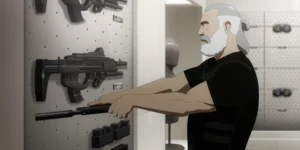
Deathwatch does a decent job of bringing Fisher back into the field — complete, initially, with an annoying man bun — and allowing him to still be badass, but also not ignoring the fact that he’s a legitimately old man by now. This comes across in small details, like him pausing a minute to recall the last two digits of his safehouse keycode, and more obvious ones, like him being physically exhausted whenever he’s forced to fight someone, which is a fair bit. This isn’t a show that skimps on action, but it’s of a crunching physical style that feels weird for the franchise, and sometimes devolves into outright psychotic territory violence-wise, which is also a bit ill-fitting for the brand.
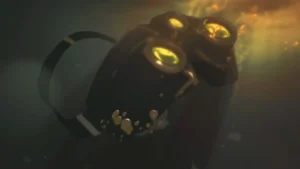
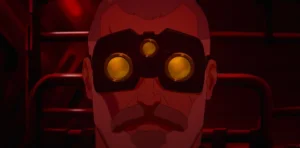
The recognisable iconography is all there, at least. Deathwatch looks and sounds the part, boasting a lot of recognisable Splinter Cell ephemera like the goggles, the OPSAT, and a brief SC-20K cameo. The sound effects are on point, and Schreiber’s take on the character, while audibly not Michael Ironside, is at the very least better than Eric Johnson, who took over in Splinter Cell: Blacklist. The original characters fare just fine. People will hate McKenna for the predictable reason of not being Sam, but she basically is Sam, with a personality consisting of operational competency and a tendency to go rogue. A smarmy Canadian hacker named Thunder (Joel Oulette, Avatar: The Last Airbender) rounds out the Fourth Echelon gang, but he fits neatly into a common tech specialist archetype that the franchise has deployed many times.
It’s difficult to get worked up either way. I’m a long-time franchise fan, and while I would have undeniably preferred a game, I’m not totally opposed to the idea of a Splinter Cell TV show. I’m not even necessarily opposed to this one, which I don’t think is any kind of detriment to the brand overall. But it’s awkwardly wedged between its responsibility to established characters and its need to be something unfamiliar to suit a new medium, unlikely to really satisfy either group. If nothing else, though, it brings Splinter Cell back to the forefront of the public consciousness, which, in a roundabout way, might lead to that remake of the first game we’ve all been waiting years for. Eight so-so episodes are a price I’m willing to pay.
RELATED: