

Predictably, Harlan Coben’s Lazarus has one of those endings that seem to go on forever, delivering twist after twist just for the fun of it. Its grace note also reminded me of another Prime Video show, the underrated Butterfly, which also deigned to bow out with a moment of surprising, ambiguous brutality, just to leave everything on a downer. Nobody said communing with the dead was supposed to be fun.
But that’s the thing – Episode 6 also gives a rational, albeit unsatisfying, explanation for Laz’s unexplainable ability to see ghosts in his father’s office. It might explain why he only sees them in that office, and why they all have a connection to his father, but if you rigorously examine the previous five episodes, it doesn’t quite explain most of the things Laz has seen with his own two peepers. But Harlan Coben’s shows aren’t intended to be scrutinised. It never ends well.
Let’s break it all down anyway, since there’s plenty to make fun of. I laid out the basics of the series in my review, so I won’t repeat myself by going over the general premise. Besides, most of the juiciest stuff occurs in the finale.
The Death Of Detective Alison Brown
Laz is led to Alison by serial killer Arlo Jones. When Laz looks into it, Alison has a connection to all of the cold cases and told several lies to Laz about her involvement in them. He takes his findings to Seth, who is sceptical at first, but the evidence is pretty compelling.
All of the cases that were connected to Laz’s father – including Arlo, Imogen, Father Frank, and so on – also seem to have had some link to Alison, including a video Father Frank made that was apparently given to her but never seen by anyone else. Laz and Seth present all of their assembled information, and Laz accuses her directly. He has a theory: That she was using his father’s psychiatric practice to seek out unstable and vulnerable people whom she could scapegoat for crimes she herself was committing. When Jonathan found out and confronted her, she killed him.
This is obviously close enough to the truth to have hit a nerve, since when Alison gets an opportunity, she upends the table they’re sitting at, tases Seth, and flees. She doesn’t make it far, though, until she runs out into the road and falls over a bike, and then gets her skull pulped by a passing bus. Oops.
However, we immediately see another angle of her final moments with Laz. She presented him with a cassette tape and warned him that he didn’t really want to know what was on it; it’d be better for him if he let it go. But he isn’t willing to do so, which is what prompted her to run. From her mangled body, Laz takes the tape and heads straight to his father’s office.
Who Killed Dr. Jonathan Lazarus?
Technically, Laz’s father killed himself. But he was compelled to do so by Alison.
When Laz plays the tape, he naturally sees the event as it unfolded in the office, as he has been doing all throughout the season. Alison confronts Jonathan, not the other way around. As it turns out, they had a mutually beneficial arrangement. He found her patients whom he believed were irredeemably evil, and she framed them for crimes they hadn’t committed. Together, they got the worst of the worst off the streets, and Alison’s career got fast-tracked.
But the reason for the confrontation is that Alison had figured out that Jonathan was using her to obscure his own crimes. After Cassandra murdered Neil in his office, he helped her hide the body, and then killed her to keep her quiet. That set the ball rolling, and he killed several others, justifying their murders as protecting people from the crimes his victims would have inevitably committed down the line.
Alison refuses to play along any further and presents Jonathan with a revolver. If he takes his own life, his secrets will die with him. It’s a pretty one-sided arrangement, which he points out, but it’s also the only one. While Alison waits outside, Jonathan writes his suicide note, attempts to call Laz, and then blows his own brains out.
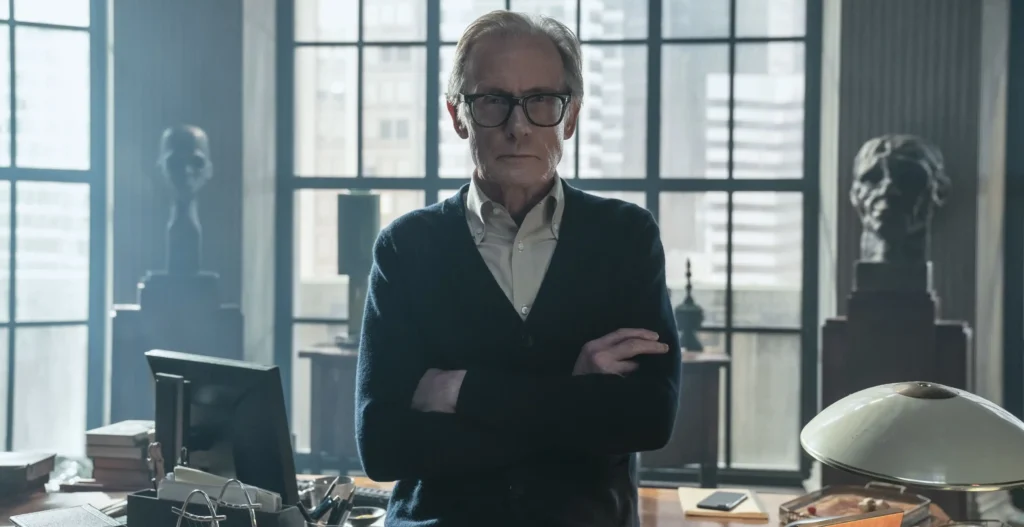
Bill Nighy in Lazarus | Image via Prime Video
Laz Was Imagining The Ghosts (Maybe)
The quasi-supernatural elements of Lazarus helped to set it apart from Harlan Coben’s other shows, but the ending even has an answer for that. After Laz presents Jonathan’s suicide note to Jenna and presumably explains what he was really up to, he leaves her house to go and see Laura, leaving Jenna alone. In Laz’s room, she finds a giant box of tapes, all recordings of sessions from inside Jonathan’s office.
When Jenna listens to the tapes, she hears the conversations with Cassandra and Arlo, which are almost identical to how Laz experienced them when he was “visited” by the ghosts in his father’s office. The implication is very clear. Laz, never having processed Sutton’s death and still reeling from the sudden loss of his father, obsessively listened to the tapes and imagined them as paranormal encounters. In reality, he was just listening to the original conversations with his father.
This explains why all the “ghosts” addressed him as his father; why they only appeared in his office, and why he never encountered any other spectres other than his father’s patients. I strongly suspect that if you rewatched the show with this knowledge, you’d find a bunch of things that were impossible for Laz to have known based on audio alone, but whatever. It’s not worth thinking too much about.
A Final Twist of the Knife
With this revelation out of the way, Lazarus still isn’t satisfied. Instead, it leaves us with one final twist that lives up to Jonathan’s theory that fathers ultimately become their sons, despite Laz’s efforts to break this cycle.
Earlier, we had seen Aidan visit Laura to talk to her about his father. We saw a snippet of their conversation, but nothing more. At the very end of Lazarus, Laz calls Laura but can’t get through, so he goes to visit her at home. He finds the door eerily ajar. Inside, the place is trashed. When he turns around, Aidan is standing in the doorway brandishing what looks like a bloodstained scythe, and only says, simply, “I’m sorry.”
As before, the implication is pretty clear. Aidan seems to have killed Laura, showing some of the same murderous impulses as his paternal grandfather. Maybe psychopathy skips a generation.