Summary
It: Welcome to Derry quickly establishes itself as a capable extension of Muschietti’s movies in Episode 1, a premiere bookended by two great scenes of messy horror.
There are openings, and then there are openings. It: Welcome to Derry has an italicised version. It also has a similarly trauma-inducing ending; more children are messily killed in Episode 1 of this series than any other that springs to mind. It’s weird to be awarding points for that sort of thing, but what else do we really want from a return to Derry, Maine, much less one helmed, like the 2017 and 2019 film adaptations of Stephen King’s classic novel, by Andy Muschietti?
Welcome to Derry feels, rightly, like an extension of that film universe. Its very existence is cynical, of course, since it’s a giant company leveraging the curb appeal of popular IP to satiate shareholders, but there are good and bad versions of even that – or at least better and worse – and, while it’s probably too early to tell, this feels like it’s landing on the right side of the equation.
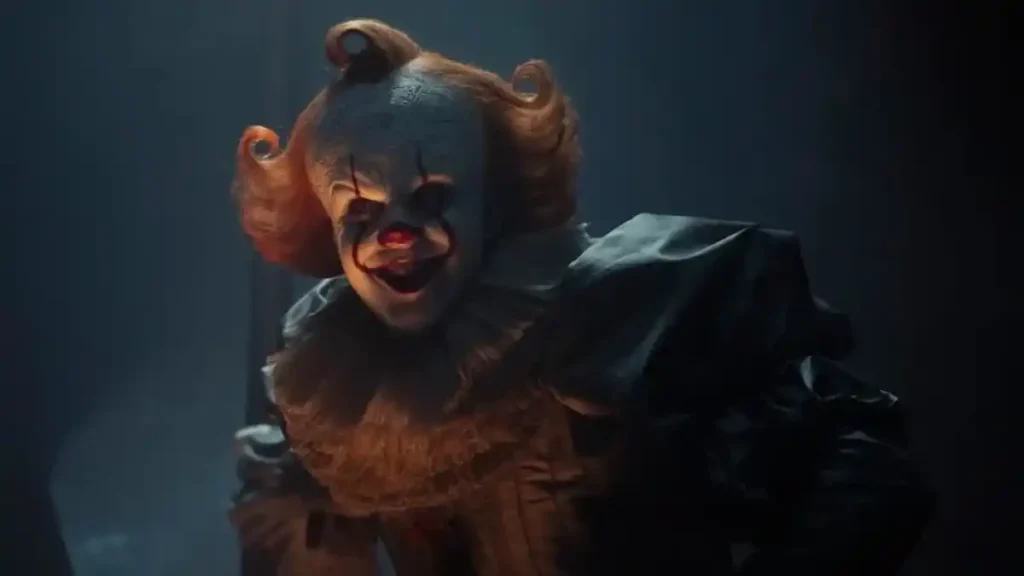
Muschietti, along with sister Barbara and screenwriter Jason Fuchs, continues to imagine Derry as a treasure trove of trauma squatting beneath chintzy small-town Americana; it’s like Stranger Things had a nightmare about itself. The clock has been wheeled back – the story’s set in the 1960s – but nothing has really changed. Kids are largely left to their own devices, bad things are happening to them, and the being tormenting them can be heard in sing-song through the pipes. It’s a coming-of-age story again, since it has to be, confused and terrified children being a favourite entree of Pennywise the Clown, not seen here, at least not in that form, but certainly feeling like he’s lurking somewhere nearby.
The opening of “The Pilot” that I mentioned at the top is one of Muschietti’s trademark sequences. Matty, a young boy hiding from a difficult home life, gets chased out of the local theatre and hitches a ride with a seemingly normal family on the way to Portland. What follows is a stretch of attention-grabbing unpleasantness capped off by the full-frontal birth of a winged demon baby. It escalates from garden-variety weirdness to outright psychopathy with such confidence that you find yourself genuinely worrying about what you might be forced to witness next.
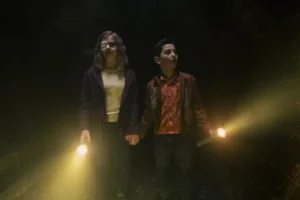
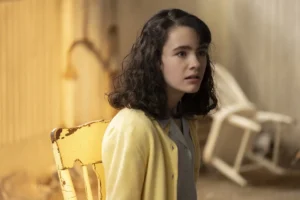
Everyone in Derry believes Matty is dead, but some of his classmates aren’t so sure. Fellow outcasts Teddy and Fred speculate about his fate, among other things, and eventually join up with Lilly, who is ostracised and tormented about her father’s death at a pickle factory, and finally Ronnie, whose father works at the local movie theatre where Matty was last seen alive. She even helped him to flee by pretending not to see him hiding in a corner, and ever since she has been hearing voices. She’s not the only one.
Lilly, who was cruel to Matty before he disappeared, has also been hearing him emanating from her bathroom pipes. Teddy, meanwhile, a staunch comic book fan, presses his Jewish father for his take on whether a kid could survive in the sewers, which dad assumes is something plucked from the comics he loves so much and responds by regaling Teddy with a story about how the skin of Jews who were tormented in the Holocaust was turned into lampshades. That night, Teddy has a nightmare – but is it really a nightmare? – of his lamp issuing fleshy screams and laughs, which makes him think there might be something weird going on with Matty after all.
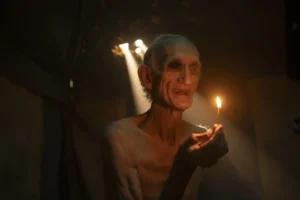
And there is, of course. The climactic sequence of It: Welcome to Derry Episode 1 takes place in the theatre where it began, where the kids gather to watch the movie Matty caught a glimpse of on the last night anyone saw him. They find Matty immediately, living inside the movie, nursing a baby swaddled in a yellow blanket. When Matty offers the child up to the audience, his face stretched into a familiar rictus, the half-winged demon baby from the opening scene leaps through the screen and tears all the kids apart among the seating. It’s a dynamite sequence of serious horror. If you thought these were the kids who we were going to be following for the entire season, think again. Ronnie and Lilly are the only survivors.
The most surprising element of “The Pilot” is that it has a totally different point-of-view character who isn’t a child at all. Instead, Major Leroy Hanlon is a veteran of the Korean War who has been summoned to Derry to test the experimental weapons the Air Force is amassing for an inevitable conflict with Russia. Cold War panic is everywhere in this episode, with as many allusions to mutually assured destruction as A House of Dynamite made recently, but Hanlon isn’t so much a lens through which we explore this kind of paranoia, but instead the racist realities of early-60s America. Despite his rank and his service record, there are still some who can’t even bring themselves to salute him, and that’ll probably end up being the least of the problems experienced by him or the family he’s moving into town.
Mysteriously, Hanlon is jumped in the night by men wearing gas masks and rubber suits, but that isn’t a racist attack any more than an effort to force him to divulge the specifications of the bomber he’s testing. Hanlon remains tight-lipped, and his attackers are forced to flee, but one imagines it won’t be long until he has another crisis to deal with. Perhaps something relating to that mysterious Special Projects division?
RELATED: