Star Wars: Visions returns for Season 3 with another batch of experimental non-canon short films plucked from prominent animation studios all over the world. As ever, each short boasts a unique visual style and exists in a fanciful pocket dimension outside the established continuity, plucking ideas, aliens, and sometimes characters from all over the place but assembling them in a unique and often daring way that wouldn’t necessarily fit into the main storytelling arc of the films or Disney-era shows. It remains one of the most strikingly original projects in the entire franchise.
There are nine shorts in this season, some connected to ones from previous volumes, others entirely original. We’re on-hand to break them all down in terms of their art style, underlying themes, potential connections to other stories, and how they repurpose familiar Star Wars ephemera. So, let’s get on with that.
“The Duel: Payback”
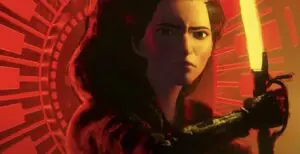
Episode 1 of Star Wars: Visions Volume 3 serves as a direct sequel to the premiere of the first volume, “The Duel”, reintroducing the enigmatic character of the Ronin and the same Kurosawa-esque monochrome art style embellished by splashes of vivid colour.
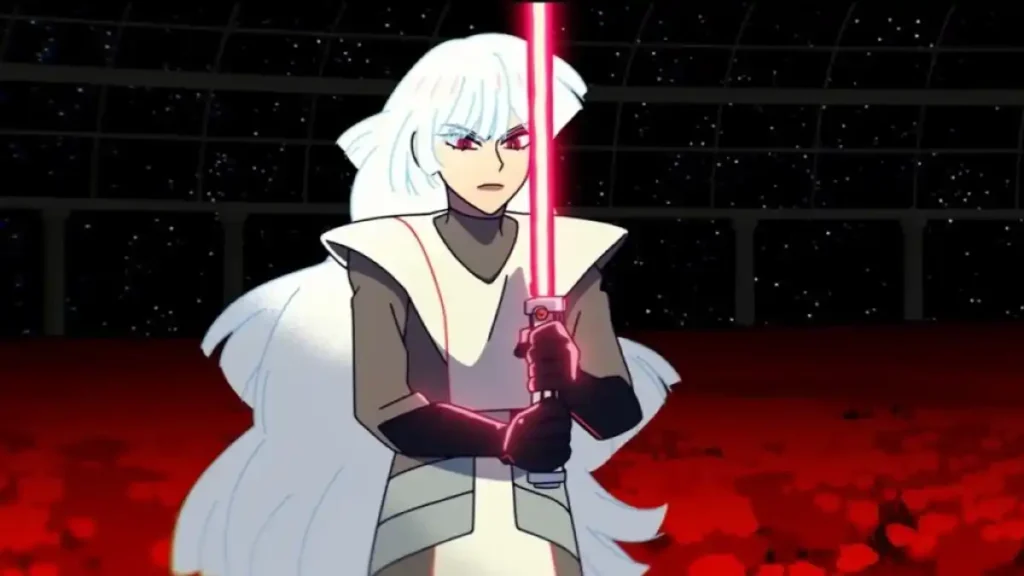
The Ronin is a character who took off immediately among the fandom. Stories of the former Sith turned hunter of current Sith were expanded in a novel and across one-shot comics, perhaps because it’s an inherently cool idea, but perhaps also because it feels as if the concept could fit quite neatly into the established continuity. “The Duel: Payback”, which finds the Ronin teaming up with a Twi’lek Sith named Aneé-san (Suzy Nakamura) against a former Jedi known as the Grand Master (Will Sharpe), includes a bunch of quintessential Star Wars stuff, like kyber crystals, Ewoks, and AT-ATs, and doesn’t do much to actively break the canon beyond tease out the boundaries of the series’ typical dark and light moral dichotomy.
The art style remains great, there’s action aplenty, and the Ronin’s faithful droid B5-56 provides the requisite small doses of humour. Credit, too, for the inclusion of a lightsaber prosthetic leg. Even I wouldn’t have thought of that.
“The Song Of Four Wings”
This great-looking short, obviously inspired by classic anime and manga, is an excellent example of how to take a sampling of Star Wars storytelling fundamentals and rework them into a more kid-friendly composition. It doesn’t engage in bothersome moral debates, it isn’t about the Jedi and the Sith, at least not in a direct way, and it has a Saturday morning cartoon sensibility that makes it very charming.
The plot, such as it is, finds young princess Crane (Stephanie Hsu) investigating the ruins of a village decimated by the Empire. It isn’t made entirely clear which planet she represents, though she communicates often with a Mon Calamari Admiral named Basil Kiucee (Trevor Devall) as she snoops around a snowy landscape with her astromech droid. A brave female princess is not a new idea for Star Wars, nor is the idea of a hero discovering a cute creature that they immediately become responsible for. It’s hard to ignore the Din Djarin/Grogu dynamic from The Mandalorian as soon as Crane discovers a Force-sensitive Gigoran infant named Woopas (Aki Toyosaki).
“The Song of Four Wings” gives away its more experimental underpinnings in an action-packed climax featuring some cool new designs and takes on familiar ships and vehicles, but at its heart, this is for-all-ages Star Wars storytelling at its most recognisable and fundamentally effective.
“The Ninth Jedi: Child of Hope”
As with “The Duel: Payback”, “The Ninth Jedi: Child of Hope” is a direct sequel to a short from the first volume of Star Wars: Visions. It’s also a much worse example of how this type of storytelling in an anthological format can be detrimental overall. Lacking the action, striking visual style, and condensed narrative of “The Duel: Payback”, this instead feels like the middle-chapter of a wider story arc, ill-fitting in a largely standalone collection.
The story catches up with Lah Kara (Kamiko Glenn), who goes from fleeing with the remnants of the Jedi Order to being flung into the void of space, where she’s rescued by a helpful, overly chatty droid named Teto (Freddie Highmore). Kara is being pursued by the bounty hunters who took her father in the first outing, but the more compelling aspect of her arc is that she’s trying to find the strength to become a fully-fledged Jedi Knight, which is what her pursuers believe they’re hunting in the first place.
A lot of the narrative building blocks are familiar and effective, and Teto has one of those immediately cute and characterful designs that this franchise is known for, but outside of the brief action bookends, this is basically Luke Skywalker’s time on Dagobah condensed into a short and offered up on its own. Teto and his relationship with his master, who is recovering in a bacta tank, has a sweet emotional payoff, but the short overall doesn’t really work without the establishing context of the first one, and won’t conclude until an eventual payoff somewhere down the line.
“The Bounty Hunters”
Star Wars loves droids. Always has. There have been plenty of them in all three volumes of Visions, including several in this collection with immediately striking designs. The droid in “The Bounty Hunters”, IV-A4, is the best thing about it, in part because he has a fun multiple-personality gimmick, but also because he’s surrounded by relatively thin human characters who aren’t very memorable. The titular bounty hunter, Sevn (Anna Sawai), is a familiar type, hardened by betrayal, and the smarmy industrialist, Jin-Sim (Joseph Lee), who assigns her a bounty when she crash-lands on his planet to get rid of the rebels threatening his business, is an old franchise favourite cliché.
The rebel leader, Eno (Jodie Turner-Smith), is similarly recognisable, and turns Sevn back against Jin-Sim in the predictable “twist” that he’s really using slave labour to make his fortune. Cue a team-up and a hefty helping of action that is visually pleasing but thematically unremarkable. Like droids, Star Wars has a real fondness for bounty hunters conceptually, but it can sometimes make the mistake of assuming that their presence is enough to be interesting on its own.
“The Bounty Hunters” is just fine, pleasing in many ways, but it’ll probably be the first short in this collection that you forget about entirely when all’s said and done.
“Yuko’s Treasure”
Like “The Song of Four Wings”, “Yuko’s Treasure” is aimed at a younger audience of Star Wars fans, but it takes that idea a little further by not just being suitable for all the family but really explicitly aimed at kiddies specifically. You can really see this in the designs of the droids – especially BILY, a giant teddy bear who looks after the protagonist, Yuko (Liam Karlsson) – and the frictionless passage of the story, which calls on the usual orphaned hero archetype.
All the art in this is smoother and softer, which makes the fact that it’s set on Tatooine quite interesting – the twin-sunned desert planet is wildly overused across Star Wars media, but it’s always depicted the same way. “Yuko’s Treasure”, which finds a local kid named Sola (Julian Paz Fedorov) helping Steve Buscemi’s villain Fox-Ear to kidnap BILY in the hopes of finding a secret vault supposedly containing a trove of treasure stashed away by Yuko’s family before they died, is very safe and predictable, but it works in its broad strokes.
I should like this less than I do, given there’s so little to it, but the ability of this franchise to contort its usual fixtures into child-friendly shapes without losing its essential sense of self remains endlessly fascinating to me, and there’s a ton of big personality in the designs.
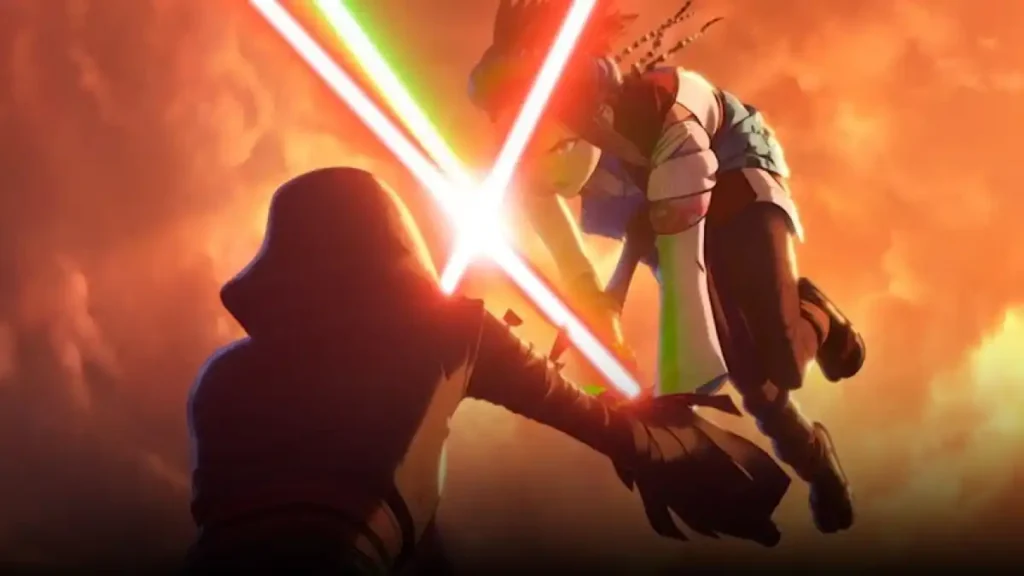
A still from Star Wars: Visions Season 3 | Image via Disney+
“The Lost Ones”
“The Lost Ones”, like “The Duel: Payback” and “The Ninth Jedi: Child of Hope”, is a continuation of a story from Volume 1 of Star Wars: Visions, in this case “The Village Bride”. That connection does feel looser and less specific here, though, and also less important to the overarching story of everyday folks suffering under the yoke of the Empire. The most striking thing about it is the painterly watercolour quality to the background art, which stands in stark contrast to the block colours and clean outlines of the characters.
F (Karen Fukuhara), after saving a couple of ordinary dudes from an earthquake on a planet that has been decimated and half-frozen by the Empire’s efforts to mine carbonite, finds herself aboard a refugee ship that earns it the attention of an Imperial Star Destroyer, unsubtly called Oppressor. F voluntarily surrenders herself to protect the refugees, but is joined by Ron, one of the people she saved, who helps her to sabotage the Star Destroyer while she confronts her old master, Shad-Rah (Mark Strong).
This is classic Star Wars stuff that looks really nice but doesn’t do anything new or interesting conceptually. Former students taking on their old masters, and unremarkable people showing their bravery in rebellion against the Empire, is extremely familiar material. It’s executed well enough to be entertaining, but struggles to justify its inclusion in a collection like this.
“The Smuggler”
“The Smuggler” is one of the shortest installments in Star Wars: Visions Volume 3, but it packs a punch all the same. Boasting a familiar structure and several obvious storytelling beats like the previous shorts, it’s just a very slick version of something that works well. It also has a whiff of Star Wars: Outlaws about it, with its protagonist Chita (Emma Myers), a scoundrel indebted to the rough-and-tumble local cantina, feeling a lot like Kay Vess to me.
Chita is hired by an elderly woman named Gleenu (Judith Light) to sneak her and a young prince named Arluu (Tanner Buchanan) past an Imperial blockade. The “twist”, so to speak, is that Gleenu is a former Jedi who swore herself into the service of the planet’s royal family after they saved her from Order 66 (or at least a version of it – none of these shorts are officially canon).
All three of these core characters immediately feel more rounded than those in, say, “The Lost Ones”, which was similarly adherent to familiar storytelling beats. There’s nothing overly striking about the art and animation, either, which is nice enough but doesn’t have a stand-out aesthetic gimmick to fall back on. It’s just intended to be a very good version of a comfortingly recognisable thing, and it is. There’s a skill in that all the same.
“The Bird of Paradise”
“The Bird of Paradise” is a stand-out short in Star Wars: Visions Volume 3 because it really feels like it exists properly apart from the rest of the collection. Visually, it’s rendered entirely in CGI rather than being hand-drawn, and conceptually, it’s a mostly contained journey of self-discovery about one character on a kind of trippy vision quest. It feels truest to this show’s mandate of using unique visual expression to explore the core tenets of Star Wars storytelling.
Nakime (Sonoya Mizuno) is a Jedi Padawan who, after falling in battle, wakes up blinded, with two scars running down her eyes, keeping them closed to the strange world around her as she attempts to think and feel her way through its mysteries. It’s an obvious metaphor, but rendered strikingly in extremely appealing colour and detail. This isn’t just a short that happens to have been animated in CGI, but could have only been animated that way, and it puts it to good use at every turn.
Some may not vibe with the psychedelia of this short, or its use of symbolism and inference rather than explicit exposition, but to me, it’s very symbolic of exactly the kind of storytelling that this collection exists to provide.
“Black”
And here we have what it is, to my mind, the very best short film that Star Wars: Visions has produced across its three volumes. “Black” is the cleanest expression of the anthology’s underpinning ideas about channelling franchise fare through experimental visual storytelling; a remarkable near-wordless flurry of sight and sound depicting the whirring cogs of the Imperial machine through the first-hand experiences of a rank-and-file Stormtrooper.
Set to often whimsical jazz music and upbeat percussion, “Black” shows terrifyingly chaotic scenes blending in and out of one another, occasionally lapsing into dead silence as the horrors of war become too much to bear. It’s the kind of thing you could watch again and again, picking up new details every time. The effect, in its deliberate idiosyncrasies and dreamlike continuity, is of a beautiful nightmare that leads us through a hellscape of war and devastation.
As a payoff to this volume, “Black” is a real masterpiece. But it’s also a prime example of the value of this series overall, and the scope of storytelling opportunities contained in a franchise so seemingly determined to be as frictionless as possible. A remarkably expressive visual achievement.