Summary
The Witcher never really handles endings well, and that’s true of Season 4 as well, but it at least has the decency to reach major turning points in each of its key narrative tracts.
The Witcher has never been very good at endings, since it’s one of Netflix’s crown jewel IPs and makes a ton of money, so it’s designed to never really end. This is as true of Season 4 as it has been of any of the others, but its finale, “Baptism of Fire”, at the very least has the decency to leave us with each narrative tract having hit a clear and obvious turning point.
In short: Geralt knows where he’s going, but may well be waylaid in his efforts to get there; Yennefer has gone after Vilgefortz, though admittedly to fight him on his own territory and having left the responsibility of rebuilding Aretuza in the hands of the mages who survived the attack on Montecalvo; Ciri’s loss of his innocence has cost her a found family and left her in the clutches of a deadly sociopath; and Emhyr knows that he must find and kill Geralt in order to ensure that Ithlinne’s Prophecy pertains to him.
There’s no closure, then. Season 5 can handle that. This is a transitional end to a largely transitional season, one that has been about journeying and relationships and introspection. Often, it hasn’t been very good. But it has still left us with plenty to talk about.
The Lodge of Sorceresses
Some lessons have been learned in this season, and one of them is that assembling an army five minutes before a battle invariably doesn’t end well. Yennefer learned this lesson pretty harshly during the Montecalvo fiasco, which cost the lives of Istredd, Margarita, and Vesemir. Even though there are other things for her to be handling, including going after Vilgefortz and getting Ciri back, the surviving mages need to busy themselves forming a home for Ciri to return to – a centre of magical and political influence that they control. The Lodge of Sorceresses.
Building the Lodge, though, will be the responsibility of Triss and the others, since Yennefer is going after Vilgefortz. She has Triss use the knife that Vesemir stabbed him with to open a portal to Stygga Castle, where he’s hiding out and murdering the only three mages who survived Montecalvo on account of their cowardice.
Yen emerges in the middle of a churning ocean and starts swimming towards a whirlpool nearby. That’s one way to hide a castle.
Live Like A Rat…
Ciri spends most of this finale racing back to try and save the Rats after learning through Hotspurn that they had been lured into a trap. She doesn’t make it in time, though.
In Ciri’s absence, the Rats try to take on Leo Bonhart, believing they have the advantage, but he cleaves through them like they’re nothing. It’s a brutal scene, since while the Rats aren’t exactly the Robin Hood-style good guys they have portrayed themselves as and had no issue carrying out assignments for Nilfgaard, they’re mostly just kids. Leo doesn’t just kill them, but delights in doing so. By the time Ciri arrives, most of them have been pulped and dismembered, with only Mistle still – barely – alive.
Ciri tries to take Leo on, but she’s overpowered fairly easily. He doesn’t kill her, though, and instead leaves her alive to make her watch him behead her friends. The bounty on the Rats was apparently higher if they were brought in alive. Since “Falka” was the most famous of them, we can only assume that he wants to keep her alive to collect. But he seems pretty adamant about tormenting her every step of the way.
Rise, Sir Geralt of Rivia
All throughout The Witcher Season 4, Geralt has stuck his nose in other people’s business, and that really costs him in the ending, albeit in a roundabout way. A knight might have been the one thing Geralt privately dreamed of being since childhood, but he didn’t quite anticipate how his knightly responsibilities might keep him from being able to pursue his true purpose.
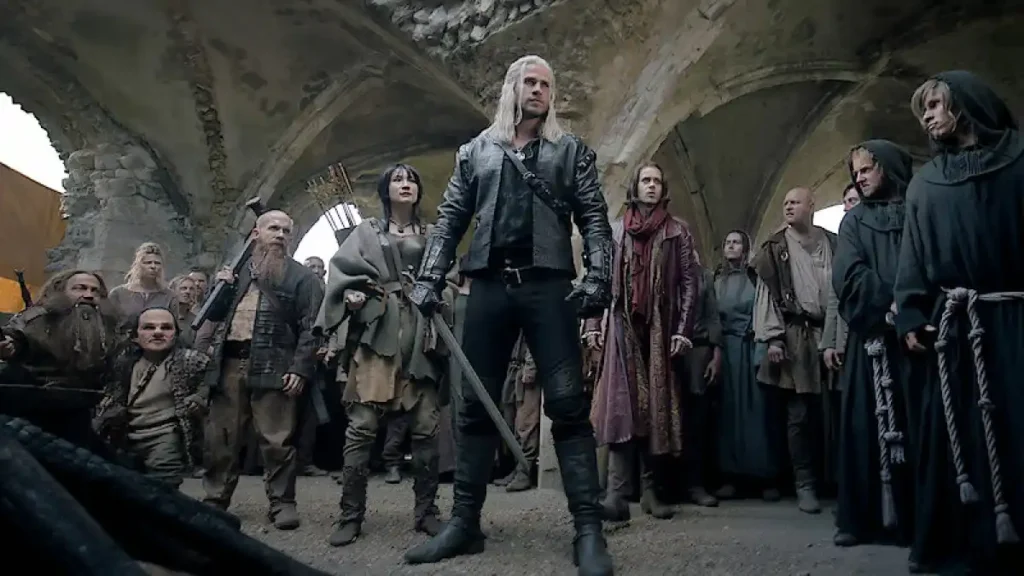
While sailing down a river on their way to Caed Dhu, Geralt’s hansa comes under fire from Nilfgaard and northern forces, who are fighting each other across the water. The Nilfgaardians are trying to take a bridge that functions as a key chokepoint in the area, and the northerners – of Lyria and Rivia, we later learn – are struggling to fight back. When the Hansa are finally able to make land, Milva is in the midst of a miscarriage, and the only way they can buy Regis enough time to treat her is by Geralt and Cahir climbing up onto the bridge and leading the charge against the Nilfgaardians.
The battle – a fun set-piece with great choreography and a battle against a giant troll for good measure – is a success, and Geralt and Cahir, now clearly best buds for life, repel the Nilfgaardian forces. For this, Geralt is made a knight, fulfilling an old dream. But that means swearing fealty to his new queen, and only her, which will make quickly moving on to his next destination a little difficult. Geralt’s trademark four-letter expletive summarises his thoughts on his new predicament rather nicely.
RELATED: