Summary
Last Samurai Standing can’t avoid obvious comparisons to Shogun and Squid Game, but it takes worthwhile elements from both to create a fun action showcase that stands on its own.
It’s usually reductive to compare one show to another, especially when the shows being compared are very good award-winning prestige dramas and/or impossibly popular global sensations. On that level, Netflix’s Last Samurai Standing, which has been endlessly summarised as a fusion of Shogun and Squid Game, is in a bit of a predicament, and ordinarily I’d avoid the comparison for the sake of fairness, since if we’re being frank, it’s nowhere near as good as the former and won’t achieve half the popularity of the latter, nor was it ever going to. But blimey, this really is Shogun meets Squid Game, to enough of an extent that it’d almost be professionally irresponsible to describe it in any other way.
But putting aside the fact that, as mentioned, it doesn’t have the epic sweep of Shogun or the zeitgeisty mass appeal and social commentary of Squid Game, the similarities are a boon, not a hindrance. It takes the advantages of a period setting – Japan’s late 19th-century Meiji era with all its attendant political and cultural context – and the binge-ready structure of an elaborate tournament and mashes them together, unifying the disparate parts with intimate and ambitious action choreography that is really good at its worst and legitimately tell-your-friends brilliant at its best.
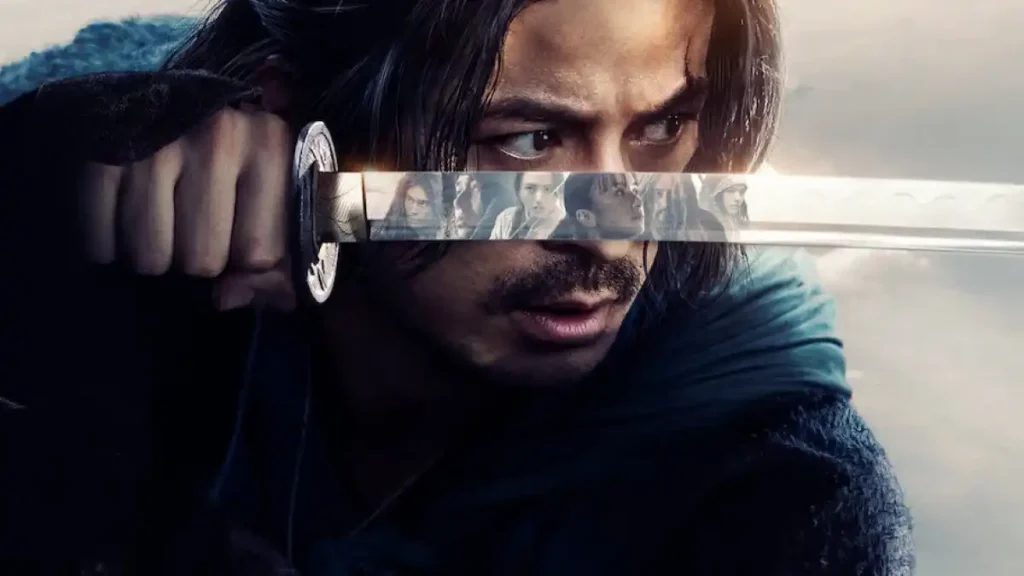
Last Samurai Standing is adapted from a novel, but it doesn’t have a very literary quality to it; instead, it has been packaged as a series of small skirmishes and the occasional blowout set-piece strung together by unavoidably lax character drama. There is a good amount of scene-setting, though, with the most important being that in the decade following the Satsuma Rebellion, Japan’s new imperial government have determined the noble samurai class surplus to requirements, stripping them of the privileges they once enjoyed and leaving them to languish in purposeless squalor, which is how we meet Shujiro Saga (Junichi Okada, Hard Days). Once a swordsman of some considerable renown – complete with a catchy wartime nickname that makes him visibly uncomfortable whenever anyone uses it – he’s now eking out a humble living with his wife and children, who’re promptly stricken with cholera.
Bereft, haunted by war and regret, and unable to quite reconcile the mistreatment of the once-honorable samurai, Shujiro is an easy mark for a mysterious flyer that has been distributed en masse advertising a martial arts tournament at a temple in Kyoto and promising a sizeable cash prize for the winner. Shujiro is one of 291 other participants, all led to the same place by similar economic or circumstantial strife. So far, so Squid Game.
But the parameters of Last Samurai Standing’s tournament don’t have the same novelty as that show’s eerily reimagined playground games. It’s basically a straight-up battle royale in which every participant is assigned a numbered tag and instructed to acquire the tags from the other players, by force, stopping at various checkpoints on the road to Tokyo with the required number of spoils. There’s very little deviation from the established format, so it lacks the inherent suspense and drama that emerges from something like licking honeycomb shapes or the superbly executed marble game, which is presumably why so much effort has been expended on making the swordplay so fun. There’s a lot of it.
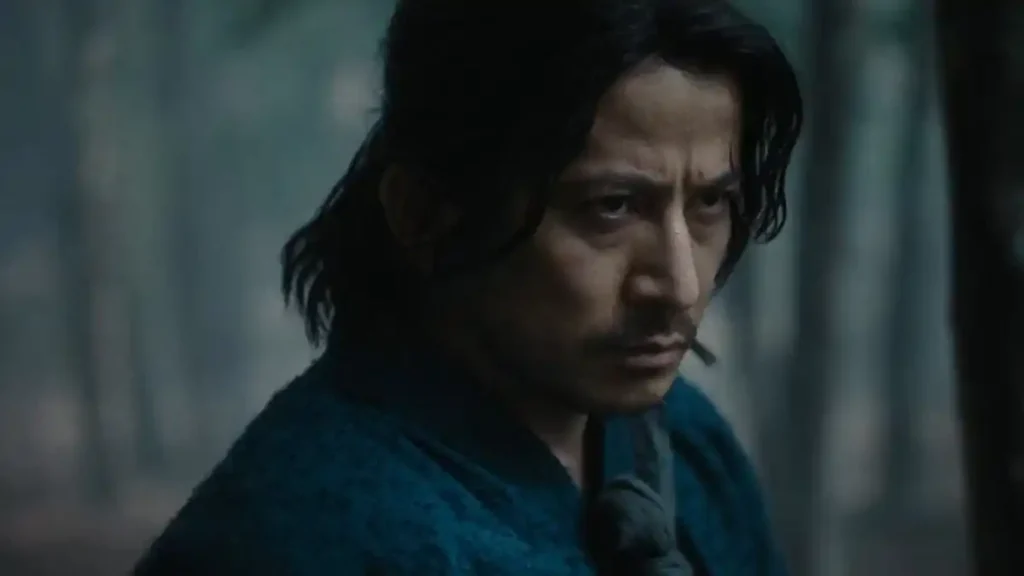
Jun’ichi Okada in Last Samurai Standing | Image via Netflix
What is very much like Squid Game, though, is that the tournament is being organised for the entertainment of a clutch of money men who are constantly betting on which contestants will progress, and it has all been set up by some mysterious, anonymous organiser who is spoken about in hushed terms. And that means that there’s an appropriate sense of mystery and upstairs/downstairs class dynamics as the players form ad-hoc alliances – Shujiro quickly teams with the totally untrained civilian Futaba (Yumia Fujisaki) and old acquaintance Iroha (Kaya Kirohara), and they’re all periodically given sage but deeply enigmatic advice from the mysterious Kyojin (Masahiro Higashide), who seems to know more than he’s letting on – and challenge each other to duels tinged with personal backstory that is often hastily explained (if it’s explained at all).
But the action. Last Samurai Standing is consistently kinetic and choreographed in very clear terms, full of long wide shots and minimal editing, and performed almost exclusively in practical terms with minimal CGI embellishment. This gives all the action a baseline level of quality, but the show also has another gear that it shifts into semi-regularly. The first hint comes at the end of the second episode, when Shujiro cleaves through a group of soldiers, and there’s a showy oner in the fourth. But it’s the finale where things reach a fever pitch. Anyone invested in the story and characters will feel short-changed by what amounts to an episode-long action sequence at the expense of any meaningful resolution, but those of us who realised early on that this series was here to provide quality action at the expense of everything else will get the payoff they were hoping for.
And let’s be frank, that’s the point. There are characters here, for certain, but none who really develop beyond labelled containers for different emotions or plot beats. The seriousness of the stakes mostly prohibits the sense of fun and playfulness expressed through the action from being embodied by the characters, which isn’t to say the whole thing’s entirely humourless, just generally grim by design. Everyone’s quite arch, especially the cartoonish upper-class string-pullers, and the blanks that are filled in by the historical moment require a bit more audience familiarity with the era than seems strictly reasonable.
All this aside, though, it’s important to understand what Last Samurai Standing is here to do, and criticising it for being light on feudal politics is a bit like criticising John Wick for not spending an additional thirty minutes explaining how the hotel works. The obvious similarities to two of the best shows of recent times, or at least one of the best shows and one of the most memorable, will undoubtedly muddy expectations, but once the whole thing coheres into the visually striking action showcase it so clearly wants to be, it offers a considerable return on investment.
RELATED: