Summary
Jay Kelly is a wonderful meditation on fame, movies, and life, anchored by a tremendous George Clooney – and a brilliantly tender Adam Sandler – and building to one of the finest endings I can remember seeing.
I’ve heard Noah Baumbach’s Jay Kelly described as a “coming-of-age story… for adults”, which is just a polite way of saying it’s about a man having a midlife crisis. But it’s so much more than that, a wonderful, whip-smart meditation on fame, family, and identity with one of the better endings that – at the risk of sounding hyperbolic – I think I’ve ever seen. It’s an obvious awards contender for Netflix, where it’s streaming after a very brief and understated theatrical run, but far from being a cynical ploy to appease voting bodies by being very much of the industry it’s ultimately critiquing, it’s a deeply human and profoundly moving film – yes, one that’s about film, but only inasmuch as it’s about everything.
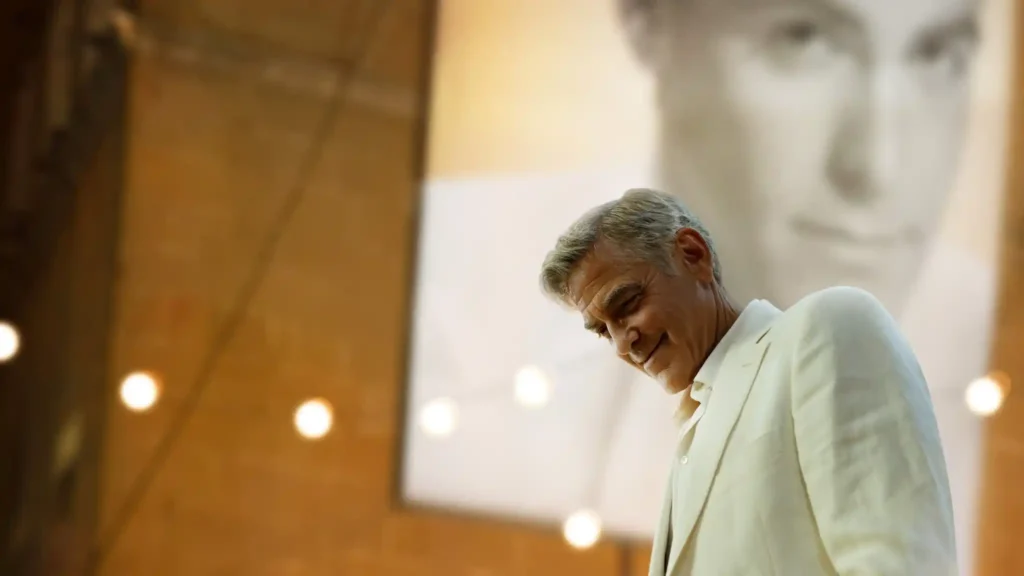
The elephant in the room is whether Jay Kelly is about Jay Kelly, the eponymous movie star in his 60s who is globally famous for reliably playing a version of himself in every project, or about George Clooney, the movie star in his 60s who is globally famous for reliably playing a version of himself in every project, and is here playing Jay Kelly. You can see the problem, and also how determined Baumbach is in refusing to clarify it. There are obvious differences, but too many similarities for them to be accidental, and in a late moment, when a montage of clips from Kelly’s movies is played, they’re George Clooney movies.
But the idea that this is some personal biography undersells what the movie is really about, which isn’t George Clooney at all. He’s merely a vessel for Baumbach to explore various ideas about movie-making and relationship-building; about navigating fame and weighing professional success against the familial. Jay Kelly has been at the top of his game for 35 years, but the preservation of his image has meant sacrifices. It has also meant handing the reins of his life to an entourage, including, most notably, his publicist Liz (Laura Dern; Jurassic World Dominion, Lonely Planet, Palm Royale) and his loyal, long-suffering manager, Ron (Adam Sandler, Spaceman). With the youngest of his children, Daisy (Grace Edwards), on the cusp of being grown-up, due to depart for a European road trip with her friends and not, crucially, her father, Jay is forced to consider what his long service to Hollywood has all meant, especially for him personally.
This entails, at least in part, a road trip, as Jay is set to receive a lifetime achievement award at a cultural event in Tuscany. But it’s also framed as a string of unfortunate events, each designed to make Jay question something else about the firmament of his career. A chance encounter with an old acting-class colleague, Timothy (Billy Crudup; Hello Tomorrow!, The Morning Show), leads to a fistfight and a potential legal case, but also to recollections of how, from its very beginning, the elevation of Jay’s career required the sufferance of his friends and family. In the present day, a beloved former director (played by Jim Broadbent) has just died, Jay’s relationship with his own father (Stacy Keach) is strained, and the one with his eldest daughter, Jessica (Riley Keough; The Guilty, Daisy Jones and the Six, The Terminal List), is virtually non-existent. These are all people sacrificed on the altar of Jay Kelly, a man whom even Jay Kelly isn’t sure exists in any meaningful sense. At some point, the man became the movie star, and ceased to exist outside of the bits – the name and the face – that could be marketed.
Baumbach’s script – written with Emily Mortimer (Mary Poppins Returns) – is brilliantly clever, and his cast is perfection. There are cameos all over the place, but instead of being showy look-at-me flourishes, they’re often deployed to embellish various corners of Jay’s life that he’s forced to re-examine. Sure, Mortimer’s own small role, and the appearance of Baumbach’s wife, Greta Gerwig (White Noise), as Ron’s missus, are mostly just playful. But Eve Hewson (Robin Hood, The Perfect Couple, Bad Sisters) turning up as an angelic movie star Jay acted opposite in his youth, and who potentially cost him a marriage, is wonderfully effective, as is Patrick Wilson as one of Ron’s other, much less attended-to clients (Isla Fisher plays his wife in a blink-and-you’ll-miss-it role that is nonetheless much more substantial than whatever she was doing in Playdate.) A recognisable thief who Jay “heroically” chases down forces him to reconsider the idea of how his own image is shaped by the media and onlookers who see whatever they want to; how his status as one of the “few remaining movie stars” streamlines his very identity, planing away all its rougher edges.
Jay might be inseparable from George Clooney, but that doesn’t really matter, because Baumbach understands how thin the boundary between star and human being really is, and uses that to explore the boundaries of our own lives, to unpick the lies we tell ourselves for not being present for those we idly profess to be making our selfish decisions to support. Jay Kelly is a rigorous examination of not just who Jay is, or who Clooney might be, but who we are. In the hands of a lesser filmmaker, the conceit would have burst at the seams. But Baumbach uses it to craft one of the finest closing scenes in recent cinema history, a masterpiece of looping, self-referential writing that coalesces into the deeply painful realisation that life isn’t quite like the movies after all, and the only take we’ve got is the first.