
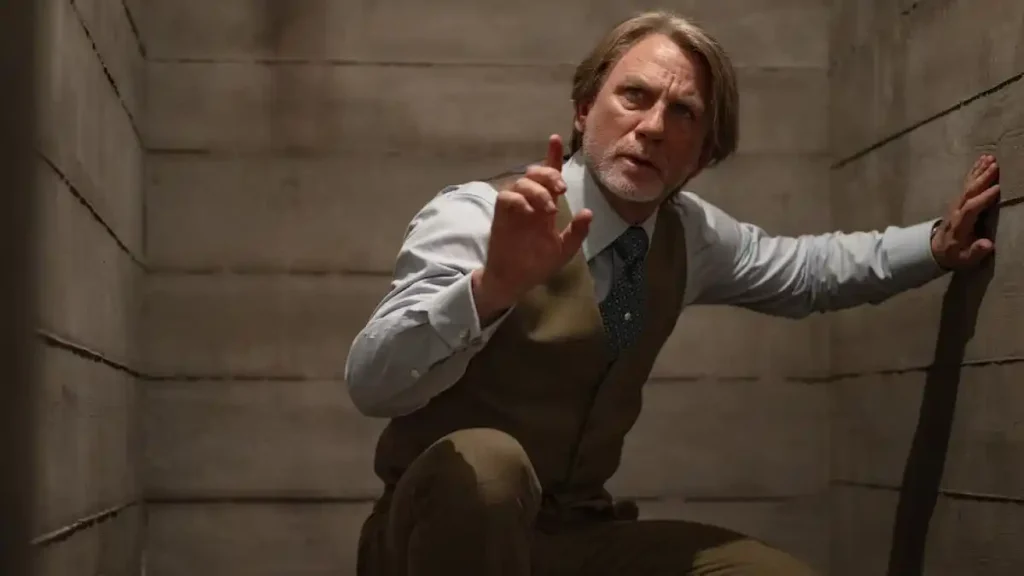
I’m pleased to report – albeit behind schedule – that Wake Up Dead Man, the third in Rian Johnson’s Knives Out mysteries, is probably the best of the bunch. It’s certainly the most ideologically curious and thematically interesting, which is obvious throughout, but especially in an ending that doesn’t just reveal whodunit, but why, and what having done it might mean for the worldviews not just of Benoit Blanc but also his new co-protagonist, Father Jud Duplenticy.
This means there’s more to unpack than simply who the killer was. There’s a much deeper sense of what it all means, and especially to whom. Benoit Blanc has never taken on an open-and-shut case, it seems, but one assumes very few will linger with him the way this one will, since much like how Murder on the Orient Express is the most famous Poirot story because it’s the one that challenges his most fundamental beliefs, Wake Up Dead Man redefines how Blanc sees the world.
Let’s break it down, shall we?
A Long List Of Suspects
Like all Knives Out movies, this one revolves around a murder. But unlike the other two – Knives Out and Glass Onion, if you’re keeping score – this one revolves around a seemingly impossible murder with miraculous religious implications. Josh Brolin’s fire-and-brimstone Monsignor, Jefferson Wicks, is found dead in a closet with a knife in his back, and his entire parish is on the hook for it. Here are the major players:
- Father Jud Duplenticy, a former boxer who killed a man in the ring and later found Jesus;
- Martha Delacroix, Wicks’s housekeeper and fierce devotee;
- Dr. Nat Sharp, a doctor whose recent divorce has turned him into a misogynist;
- Lee Ross, a novelist banking his floundering literary career on a book about Wicks;
- Vera Draven, Wicks’s lawyer;
- Cy Draven, a cynical Republican political aspirant and social media obsessive;
- Simone Vivane, a famed cellist suffering from chronic pain who believes Wicks can miraculously heal her (in exchange for sizeable donations to the parish from her personal savings), and;
- Samson, the church’s groundskeeper (who also has a thing for Martha).
Phew! But whodunit?
And the Killer Is…
It wouldn’t make sense to explain all the clues and possibilities and red herrings or this article would be 5000 words long, so I’m just going to reveal who killed Wicks and work backwards from there. The killer is… Martha, technically, but also Nat and Samson. It’s complicated.
Putting It All Together
As is always the case with these movies, the big moment comes when Benoit Blanc gathers all of the suspects – those still alive, anyway – to explain what happened, and how all of the clues fit together. I’m going to do a version of that now, so just read this out in a Foghorn Leghorn voice if it makes you feel better.
The Devil’s Head Swap
One of the key clues in the case was a carving of a devil’s head stuck on the end of the knife that was supposedly used to kill Wicks. It came from a local Satan-themed bar, but had been painted red. This was used to frame Jud, since he’d earlier gotten drunk and hurled it through the church window.
But! There were two devil’s head ornaments in the pub, which Blanc notices near the beginning but doesn’t reveal until the end. This is why nobody realised that the heads had been swapped. Martha had sewn one of them into Wicks’s robes so that at first glance, people would assume he had already been stabbed. During her distraction, Nat had swapped it out with the other when he buried the knife in Jud’s back.
Drinking Kills
The stabbing wasn’t the cause of Jud’s death. He had already been fatally dosed with pentobarbital by Martha, ingested during one of his secret swigs from the flask hidden in the closet.
When Jud collapsed forward, Jud had heard the clang of the flask on the floor and had intuitively hidden it so that nobody else discovered the flask and tarnished the Monsignor’s reputation. He was already dead, after all. Did everyone need to know he was a drunk as well?
Disturbance in the Force
To perpetuate the idea of Wicks having been fatally stabbed, Martha had sewn a blood bag into his robes to be triggered by remote from a tidy radio receiver. However, triggering this – even though it created the right impression – caused a glitch on Samson’s VHS recording of a baseball game, forming another important clue.
What Was Martha’s Motive?
Earlier in the movie, Martha had recounted some of her backstory, which, in typical Knives Out fashion, contained all of the clues we needed to put the motive together.
In the flashbacks, we got our initial impression of Wicks’s mother, Grace, a troubled woman who, predictably, the powerful parish priest, Prentice, considered to be a “harlot whore”. However, despite being disgusted by her ways, he had vowed to leave the parish’s vast estate to her for young Wicks’s benefit.
Eventually, though, Prentice began to suspect that Grace would be corrupted by the influence of the fortune. He revealed to young Martha that he had spent all the money on a single pink Fabergé gem and decided to hide it so Grace could never discover it. But he did so by swallowing it, leading to his death, supposedly by a sudden aneurysm.
Incensed, Grace tore the church apart looking for the gem, but Martha never revealed its location. It has remained in Prentice’s body ever since. Martha never told anyone. Until, inspired by Jud, she confessed to Wicks – and then realised that he planned to steal the jewel for himself. She concocted the incredibly elaborate ploy to prevent him from doing so.
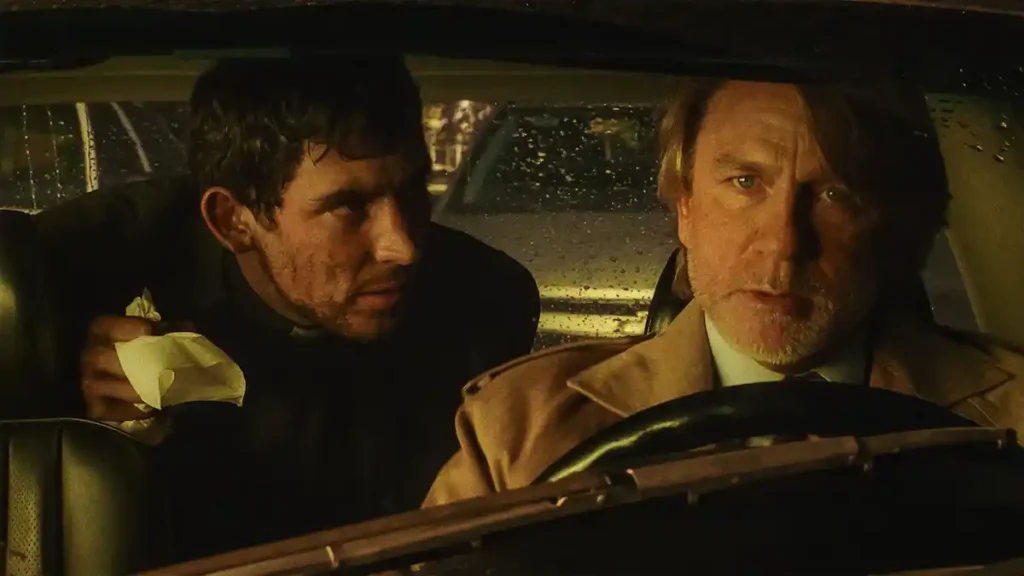
Josh O’Connor and Daniel Craig in Wake Up Dead Man: A Knives Out Mystery | Image via Netflix
He Is Risen
Part of Martha’s plan involved staging a theatrical resurrection so that Samson, disguised as Wicks, could gain access to the mausoleum, retrieve the jewel from Prentice’s long-interred corpse, and then escape with Martha.
This part of the plan involves Nat, whose job is to dissolve Wicks’s body in a vat of acid in his basement, and Samson, who is to pose as Wicks, nick the diamond, and then emerge from behind the mausoleum’s Lazarus door in full regalia, implying that Wicks had risen from the dead and disappeared.
However, Nat got greedy and killed Samson, trying to take the diamond for himself. He also intended to kill Martha by poisoning her coffee with the same pentobarbital that killed Wicks, but she anticipated the move and swapped their drinks, killing him instead. Martha staged the bodies so it looked like Samson had dissolved Nat in the acid.
The Road to Damascus
The idea of the “road to Damascus” moment recurs repeatedly throughout Wake Up Dead Man. It’s a reference to the Bible story of St. Paul, who was entreated by Christ while on his way to Damascus to persecute Christians, and ended up completely changing his ways. It’s a shorthand for a sudden moment of clarity that results in a radical change of direction.
There are loads of these moments throughout the film. Father Jud’s was killing a fellow boxer in the ring; Nat’s was killing Samson; Martha’s was confessing to Wicks about the diamond; Prentice’s was swallowing that diamond… You get the idea.
Blanc doesn’t quite get one of these. He’s a staunch atheist and is presented as a counterpoint to Father Jud’s earnest belief in a higher power, but there is a telling moment during the whole confession sequence when light filters in through the stained glass windows and you can see, just for a moment, that he’s contemplating the idea of all this being bigger, for once, than himself.
Martha takes her own life, timing her death to come just after her grand confession. Father Jud takes over the parish, renaming it Our Lady of Perpetual Grace and constructing a giant cross depicting Jesus’s crucifixion. Inside the image of Jesus, winking in the light, is the diamond.