
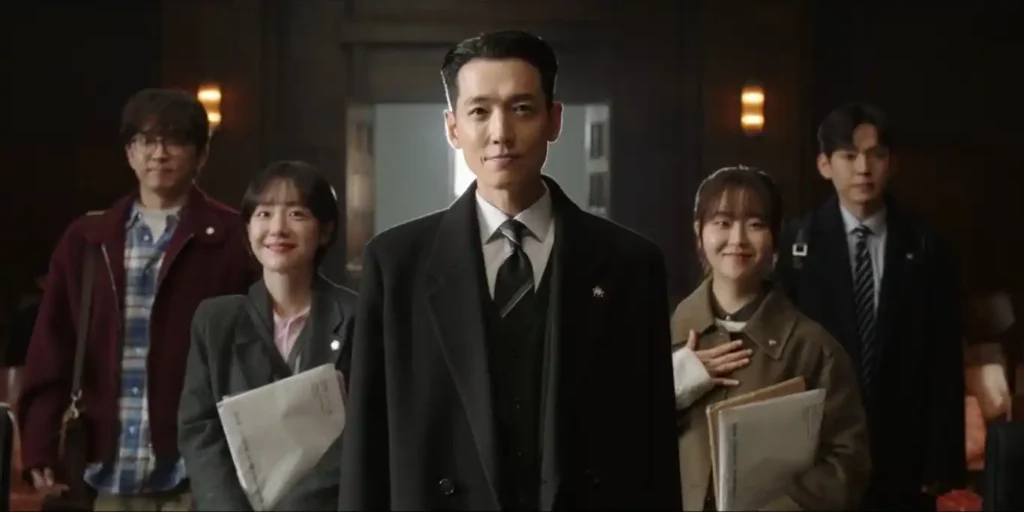
Summary
Pro Bono provides the neat and tidy happy ending everyone was expecting, with Episodes 11 & 12 delivering big on satisfaction and closure.
As far as clear-cut climaxes go, you could probably see this one coming a mile away. Pro Bono is the sort of show that lends itself pretty perfectly to the exact kind of ending built up in Episodes 11 and 12, all about personal payoffs and evolving the starting premise into a logical outgrowth of the same core idea. It’s about truth, justice, and the Korean way, but now no longer free of charge, since class action lawsuits are where the money is, and corrupt corporate fatcats can afford to pay it. It took us a while to get here, and I’d still argue the season has failed to capture broad imaginations and interest by adhering just a little too close to the standard genre playbook, but it makes for an undeniably satisfying finale all the same.
Naturally, there are a couple of loose ends to deal with initially, particularly stemming from where we left things in the previous pair of episodes, with Da-wit himself on the stand. Then we’ve got a couple of final cases to move into that help shuffle our characters to where they need to be, leading to the big, obligatory payoff and the tasteful reinvention, not to justify a second season – since that isn’t the K-Drama way, typically, even on Netflix – but to reassure us that everyone will probably be alright once we’re done watching.
On with it, then.
The Exoneration of Da-Wit
The big dilemma of the previous two episodes was whether Da-wit would go to prison on the back of an accusation by Jae-beom of long-ago corruption resulting, in a roundabout way, in the death of his father. So, this is the first order of business.
Despite Da-wit being all dramatic and saying outright that he wanted revenge against Chairman Yoo, Gi-Ppeum astutely points out that this isn’t a confession of any wrongdoing and, predictably, that turns out to be the case. Da-wit didn’t plant any evidence or prejudice the trial in any way. He knew what happened, couldn’t necessarily prove it in court, but managed to railroad Yoo into admitting that his penny-pinching measures had resulted in his factory being a death trap in the event of an emergency. This justified the maximum sentence at the time.
It’s a sad story, one that the poor factory overseer has carried the guilt for all these years, since the door that Mi-seon could have safely escaped through was locked on Chairman Yoo’s instruction. The verdict – we don’t see it, just move to the pro bono team enjoying a celebratory dinner after the prosecutors apparently dropped the charges ahead of an inevitable acquittal – not only exonerates Da-wit, but allows that poor guy to finally achieve some measure of closure.
The Dissolution of the Pro Bono Team
While this case represents a personal victory for the team, upper management considers it a breach of ethics and dereliction of duty, so the team is dissolved and their office disappears. They’re all fired. Needless to say, this makes it a little bit harder to fight the good fight, legally speaking.
Da-wit leases an office space and recruits all of the members of the team, but of course, the lingering issue of Dr. Oh remains. He’s furious with CEO Bae for failing to secure Da-wit’s conviction, and now the fight must be taken to him by another, “mercenary” firm. Who else for this job but recurring nemesis Myeong-hun, of Baeksung Law?
Myeong-hun has a personal stake in all this, as he has resented Da-wit ever since he stole Jung-in’s romantic interest 16 years prior, and plans to defame him by proving that he manipulated the trial of Yeong-sil’s father, Jang Hyeon-bae.
Yeong-Sil Steps Up
Needless to say, this case puts Yeong-sil firmly in the crosshairs of his criminal dad, who went to prison on the back of a number of abuse and sexual assault allegations that have, conveniently, all since been retracted. The team is in support of Yeong-sil, but he still has to face his trauma directly on the stand, in the form of his father, who wastes no time in reducing him to tears with reminiscences of his traumatic childhood.
Yeong-sil has to muster the courage to stand up to his father, coached by Da-wit, but that also means going through his mother, whom he calls to the stand as a witness. She considers herself complicit in Hyeon-bae’s crimes, since she was aware of his behaviour towards the housekeepers, but she, too, was living in fear.
Pro Bono builds appropriate drama for Episode 12 by roping a whole bunch of very powerful people into this case as witnesses, including Supreme Court justice Shin Jung-seok and, of course, Dr. Oh Gyu-jang. Da-wit sensationally claims they’re all in cahoots, all part of the same justice system-spanning conspiracy.
Taking on the System
Da-wit has a recording that proves Oh and Shin discussed prejudicing the case against Hyeon-bae, and while technically inadmissible given it was obtained illegally, Jung-in’s presence during the call and the consent of a single participant mean that it can, in fact, be presented as evidence. Somewhat hilariously, given the corruption allegations, a new judge is appointed in the case who is a close friend of Shin and more sympathetic to the interests of the status quo. Fancy that!
Da-wit has a week to gather enough evidence to blow the conspiracy wide open. When Shin and Hyeon-bae receive videos of each other ratting out their conspirators to Da-wit, panic begins to set in, and in this panic, Dr. Oh talks to Da-wit directly. Apparently, “it’s not what you know, it’s who you know” suffices as some kind of moral justification. But the benefits of his connectedness are proven when Dr. Oh offers Da-wit Shin’s current Supreme Court position. All he has to do is ensure he gets off.
This is Da-wit’s dilemma. Does he value his long-held career goal more than he does his own pride and honour? I think we already know the answer to that question, but Pro Bono plays with it all the same, reminding us of the promise Da-wit made to his mother to be successful.
Moment of Truth
When Da-wit turns up in court, there’s a deliberate dramatic indication that he has taken the offer, since he withdraws his request for Oh to stand as a witness, baffling Gi-Ppeum. He gives Hyeon-bae and Shin a final chance to turn on each other, lest they all be destroyed by his smoking-gun recording. And just like that, Hyeon-bae cracks and tries to save himself.
Oh still seems fairly confident that there is no such recording, but he’s dead wrong. Da-wit recorded the conversation that they had, in which Oh justified his own corruption and tried to bribe Da-wit with Shin’s position. In his arrogance, given his long history of making people offers they can’t refuse, he never even considered the possibility that Da-wit would say no, let alone use the offer against him. But here we are.
If there’s one thing that’ll always unsettle the powerful, it’s arrogance.
New Beginnings
The ending of Pro Bono reveals that Jung-in was responsible for Da-wit’s initial accusations of bribery, kind of putting the kibosh on her desire for him to become a co-CEO of Oh & Partners and take the firm global. Of course, Da-wit already has a team. He just hasn’t rearranged the members yet.
Da-wit has reconciled the idea that he won’t become a Chief Justice, as he promised his mother, but it doesn’t matter since he has become successful and made her proud in a different way. He has become a man of staunch principle who fights for the needy, not the powerful. He doesn’t want what Jung-in is offering him anymore. He doesn’t want to represent the corporations that are killing babies with toxic diapers; he wants to represent the families who can’t legally defend themselves.
And to do it, he’s setting up his own law firm. And he’s taking the pro bono team with him.