Summary
Star Trek: Starfleet Academy is undeniably flawed and will likely split opinion, but it’s nonetheless decent fun with some interesting ideas under the off-puttingly modern hood.
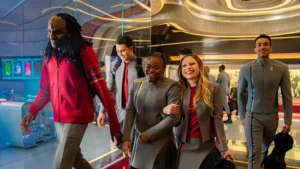
Star Trek has been around since 1966, and the San Francisco campus from which this spin-off takes its name has somehow never been depicted on-screen before, despite the idea having been talked about on and off since the ‘90s. From that perspective, Starfleet Academy should be well-received, a chance to finally roam the halls of the prestigious institution that spawned iconic captains like James Kirk and Jean-Luc Picard. But not so fast. Set in the 32nd Century, as far into the future as the franchise has ventured, this show is part of the Trek renaissance ushered in by Star Trek: Discovery and largely despised by long-time fans. So, it’s in a weird spot.
You can feel the weight of some of the baggage, too. The underlying idea is essentially Hogwarts in space, but connections to the broader franchise mean that the action is picking up after the Burn, the cataclysmic event from the third season of Discovery that imposed a period of complete isolation on various familiar – and unfamiliar – worlds until they could catch back up with interstellar travel. That means Starfleet Academy has been closed for over a century, the new intake is besieged by challenges relating to post-Burn diplomacy, and all of the characters old enough to remember the universe before the event have to keep despondently referring back to it just to remind us of the continuity.
But no matter, since the story being told here is largely an original and coherent one. The two-part premiere does a fairly adroit job of laying out the framework, introducing us to the Academy’s new Chancellor, Nahla Ake (Holly Hunter, Succession), and to the show’s protagonist, Caleb Mir (Sandro Rosta), a kid whose mother was sentenced to a long stint in prison 15 years prior, making Caleb a ward of the Federation. The twist? Ake was the officer who separated them, and her return to Starfleet after resigning in the aftermath of that decision is contingent on Caleb being a part of the new intake. He’s looking for his mother (Tatiana Maslany, She-Hulk: Attorney At Law), she’s looking for redemption. What could go wrong?
Caleb’s mother was sentenced for conspiring with a rapscallion named Nus Braka, who Paul Giamatti (The Sons of Sam: A Descent Into Darkness, Gunpowder Milkshake, Black Mirror) plays like a Shakespeare villain, and he shows up again in the present day, suggesting that he’s going to be one of those Harry Mudd-style recurring antagonists. He and Holly Hunter chewing the scenery make it almost impossible to dislike Starfleet Academy, which is perhaps just as well since it leaves a little to be desired elsewhere.
There is, one has to admit, the air of performative new-school modernity to this setup, and several of the supporting characters, which can occasionally feel trying. Star Trek – like all good science fiction – has always intended to hold up a mirror to contemporary culture and reflect very real socio-political issues, so in that sense it’s very on-brand, but you can tell it’s being done aesthetically rather than textually, with the writing often feeling lacklustre and muddled. It’s usually clear what we’re supposed to think, who we’re supposed to be sympathetic to, and who we’re not, at a glance, which gets away from the core of Trek as a nuanced exploration of competing approaches and ideals.
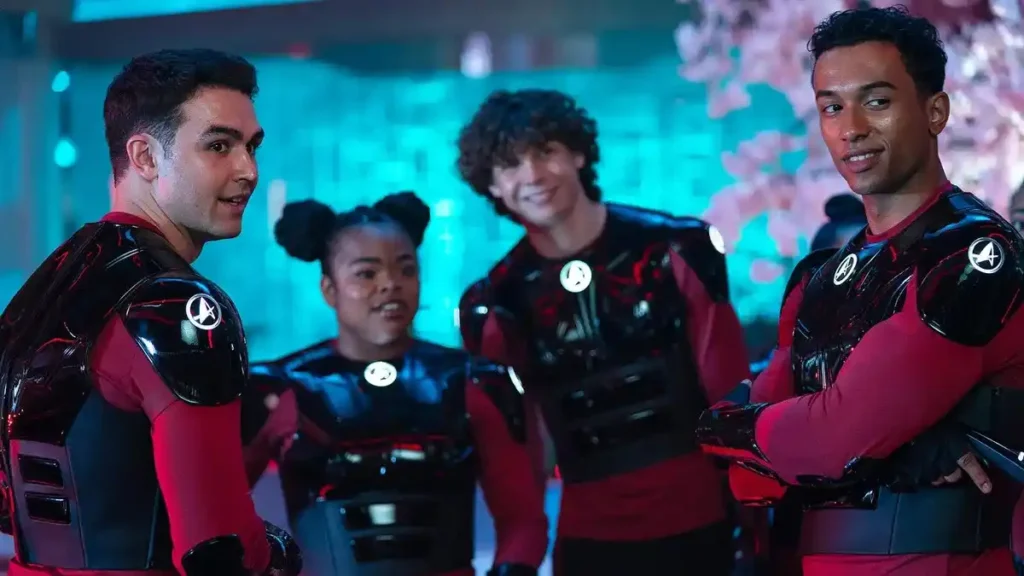
It’s also very Caleb-focused, especially in the early going, reducing some of his contemporaries to set dressing. Most students and officers are initially defined exclusively by their sole quirk, or whatever relationship they have to Caleb. We’ve got his nemesis and roommate, Darem Raymi (George Hawkins), pacifist healer Klingon pal Jay-Den Kraag (Karim Diane, One of Us Is Lying), and love interest Genesis Lythe (Bella Shepard, Wolf Pack). There’s a character whose entire personality seems to be the fact that she’s a hologram – Kerrice Brooks’s SAM – and even Ake seems to exist entirely to guide Caleb specifically. That seems a shame, too, since she’s genuinely quirky in several understated respects, like how she curls up in the captain’s chair aboard the USS Athena, a great-looking vessel aboard which are several “teachable moments”.
Teachers, on that subject, don’t fare much better, but it’s nonetheless nice to see Robert Picardo return as the Doctor from Star Trek: Voyager, and Tig Notaro (Your Place or Mine, We Have a Ghost Review, The Morning Show) reprising her role from Star Trek: Discovery. A lot of Starfleet Academy is like that. It’s fun almost in spite of itself, flitting between broad Trek modes – interstellar action, terrestrial diplomacy, etc. – and merging them with U.S. high school campus cliches to create something that is pretty legitimately new within the confines of the franchise, if not necessarily all that new-feeling in its totality.
Perhaps against my better judgement, I rather like it, though I can acknowledge it’s flawed and will divide opinion for reasons both justified and not. But for what it is, it works, and based on the pre-release furore, that’s more than anyone seems to have expected.