
Summary
Everything that works and doesn’t work about American Classic can be summed up in a single scene in “Juniper Berries”, a sequence that is both ridiculous and true to the show’s earnest love for the arts.
Money is at the forefront of American Classic Episode 3, chiefly in the context of how much of it Richard will need to spend to bring his version of Our Town to life. The answer, predictably, is “much more than he has”, but don’t worry too much about that minor logistical detail, since the idea is mostly just an excuse to once again showcase the power of theatre in Millsburg, Pennsylvania.
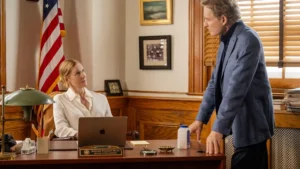
I’ve moaned about this already, you’ll recall, but it’s so obvious and silly in “Juniper Berries” that it’s worth highlighting again. There are two moments of transformative performance here, but the latter is particularly egregious. In it, Richard and a newly converted Jon try to acquire a bank loan to finance the production, and when it seems to be untenable, Richard breaks out into a nonconsensual Hamlet monologue. In reality, he’d have been escorted from the premises by force, but here he reduces the clerk to tears and gets a round of applause from the other customers, all of whom stop what they’re doing to listen. Everything that works and indeed doesn’t work about American Classic is embodied by this scene; its earnest love and appreciation for the arts, but also its idealistic, lightly fantastical idea that anyone else cares even half as much.
This, I think, is why the money angle doesn’t work very well. Is there really any doubt that Richard will find a way? With Connor now having been introduced as the closest thing this show has to an antagonist – a greedy developer who doesn’t respect the sanctity of the theatre – there’s even more motivation for Richard, Jon, Miranda, and, to a slightly lesser extent, Kristen to do anything necessary to make the performance happen. And the performance will, almost certainly, redefine the town’s future, pay off whatever loans are taken out to facilitate it, and repair the bonds of a fractured family. You just know that’s going to be the case.
But so what, right? That’s the whole point. The experience is supposed to be cathartic, and goddammit, I can’t help but find myself rooting for Richard just a bit more than I expected to. Kevin Kline is pitching his performance just right, treating his narcissism as oddly charming rather than actively off-putting. Sure, it’s stupid for him to spend $20,000 on new seats, but it’s also totally the kind of thing he’d do, largely for the right reasons.
This is the version of Richard that Jon sees. I especially liked the evolution of their relationship here in Episode 3, since in the premiere, they risked seeming like strangers. But they are from the same family, after all, and the love of the theatre runs in their blood. You can see it in their shared understanding about Jon’s sandwich – it’s the juniper berries – and, of course, in their performance with Miranda, which is a touch more believable than the bank scene since the audience there have turned up to see some theatre and not remortgage their house.
The bank thing is slightly more important, though. As it turns out in American Classic Episode 3, Kristen has remortgaged the theatre through Connor and fallen behind on the payments, which wouldn’t be too big of a deal except for the fact that she has fallen behind on those payments. Connor seems understanding about it, initially, since he offers her a payment holiday in exchange for inviting him and his wife, Nadia, to dinner, so that the latter can pick Richard’s brain about theatre (she is, of course, a big fan).
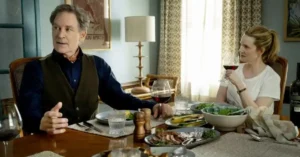
But it’s during that dinner that Connor reveals he is planning to build a casino in Millsburg, and of course, Kristen being behind on the mortgage opens up the space for development. He’s clearly playing a long game to try to wrest that valuable real estate away from the family. But since Richard has burned all of his bridges in New York, it doesn’t seem like any help will be forthcoming from anywhere outside of the town. Even his Hamlet recitation doesn’t yield anything.
I think I smell a touch of crowdfunding on the horizon. And that’ll require – of course – the entire family to be on the same page.
RELATED: