
Summary
The Testaments turns things on their head in “Daisy”, providing welcome new context around its title character and complicating existing dynamics in interesting ways.
It took a while, but The Testaments finally shifts its focus in Episode 3 to provide more context around what Daisy is really up to. And it’s welcome. Agnes’s point of view has been compellingly expressed, and is obviously going to be central to understanding the two worlds that Daisy finds herself trapped between, but it’s Daisy’s story, really, that connects this show more intimately to The Handmaid’s Tale, and provides a more compelling undercurrent to the narrative as it develops through this first season.
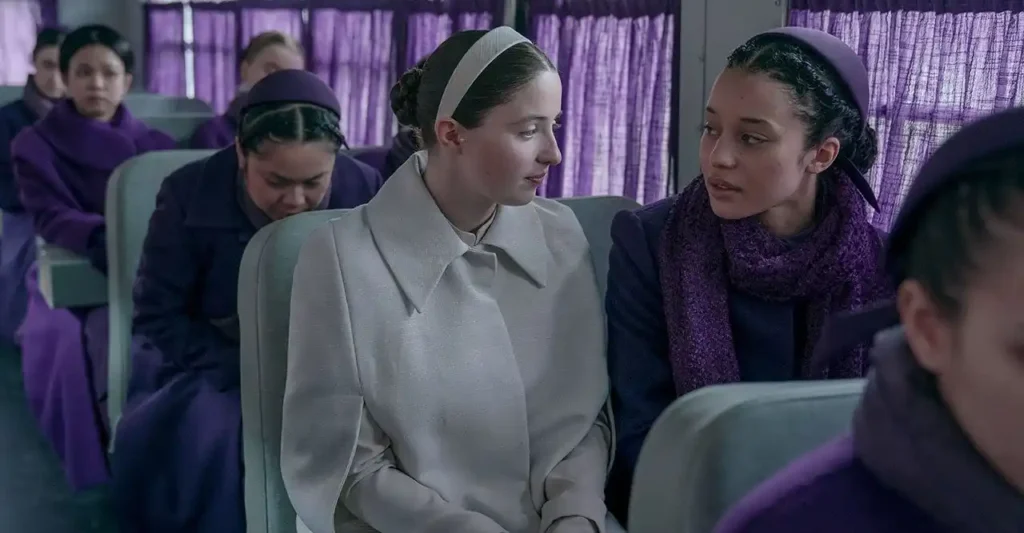
This requires a broader focus. It leaves the halls of the prep school on a field trip, allowing the Plums to pass dangerously through the world outside its walls, but it also toys with time, devoting a good chunk of the runtime — the longest of the season yet, as it happens — to explanatory flashbacks that help to explain how Daisy made her way from Toronto to Gilead. It also hands narration duties over to Daisy herself, which doesn’t just lend a different voice to the ongoing story but also provides a revealing internal monologue that undercuts Daisy’s performative piety when she’s around the other girls, especially Agnes.
A Tragic Past
Through Daisy’s narration, she explains that Gilead grew gradually. It began with elected officials saying heinous things that were dismissed as hyperbole until they became public policy. It isn’t an unfamiliar idea. And that makes it credible. The white-garbed Pearl Girls hawking honey in Toronto were madcap weirdos treated with the same derision as door-to-door Mormons or Jehovah’s Witnesses. Daisy never imagined that Gilead, as an institution, was sinister enough to murder her parents. More fool her.
Daisy’s parents, Neil and Melanie, ran a vintage clothing store. They had nothing to do with anything. Their murder is sudden and numbing to Daisy, who is taken to identify their bodies and consoled by a representative from Social Services. She doesn’t consider that anything nefarious might be afoot until June Osborne appears and tells her that she’s in danger. Her parents were collaborating with Mayday. They were killed by Gilead.
Daisy isn’t buying it initially. She sneaks out in the night to see her boyfriend, Justin — who gifted her the radio we saw her using in the premiere — and try to feel normal again. But it’s impossible. June is waiting for her when she flees from Justin and his suggestion to tell his parents and the authorities what Daisy has been told. In the understatement of the century, June tells her she knows how she’s feeling. But she also tells her that she is a child of Gilead whose parents got her out when she was a baby. Neil and Melanie adopted her. And now Gilead wants her back.
Under Fire
These flashbacks don’t all play out together, but it’s worth recounting them in that way, since they inform the present-day drama. The Plums are out on another field trip, to visit the swanky home of a former student who has now married a Commander. Daisy is forced to tag along with Agnes, though the others, including Agnes, still visibly mistrust her. It’s here where her suddenly audible internal monologue really benefits The Testaments Episode 3, since we can hear her slagging Agnes off in her mind when she cautions Daisy about visibly pining for her Guardian, Garth. The irony!
This helps to redefine Daisy’s function in the story. We know now that she isn’t buying what the Aunts are selling; that she’s understandably judgmental of the naivete embodied by Agnes and her peers. She’s a double agent in more ways than one (more on this soon). But she also manages to earnestly bond with the Plums despite their experiential differences because when Mayday agents attack their school bus, Daisy springs into action and shields Agnes from gunfire. She’s visibly braver than, say, Aunt Vidala, who, for all her authority, just lies on the floor praying.
Daisy also becomes a source of the normality that these girls have been deprived of. Hulda is appalled to have noticed that one of the shot Guardians had a hairy stomach. When Daisy reveals that this is totally normal, they assume she only knows that because of some rampant promiscuity and not, as she explains, very normal trips to the beach back in Toronto. The Plums have been depicted as psychos until now, but Daisy’s outside-looking-in perspective helps us to see them as victims of the very system they’re being forced to perpetuate.
Playing Both Sides
The field trip to the former Plum’s house introduces what I’m going to assume is one of the season’s Big Bads — Commander Judd. He even shows up in person to be performatively loving to his new wife, Penny, to reassure the girls that Gilead is in the right, and to lightly press Daisy on her motives for becoming a Pearl Girl. “To do God’s will,” obviously.
But she’s lying. The ending of “Daisy” reveals she’s in cahoots with Garth, and that the attack on the bus was planned. It was supposed to be a retrieval mission, though. Who was to be taken? Garth reassures Daisy that none of the girls were to be harmed, but he doesn’t seem so sure. Daisy hands him the map she drew, regardless, which will prove useful for whatever’s coming. But when Daisy asks to speak to June, Garth claims not to know who that is.
Now stuck in the middle and playing both sides, Daisy is in a predicament that makes all of The Testaments immediately more compelling. We’ll have to see where it goes.