Summary
From Season 4 continues to take the show in many interesting directions in “Fray”, raising multiple new theories, even if the character drama isn’t always as convincing.
From very much likes the idea of single statements and/or sentiments that sum up the entire episode – or, for that matter, the show overall. In the Season 4 premiere, it was about the immutability of stories, the idea that, once told, a story can’t be changed, only observed or understood differently. In Episode 2, “Fray”, the idea is that knowledge does not come free. There’s always a cost. And if you push for information hard enough, eventually something will push back.
The rather unceremonious, messy death of Jim adds a ton of urgency to this hour and gives that idea of consequences a very real contour. Most of what else happens is an outgrowth of this, understandably. But the ideas are central to the show’s narrative firmament and have been since the beginning. Most of the character arcs, especially Boyd’s increasingly no-nonsense leadership style, have been percolating for a while, but the sudden developments are exacerbating the arcs.
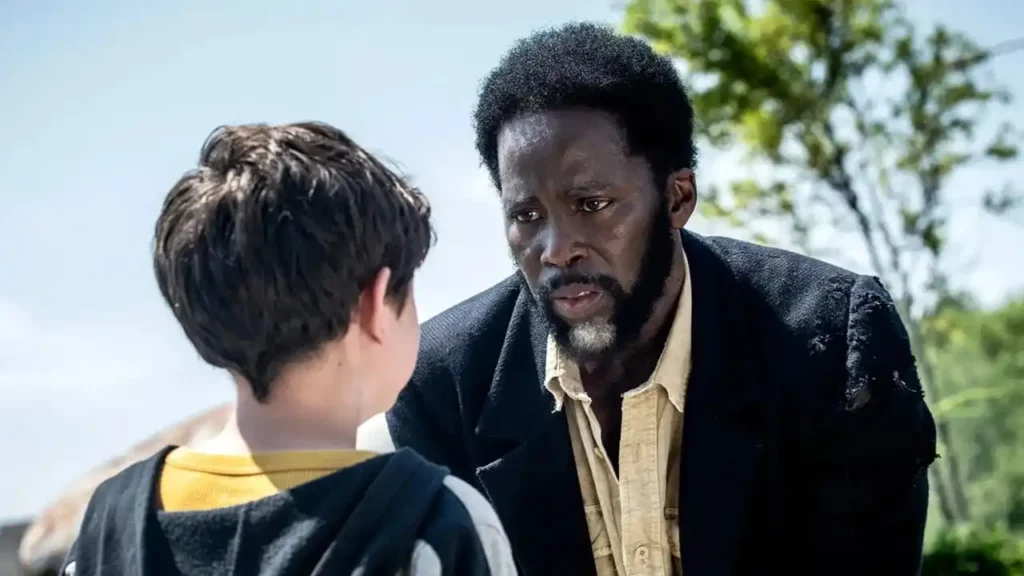
But I’m kind of with Boyd, if I’m being honest. Now’s the time for action, and beating around the bush doesn’t get anyone anywhere. Sure, telling Elgin to just forget about having his eye gouged out feels a bit unreasonable if you’re Elgin, but I’m not sure I’m buying the claim that he has suddenly become a monster. Boyd is a nominal leader, and he’s trying to keep control of a situation that is rapidly spiralling, even by the usual standards. Factor extreme grief into that equation, and Boyd is finding himself in an increasingly untenable position.
There’s a lot of gamesmanship afoot, especially with Sophia – aka the Man in Yellow – very much in the camp. But the counterpoint to this is Jade’s board, an assemblage of maps, drawings, and theories that summarize the total knowledge that everyone has accumulated thus far about how the place works. I really like this dynamic of the “good guys” trying to put the pieces together while the enemy schemes from within.
It’s also a treat for theorists, obviously. From Season 4, Episode 2 perpetuates the idea of whatever evil is living inside the town not being contained to the town itself. Or, in other words, that the evil doesn’t encompass just the town. This, too, is an idea I like, that of the town being the latest version, or the top layer, of something much older and more insidious. The more people try to figure it out, the more they build atop what was already there. Remember the recurring motif of the episode: Keep pushing, and something will, eventually, push back.
This adds more intrigue to Julie’s story-walking, which she seems to be able to do at will. The power is evolving beyond choice flashes of other events, people, or places, and becoming a more active influence over the story being told. But if we subscribe to the theory of the same story having been told so many times that it’s buried deep under the framework – the town – that has developed around it, this potentially makes Julie the most important character in the show, the only one who can realistically interact with the genuine depths of what’s afoot.
And the rules seem to be changing. Whether this is the natural course of events or a consequence of things like the story-walking, which deviates slightly from the established expectations, is a little unclear, but there’s something subtly different about Jim’s unexpected return that exists at the intersection of supernatural possibility and a child’s grief over having lost his father. You can’t quite put a finger on what’s winning, on whether Ethan seeing Jim is his own grief manifesting, hence Nu Jim not being aggressive or manipulative, or further proof that the rules binding everything in place are much more fluid than we thought.
The only real downside of “Fray” is that as the supernaturalism and mystery-box storytelling become more pronounced, the human drama doesn’t seem to be developing to follow suit. Boyd’s arc is arguably the show’s best because, while his new approach isn’t exactly endearing, it is, as I said earlier, understandable. It’s the approach of someone trapped in a magic horror town where the rules don’t apply. But then you’ve got other things, like Tabitha refusing to believe Ethan about what he has seen, and Acosta jumping in an ambulance and running laps – with Kristi having jumped in too, for some reason – as a kind of symbolic rejection of the town and the highly questionable behaviours that everyone has to indulge in to navigate it. You could make the argument that Acosta wasn’t exactly a day one adherent, but this is a show that is now long enough in the tooth that anyone acting this way just tends to irritate me.
It’s difficult to mind, though, since so many interesting new questions are emerging at such a rapid pace. If Boyd is the audience’s human tether to the town, everything else that’s cropping up, like the nature of Jim’s death and apparent resurrection, Julie’s story-walking, and whatever’s going on with Ethan, are the things we’re really tuning in to see. In just two episodes, From Season 4 is already in a very different place from where we left it. Imagine how things might look by the end.
RELATED: