Summary
A Good Girl’s Guide to Murder is significantly improved in Season 2, with Emma Myers once again anchoring the plot as it veers into darker, more complex territory.
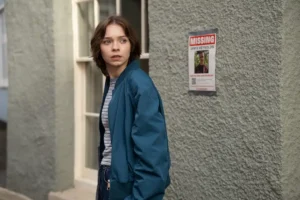
Season 2 of A Good Girl’s Guide to Murder begins with Pip (Emma Myers, Wednesday) swearing to never investigate another murder ever again, which in the YA crime genre is basically a guarantee that she’ll be investigating a murder before the end of the first episode. And so it is. The clues are all there, of course, some of them obvious. Murder-mystery parties with friends? True-crime documentary binges with a bowl of cereal? These things aren’t coincidences, folks.
And, you know, it’s based on another book. Holly Jackson’s second in the series, Good Girl, Bad Blood, forms the rubric for this supposedly more faithful second season, which doesn’t bog the story down with a bunch of go-nowhere subplots as the first season did. It’s darker and a bit more complex in how it builds on the dynamics created by the first season’s ending, and it wouldn’t do to not have Pip investigating anything. There’s too much occupying her attention for that.
This is because Season 2 of A Good Girl’s Guide to Murder is very much a sequel. It picks up a while after Pip ostensibly solved the murder of Andie Bell and posthumously exonerated Sal. She’s now dating Sal’s brother, Ravi (Zain Iqbal), using a podcast to give herself some closure about the whole affair, and counting down the days until Max (Henry Ashton, A Knight of the Seven Kingdoms), the moneyed rapist from Season 1, gets a hefty prison sentence. Things aren’t necessarily ideal, since Pip’s relationship with Cara (Asha Banks) is frayed on account of the revelations she turned up about her father, and Max seems unusually smug for someone on the cusp of a court case, but it seems like things are as close to being resolved as they’re ever going to get.
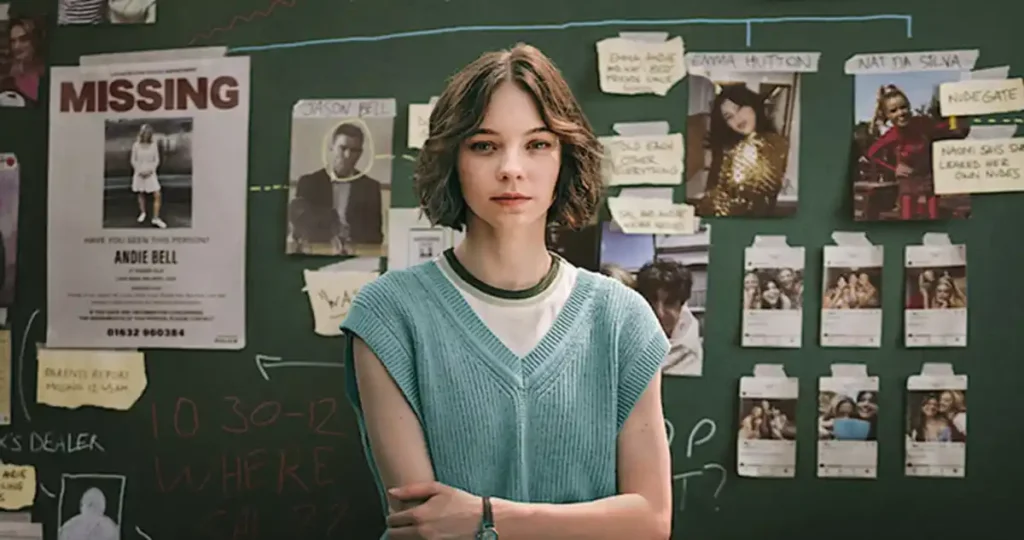
But not so fast, obviously. Out of nowhere, Becca (Carla Woodcock), who’s already in prison for her part in Season 1, drops out of the trial against Max. Soon after, Connor (Jude Morgan-Collie) turns up at Pip’s door to tell her that his brother, Jamie (Eden H. Davis), also a star witness in Max’s trial, has disappeared. The case’s success hinges on Jamie and his relationship to “Woman A”, an anonymous witness who was also testifying against Max, so unless Becca can be compelled to testify and Jamie can be found, Max is going to get away with it. It’s as good a motivation for Pip to pull out the detective board as any.
The decision isn’t made lightly, though, which is one of the key ways in which Season 2 really builds on the first. Pip remains plucky and determined, but she now has a slightly haunted quality that comes from the considerable fallout of her previous investigation. Little Kilton is a small place, and very few people were untouched by Season 1’s implications. Pip’s penchant for crimefighting has real consequences that must be reckoned with, and the new case isn’t just a passing fancy for a school report, but instead a real moral imperative.
This shift in dynamic gives Myers a lot more to play, and she really rises to the occasion, managing to sell the darker turns of the case through her performance. This season is leaner and more focused in its storytelling, too, so Pip’s arc is very central to it, perhaps even more so than in the first season. The only real consequence of this is that the single-mindedness sucks some of the energy out of the supporting dynamics. Pip’s relationship with Ravi feels much more stilted now that it’s official, mostly because she barely has time for it. There are a few other examples of this, with Cara having less to do than would have been preferred, but it doesn’t lessen the emotional impact of the core case, just the depth of the wider setting.
It’s easy to understate how much better A Good Girl’s Guide to Murder Season 2 is than its predecessor. It’s more intentional, tighter, and better-paced, while also effectively evolving in its approach to sensitively handling heavy topics and layered character development. I was firmly in the camp of this show having tied up all of its loose ends, and a follow-up seemed ill-advised on that basis. But the growth between seasons makes an adaptation of the third book in the trilogy a fairly tantalising proposition, and if this season is a hit, which I’m almost certain it will be, Netflix would be foolish not to capitalize. And the Big N doesn’t leave money on the table.
RELATED: