
Summary
Norway: The Dark Horse implicitly understands the dramatic potential of a good sporting underdog story, and the two-part docuseries examines Norway’s murderous run through the 2026 World Cup qualifiers with irresistible enthusiasm.
I’ve said it before, and I’ll say it again — there is no better storytelling medium than high-level professional sports. All the mechanisms are built in: The drama, the conflict, the emotion, the intensity, the plucky underdogs and unshakeable titans. It’s all there naturally, and it all emerges organically in unpredictable ways. There’s nothing quite like it, and there’s nothing quite like a major international tournament to function as a cauldron for this kind of excitement to boil and bubble. Netflix knows this, which is why their tie-in coverage of the 2026 World Cup is proving to be so wide-ranging, and it’s something understood implicitly by Emil Trier’s two-part docuseries, Norway: The Dark Horse.
In many ways, the Norwegian national team is the polar opposite of perennial winners like Brazil, who were the subject of Netflix’s documentary feature USA 94: Brazil’s Return to Glory, about their momentous fourth World Cup win. Norway doesn’t win anything. More to the point, they’re rarely ever in a position to win things, since before the qualifying campaign for the current tournament, which is what this series focuses on, they were on a 26-year major tournament drought. Disappointment had become a national identity, an inevitable expectation, which made Norway’s unlikely, dominant charge through the qualifying stage of this World Cup all the more riveting.
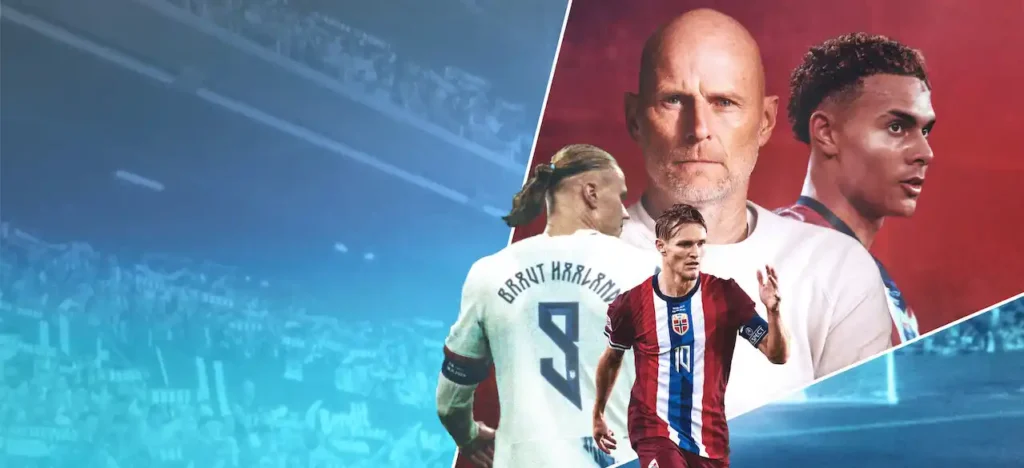
Again, the series, which comprises two hour-long episodes, knows this. There’s something in the air from the very beginning. You can feel it in the exclusive behind-the-scenes footage taken in the dressing rooms and on the training pitches of Norway’s push, the swelling sense of excitement and burgeoning belief as it trickles among the players and the coaching staff. And those players! The tiny nation of Norway, which comprises in its entirety about half as many people as are there in, say, London, has fielded several of the world’s best players. The front line is especially prolific, comprising terrifying striker Erling Haaland, consummate captain and playmaker Martin Odegaard, wonderkid Antonio Nusa, and seasoned Atletico Madrid forward Alexander Sorloth. It was almost inconceivable that this group couldn’t at least compete, and that feeling begins to permeate not just the dressing rooms but the docuseries itself.
The team is assembled under Head Coach Ståle Solbakken, and a big part of the focus is on him; his own playing career and the health issues that curtailed it, his setbacks in his earliest campaigns in charge, and the symbolic figure he became for the nation as the steward of a group of players who just might, for the first time in almost three decades, be able to compete for glory. His no-nonsense demeanour is well-suited to the type of football Norway had to play through their qualification campaign. After a stinging last-minute loss to Scotland that bounced them out of Euro 2024 qualifying, Solbakken took responsibility, fostered a determined, point-proving attitude, and led the team back into battle for a murderous run through the 2026 World Cup’s qualifying stage.
The Dark Horse has a great time dramatising Norway’s eight wins in this stage, including two against Italy, one of them at the San Siro, where the Italian national team had previously never lost a World Cup qualifying game. Norway became only the sixth European side to win 100% of their qualifying games; they didn’t just win, but battered every opponent in dramatic fashion, proving that their attacking players can hang with any other nation’s in the tournament. And they’re going to need to, since Norway begin the actual World Cup in a group containing Iraq, the potent African nation Senegal, and heavy favourites France.
But whatever happens there, it’s impossible to deny what was achieved in the qualification stage, and what it meant for Norwegian football and the country of Norway in general. Like the Brazil documentary, this is about more than just football; it’s about a national consciousness tuned to disappointment, suddenly picking up a new frequency. The collective jubilation that came from Norway’s terrorising run through qualification will, hopefully, be a sign of things to come in the tournament itself. Either way, I hope they film it. You never know.