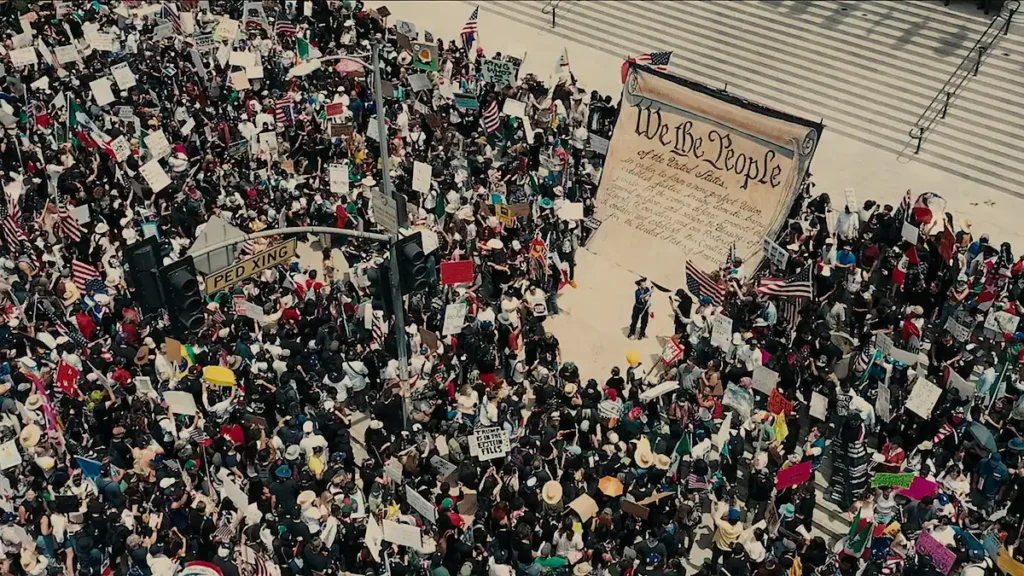
On the cusp of the 250th anniversary of the United States of America, Brian Knappenberger’s five-part Tom Hanks-produced historical documentary series The American Experiment lays out the particulars of how American liberal democracy was built, challenged, and reinvented across two and a half centuries of evolution. It’s a surprisingly cautious work, eschewing the expected jingoism in favour of a deeply informed analysis with a murderer’s row of expert speakers.
That diverse and wide-ranging list of historians, politicians, academics, tribal chiefs, and thought leaders is easily the biggest point in favour of the series, which benefits immensely from its open acknowledgement of the on-going experiment’s inherent contradictions and hypocrisies. Below, we’ve collected and (roughly) grouped everyone who was interviewed for the series so you can get a sense of how the conversation is shaped through various perspectives and relevant expertise.
Note: There’s obviously some crossover in the categorisation here, but I’ve tried to be as broad as possible in organising people into their primary (but not exclusive) function. I’ve also deliberately avoided grouping the various state senators and members of Congress according to their political affiliation, since that’s kind of the point.
Executive and Administrative Leaders
Adrienne Whaley, Director of Education at the Museum of the American Revolution
James Taub, the associate curator of the Museum of the American Revolution
Doug Bradburn, the president and CEO of George Washington’s Mount Vernon
Jameel Jaffer, the executive director of Knight First Amendment Institute
Jane Kamensky, the president and CEO of Thomas Jefferson’s Monticello
Jeffrey Rosen, CEO emeritus at the National Constitution Center
Jelani Cobb, the dean of Columbia Journalism School
Lindsay M. Chervinsky, the executive director of the George Washington Presidential Library
Lonnie G. Bunch III, the secretary of the Smithsonian Institution
Matthew Keagle, the curator of Fort Ticonderoga
Military Personnel and Interpreters
Antoine Watts, a historical interpreter of the 1st Rhode Island Regiment.
Kevin Chapman, another historical interpreter of the 1st Rhode Island Regiment
H.R. McMaster, a retired lieutenant general and former US national security advisor
Native Speakers
Chuck Hoskin Jr., principal chief of the Cherokee Nation
Kathleen DuVal, the author of Native Nations and a professor at the University of North Carolina.
Robert Miller, chief justice for the Pascua Yaqui Tribe and a professor at Arizona State University College of Law.
Politicians and Lawmakers
Al Gore, former US vice president
Hillary Rodham Clinton, former US secretary of state
Jamie Raskin, US representative for Maryland
Jeff Flake, former US senator for Arizona
Kamala Harris, former US vice president
Lisa Blunt Rochester, US senator for Delaware
Mike Pence, former US vice president
Nancy Pelosi, speaker emerita, US House of Representatives
Rand Paul, US senator for Kentucky
Ron Wyden, US senator for Oregon
Roy Blunt, former US senator for Missouri
Stephen Breyer, a former Supreme Court associate justice
Ted Cruz, US senator for Texas
Zoe Lofgren, US representative, California
Writers and Academics
Alexis Coe, an American history columnist in The New York Times
Andrew M. Davenport, a historian at Thomas Jefferson’s Monticello and vice president for research and Saunders director at Robert H. Smith International Center for Jefferson Studies
Benjamin L. Carp, a professor of history at Brooklyn College and the author of Defiance of the Patriots
Carol Berkin, professor emerita of history at City University of New York and the author of A Brilliant Solution
Cassandra Good, the author of First Family, Founding Friendships, and a professor at Marymount University
Daina Ramey Berry, a professor of history at the University of California and the author of The Price for Their Pound of Flesh
Danielle Allen, a professor of government at Harvard University and the author of Our Declaration
Dennis Rasmussen, a professor of political science at Syracuse University and the author of The Constitution’s Penman
Don N. Hagist, an editor at the Journal of the American Revolution
Eric Burns, author of Infamous Scribblers
Fergus M. Bordewich, author of The First Congress
Gordon S. Wood, a professor of history emeritus at Brown University and the author of The Creation of the American Republic and Radicalism of the American Revolution
Jill Lepore, author of We the People
Joanne Freeman, professor of history at Yale University and author of Affairs of Honor
John Yoo, professor at UC Berkeley School of Law
Joseph J. Ellis, author of Founding Brothers, The Quartet, His Excellency: George Washington, American Creation, Revolutionary Summer, American Dialogue, The Cause
Lawrence Lessig, a professor at Harvard Law School
Margaret Washington, a professor emerita of history at Cornell University and the author of Sojourner Truth’s America, A Peculiar People
Mary Sarah Bilder, a professor at Boston College Law School and the author of Madison’s Hand
Maya Jasanoff, the author of Liberty’s Exiles and a professor of history at Harvard University
Michael Klarman, a professor at Harvard Law School and the author of The Framers’ Coup
Nathaniel Philbrick, author of The American Revolution Series
Noah Feldman, a professor at Harvard Law School and the author of The Three Lives of James Madison
Robert M.S. McDonald, a professor of history at the US Military Academy and author of Confounding Father
Ron Chernow, author of Washington: A Life, Alexander Hamilton
Sara Georgini, series editor at The Papers of John Adams
Saul Cornell, professor of history at Fordham University and author of The Other Founders
Sergio J. Campos, professor at Boston College Law School
Tom Nichols, professor emeritus of national security affairs at the US Naval War College
William Hogeland, the author of Inventing American History, The Hamilton Scheme, Founding Finance
William Treanor, the dean emeritus at Georgetown University Law Center
Woody Holton, a professor of history at the University of South Carolina and author of Liberty Is Sweet
Yuval Levin, a senior fellow at the American Enterprise Institute and the author of American Covenant, The Great Debate, The Fractured Republic
Read More: Is The American Experiment Woke?