I watch House of the Dragon for the dragons. I watch for the swords and the pitched battles and the kind of CGI that only many millions of dollars will get you. I watch because I like the books and the world they built and because I’ve still got a bit of a sour taste in my mouth after the ending of Game of Thrones. This is probably true of most people, even more so in Season 3, which seems to be making a point of indulging these expectations, having kicked off with the Battle of the Gullet and followed it up in Episode 2 with Rhaenyra’s coronation. But let’s be clear – the reason you care is largely because of Emma D’Arcy.
Not solely because of Emma D’Arcy, obviously. Matt Smith is great in this too, and there are plenty of other performances to enjoy. But what D’Arcy does in “Queen’s Landing” isn’t just an Emmy-worthy turn in a prestige show but the thematic building blocks of the entire season. It’s grief, anger, and strife writ so large as to fundamentally warp events as they’re described in the book, and the changes are welcome because D’Arcy is selling them so completely. They give the show, a narrative retelling of a dry in-universe history text, a deeply human contour.
A Masterclass Opening Sequence
“Queen’s Landing” opens with Baela Targaryen arriving back on Dragonstone with the corpse of Jacaerys Velaryon, who was killed during the Battle of the Gullet after his dumbass locked Rhaenyra away so she couldn’t participate in the fighting. It has a funereal quality to it immediately, despite being largely silent, but it’s Rhaenyra’s reaction that really kicks things up a gear.
Being a monarch is about posturing. Who can forget that photo of Queen Elizabeth II sitting alone at the funeral of the Duke of Edinburgh during the pandemic? It’s about steadfastness and duty in the face of all personal turmoil. D’Arcy says, essentially, “Nah” to that, and instead depicts Rhaenyra’s grief almost as a living thing: a sturdy denial giving way to a frantic, desperate disbelief, and then a visceral outpouring of emotion that is legitimately uncomfortable to watch.
This is proper acting. It isn’t just a bit of weeping; there’s a primacy to it that feels real and instinctive. Rhaenyra is a mother first, a queen second, and the latter only unofficially (for now). But while she has to cosplay as the latter, often at the expense of the former, she treats Jace’s loss as a personal blow, not a political one, and in its aftermath everything – at least for her – is different.
Going Off Script
This difference is essential to the adaptation. Rhaenyra’s grief is being used to underpin plot points and rework scenes from Fire & Blood to give them more specificity. It’s adding emotional texture to a story that was by design dry and open to interpretation, such as how, during Rhaenyra’s coronation, instead of being cut by the Iron Throne, her grief and emotional instability are deployed to create the same foreboding around her coming rule.
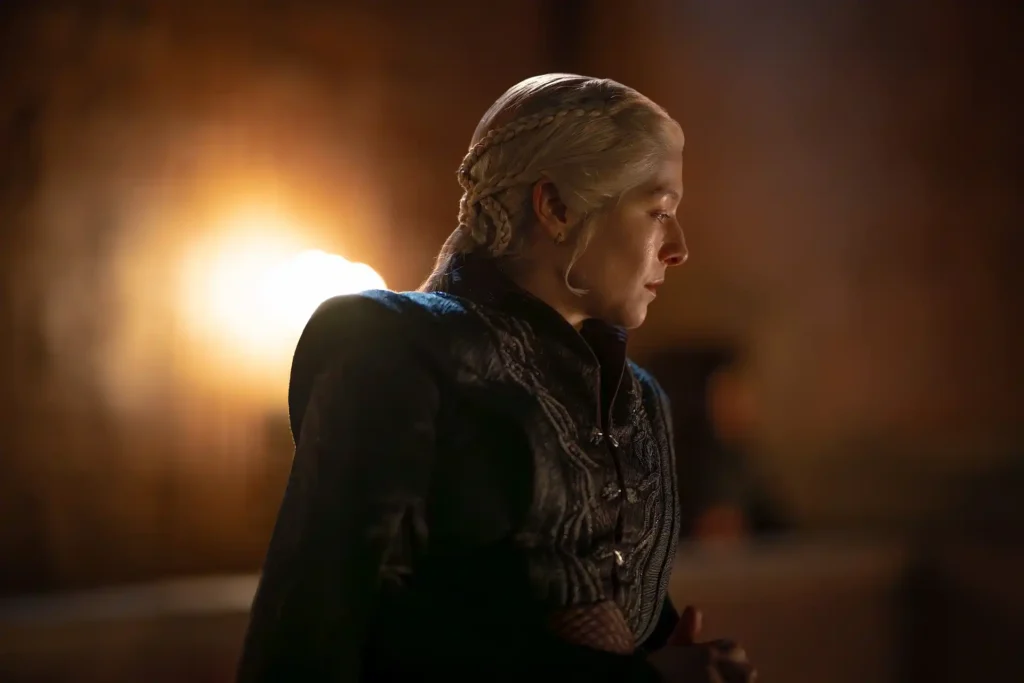
D’Arcy is able to communicate this with an expression alone – “Queen’s Landing” culminates with a lingering close-up of her face while she faces down Alicent after messily and reluctantly executing her father, Otto Hightower. The weight of her actions is leaking out a bit, contrasting with the calcified version she wielded as a weapon as she marched through King’s Landing alongside Daemon. D’Arcy shows two very different sides of the same coin.
Let’s Get Physical
The nuances of D’Arcy’s performance come through in the nonverbal details. Crying and wailing tend to get a lot of plaudits in acting circles because they’re difficult to do convincingly and are very showy, but the true horror of the scene where Rhaenyra approaches Jace’s corpse is in her talking to him as if he’s alive, breaking down when she realises he isn’t, and then battering the body as if to beat some life into it.
There are tons of small details to marvel at here: shaking hands, the cowing posture, that feeling of mental and physical collapse when she realises the truth, and so on, and so forth. The crying isn’t even half of it. Observe, too, how Rhaenyra’s posture and demeanour change depending on who she’s interacting with, whether it’s members of the small council who need to see a queen, or Daemon as she’s curled in bed.
The Dance of the Dragons is a tragedy. It’s a grand, operatic spectacle, sure, but it costs so many lives, causes so much carnage, and has such profound cultural ripple effects that it can’t be considered anything else. It’s Emma D’Arcy’s performance as Rhaenyra that really helps it to feel like a tragedy, though, and that’s something that all the CGI in the world can’t accomplish.