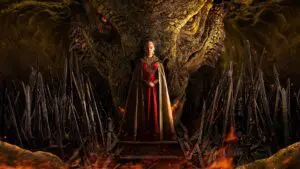
Season 3 of House of the Dragon continues to be about big moments almost exclusively. The premiere, which revolved around the Battle of the Gullet, killed off a major character and opened the season with as much fire and fury as could possibly be rendered in a multi-million dollar budget. And in Episode 2, Rhaenyra Targaryen, thanks to the bargain she struck with Alicent Hightower in the second season finale, descended on King’s Landing to take the Iron Throne with relatively little resistance. But her coronation wasn’t without difficulty all the same, and HBO’s adaptation provides a more layered and interesting take on the idea than what was offered in the source material, George R. R. Martin’s Fire & Blood.
Don’t get me wrong, the broad strokes are the same. Rhaenyra’s rule is pretty doomed from the get-go, and this is very much the implication. But for various reasons, the way it’s depicted in the book feels more obvious, more lore-driven and symbolic than the messier, more human frailties that crop up in “Queen’s Landing”. I like the changes and think they’re for the better, especially since they speak to one of my bigger problems with Fire & Blood in general.
An Uncomfortable Throne
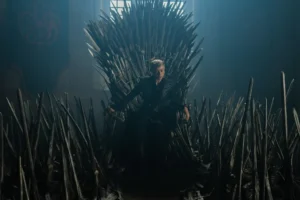
When Rhaenyra sits the Iron Throne in Fire & Blood, it cuts her arms and legs. This is pretty long-standing symbolism in A Song of Ice and Fire, since it’s repeatedly implied that the throne itself — which is literally made of swords — can reject unworthy monarchs.
There’s plenty of precedent for this. King Viserys was basically maimed by the thing, Maegor the Cruel was ostensibly killed by it directly, the Mad King caught the brunt, and Joffrey didn’t fare too well either. Rhaenyra being cut was deemed an ill omen by Septon Eustace, whose writings and testimony are used as one of the primary sources of Archmaester Gyldayn, the fictional writer behind Fire & Blood, Being a History of the Targaryen Kings of Westeros, the in-universe name for Fire & Blood.
Since Fire & Blood is presented as a historical text and collates various primary and secondary sources that are often contradictory, one of its core ideas is that anything it says happened may have happened in two or three different possible ways, or indeed not at all. It’s also inherently subject to biases, one of which is a predisposition to omens, and another is garden-variety misogyny (the key obstacle to Rhaenyra’s initial ascension, despite King Viserys I having explicitly named her his heir, is Westeros’s deeply ingrained predisposition to male-preference primogeniture.)
Grief Is Omen Enough
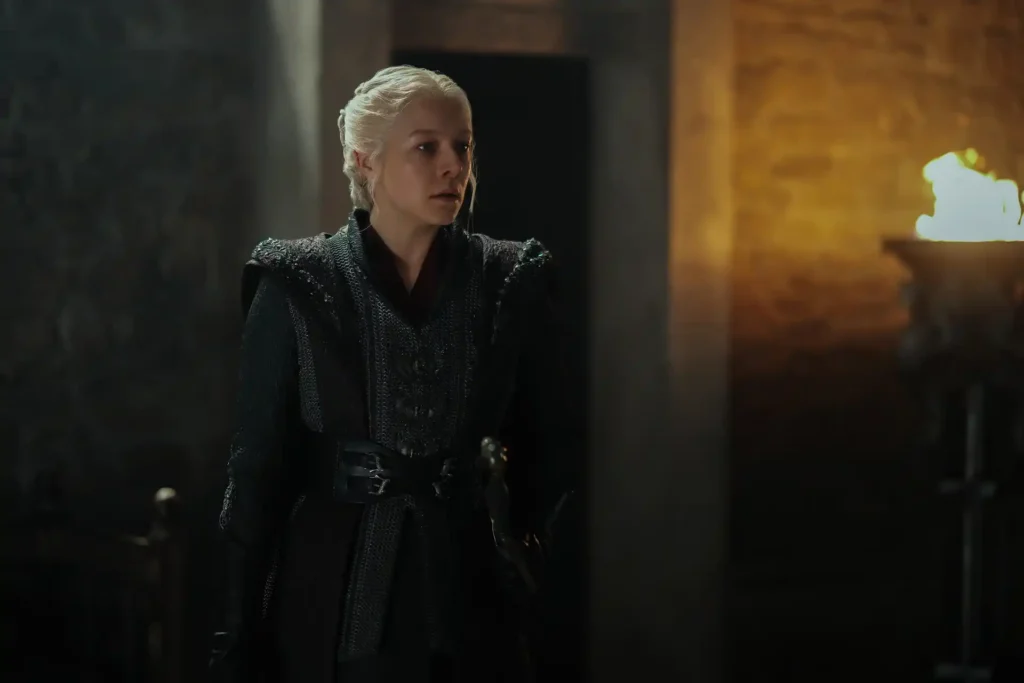
In “Queen’s Landing”, Rhaenyra isn’t cut by the Iron Throne. The HBO adaptation rejects the omen-heavy telling and instead implies the same things about Rhaenyra’s coming rule by honing in on her grief, her lack of regal traits, and the unsure circumstances in which she secured the throne. Emma D’Arcy is extremely impressive in this episode, often wordlessly, and her coronation becomes an extension of her profound grief over the loss of Jace and her lingering anger and resentment over the circumstances of her exile to Dragonstone in the first place.
Jace represents the biggest deal. His death in the premiere, which was totally avoidable, was the latest in a long line of losses for Rhaenyra, and her reaction to it was so visceral that she spent the remainder of Episode 2 in something resembling a trance, only spurred into action by Daemon whispering to her about prophecy. She is visibly haunted by what she has lost and what she has been forced to do in order to claim the throne that should have been hers by right, and it’s this internal conflict that is written on her face when she takes the throne.
The Execution of Otto Hightower
In both Fire & Blood and House of the Dragon, Otto Hightower doesn’t survive Rhaenyra’s coronation. Here, though, he is beheaded by Rhaenyra personally, with some urging from Daemon, which is a much more literal depiction of her unsuitability to dynastic rule. It takes her two messy swings to separate his head from his body, and she’s tearful and timid the entire time.
The implication is clear. Unlike Daemon, who lops off Jasper Wylde’s head without a second thought, Rhaenyra can’t cavalierly kill everyone who opposes her. She’s much more no-nonsense in the book, demanding that everyone in the Red Keep kneel and swear fealty to her, so that bluster has to be tempered by subtler implications that she isn’t fit to rule. Here, the last-minute arrival of the City Watch, even though it was arranged by Alicent rather than Rhaenyra herself, is the only reason that she and Daemon aren’t struck down by the Kingsguard, and that tenuous feeling persists throughout the entire coronation.
Anyone familiar with the source material already knows the Iron Throne isn’t kind to Rhaenyra, either literally or figuratively, but this scene makes it clear to even those only familiar with the show that her days are numbered. And it does so in a way that emphasises human emotion, ongoing character development, and Emma D’Arcy’s superb performance, playing up the advantages of a narrative screen adaptation over a comparatively dry history text. It’s as good an argument in favour of House of the Dragon being a better version of this story than Fire & Blood as any.
RELATED: