

Following its record-breaking two weeks, the reaction to Agent Kim Reactivated has largely been very positive. However, what seems to be a translation error almost landed the show in hot water among fans who assumed that either it or Netflix was taking an explicit stance in the long-running Israel-Palestine conflict. Such things tend not to be brilliant for marketing purposes, for obvious reasons.
In its first two episodes, while hinting at the backstory of the titular Manager Kim, the show made mention of the operative’s work infiltrating North Korea at the behest of South Korean intelligence, reeling off some successful operations, including, apparently, “three airstrike operations against Palestine”. Here’s the screenshot that was shared on Reddit:
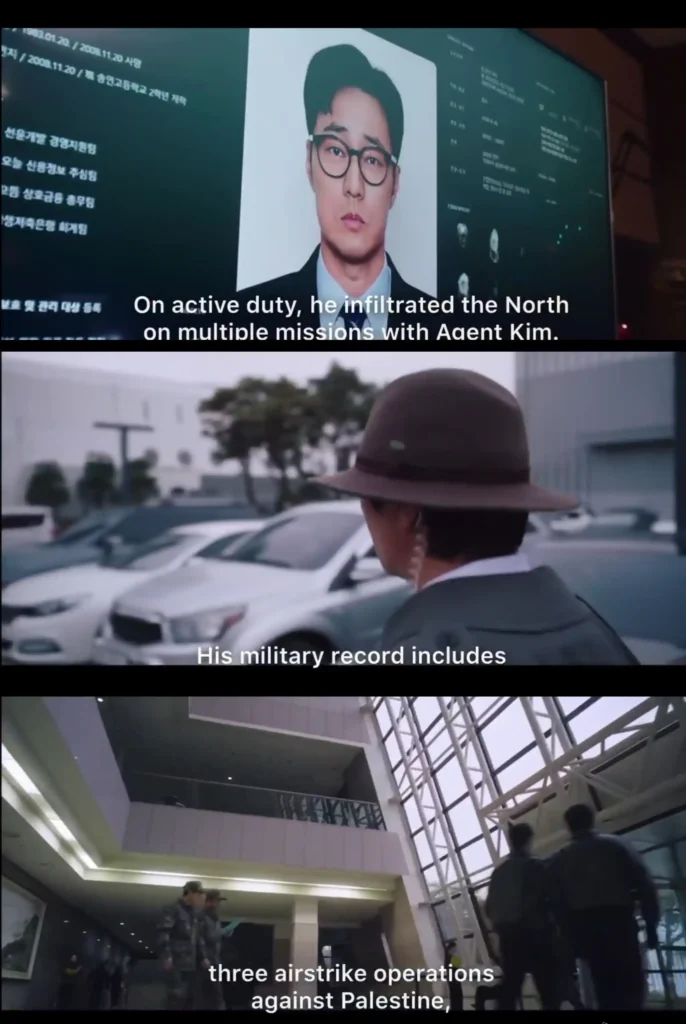
A medley of screenshots taken from Agent Kim Reactivated | Image via Reddit
It’s a curiously specific line, and many fans immediately expressed consternation about why the show would bother to specify a nation, especially given the political tensions and ongoing genocide. A more generic placeholder, like the Middle East, could have easily been used to avoid this problem.
Comment
by
u/Abysmal-Sleep from discussionin
kdramas
This point about relevance is an important one. The point of the story here is that Manager Kim is a former North Korean defector who was recruited by the South to reinfiltrate the North as an elite undercover agent. The point of this scene is to explain his backstory and build intrigue around his abilities. In the present day, his daughter, Min-ji, has been kidnapped, and Manager Kim is on the hunt for her while being pursued by the intelligence services. What’s important is his history and his skill set. The specifics of his previous missions don’t have anything to do with anything.
This dialogue exchange isn’t even about Manager Kim, to be fair, but his former agent colleague Jin-cheol, with whom he properly teams up — along with a third ahjussi associate, Han-su — in the third episode, to help out in Min-ji’s rescue efforts. However, the point still stands, since the purpose of the dialogue is the same.
Specifying the nation in this way, needlessly, is a big part of why what seems to be a translation error ended up raising some red flags. The pointlessness of the reference reiterated the idea that it was deliberate.
In truth, the whole thing seems to be a mistake. Eagle-eyed fans have analysed the lines in the original Korean and in various translated versions, and it seems like the original line used a neutral word like “intervened/intervention”, which could be interpreted either way. Most of the translations added more specificity to the line, changing the word to “prevented”. However, in the screenshot above, you can clearly see the words “against Palestine”.
Given the neutral starting point and the commonality of pro-Palestine sentiment in other translations, it does seem like the anti-Palestine stance was the error. However, this issue raises serious concerns about the potential ramifications of lazy translation practices, including subtitles and dubbing, when it comes to communicating points about serious partisan issues and real-life geopolitical crises. This is flavour text, intended to create an impression about the main characters in an action-thriller, but inadvertently, it almost became a political lightning rod about a very real conflict.
Given how easy it is for a mistranslation to change the context and intended meaning of a throwaway line, which can cast aspersions about the political leanings of an entire script, it’s worthwhile drawing attention to these things to illustrate just how important these matters can be. Perhaps next time, “the Middle East” will suffice just fine.