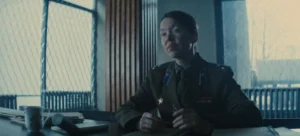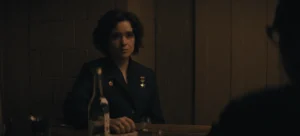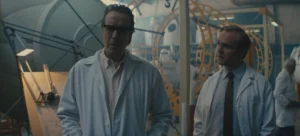

This isn’t an especially daring position given quite how badly For All Mankind jumped the shark in later seasons, but I genuinely believe that Star City is the superior show. More to the point, it’s superior sci-fi, exchanging the former’s glossy idealism for a more engaging and devolved tone. It isn’t a nationalist propaganda piece but a sobering acknowledgement that the ruthlessly efficient communism depicted in FAM was really a paranoid house of cards. It fundamentally changes the texture of the entire universe, in my view for the better.
It does this in myriad ways, too. It scales back the tech, ramps up the backstabbing politics, and recasts familiar moments and figures in a new light, one that isn’t always favourable but feels more real and dangerous. This is exactly the kind of thing a spin-off should be doing, in my book, and it’s a big part of why Star City has gone from strength to strength throughout Season 1, even if it doesn’t seem to be earning the same kind of attention as its parent show did.
The Analog Approach
The tech is a big part of things. While For All Mankind loved a glossy, pristine, almost sterile approach, Star City has a more analog feel, as if the entire Soviet Union is held together with duct tape and rusty screws.
This makes even Russia’s successes feel perilous. And, to be fair, a lot of them are perilous, but they’re rewritten as successes anyway, which we’ll get to. But it’s a deliberate aesthetic choice to have functional, brutalist engineering win the day for the Soviets, creating a stark contrast to their more performative American counterparts.
This is contrary, too, to the idea of the Soviet Union as a ruthlessly efficient and technologically advanced superpower. Seeing what it took and what it cost to get people on the moon, to construct a lunar base, to man a mission to Venus, and to get the Salyut-1 in the air massively recontexualises the Russian perspective as depicted in For All Mankind.
Victory, But At What Cost?
Pulling back the curtain, iron or otherwise, reveals the truth of Russia’s successes and how far they’d go for victory, throwing their own people to the wolves at the slightest provocation if it meant getting even a little bit ahead. This is expected of the rank and file, who can be rehomed in a gulag for reading the wrong books or listening to the wrong music, but it applies equally to all – even the higher-ups.
You can see this in the arcs of Lyudmilla and the Chief Designer, especially in Episode 7, which plays out in the aftermath of the Venera 7 having been destroyed to cover up the presence of an American double agent on board. Lyudmilla is being forced out by the new Chief Designer, Radimir Petrovsky, while the old Chief Designer is on house arrest, having been disgraced for attempting to further the nation’s space program and not simply build stolen blueprints faster than the West.
This stands in stark contrast to the happy-clappy depiction of NASA as a treasured and egalitarian U.S. institution. The Soviet Union didn’t care about progress; it only cared about winning at all costs and was willing to control science through the infrastructure of the KGB and the wider state to do it.
Optimism Versus Reality
At its core, For All Mankind is – or, at least, was – a fundamentally optimistic sci-fi show. It was possessed of a romantic idea of the Space Race and depicted the Americans, largely, as wildly progressive and influential in seismic cultural shifts. Star City is much harsher and much more real as a result, rebranding the Space Race as a Cold War spy thriller in which a minor engineering fault could land whoever was responsible in a Siberian prison.
This approach also applies to existing characters, such as the Chief Designer, Irina Morozova, and Sergei Nikulov. Their younger portrayals in the harsh cauldron of Soviet political paranoia help to set up their future character arcs and retroactively explore how they became the people they grew into. It even builds up the backstory of figures like the Governor of Mars, Leonid “Lenya” Polivanov, by introducing his parents – we’re guessing; Star City hasn’t confirmed this yet, but it very well might in its finale – and the very specific circumstances that led to his own conception.
The colder, more calculating approach is, I think, what makes Star City the superior show, but it also makes For All Mankind a more interesting and textured one, too. That’s some achievement and well worth the investment in a spin-off that many people assumed we probably didn’t need to see.