Summary
Backrooms has some genuinely creepy scenes and images, and the premise is compelling, but there’s barely any movie here.
Backrooms is one of those great ideas for a movie that doesn’t work as a fully-fledged feature. It’s an ideal horror concept, granted, which is probably how it grew from a Creepypasta to a found-footage web series by Kane Parsons, who returns to direct this studio-backed expansion of the premise, enthusiastically endorsed with a seal of quality by A24. The only problem is that they forgot to bring a movie along. The premise is all there is, and the more it’s contorted and elongated, the more obvious it becomes that the core of its appeal – that nobody quite understands how liminal spaces work – is something of an obstacle when it comes to hanging a narrative from it.
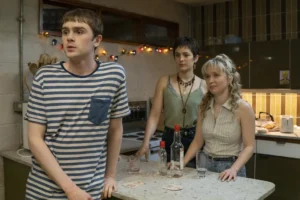
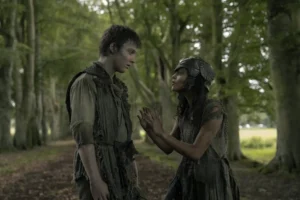
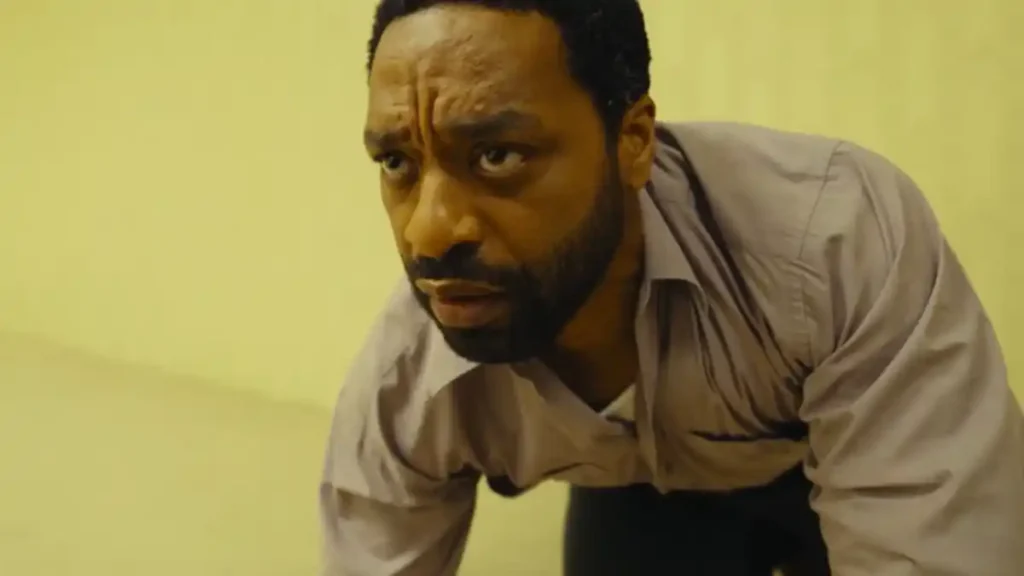
Initially, the movie presents the bones of a proper story. After a creepy cold open harkening back to the handheld found-footage style of the web series – a technique returned to later, to solid effect – we meet Clark (Chiwetel Ejiofor, The Old Guard 2), the heavy-drinking manager of a furniture store who is still smarting from his wife walking out on him, for reasons that become quite obvious. Clark only ever interacts with three people – his therapist, Dr. Mary Cline (Renate Reinsve, Presumed Innocent), and his employees, Bobby (Finn Bennett, A Knight of the Seven Kingdoms) and Kat (Lukita Maxwell, Shrinking).
Clark works at – and lives in! – a giant store that could only be a set in a movie. It’s creepy to begin with and only becomes more so when he discovers a hidden room behind one of the sub-basement walls that expands into various nested versions of itself, seemingly on a never-ending loop. The rooms are deliberately off-kilter, adorned with everyday items hanging upside-down, or with tiny doors in distant corners atop steep slopes. Initially, they look like sparse, yellow-walled office spaces, but they begin to resemble more familiar, put-together locations as Clark digs deeper: eerie simulacrums of the store itself, of old kitchens and living rooms, or basements thick with damp laundry.
The rooms also seem to be patrolled by some unspecified entity, but the less said about that, the better, mostly because I couldn’t really explain it if I tried (nor, it becomes clear, can the movie). The first half of the 110-minute runtime is superior to the latter by a significant margin because it’s all about building atmosphere and embracing the unknown. Clark gradually tries to figure things out and realises that he can’t, which brings us to the point where the screenplay – by Parsons and Will Soodik – should start drip-feeding some explanations. But it never does. Instead, it goes broader, delivering more elaborate production design and in-your-face “scares”, but it becomes sillier all the while, and eventually gets frustratingly confounding when you realise it isn’t going to tell you anything about what’s going on.
This is, I think, a problem baked into the premise of Backrooms. The thing about a short is that it can be all build-up and teasing without any payoff without anybody minding, but a feature doesn’t have that luxury. If you get an hour of build-up, you expect a return on that investment, especially if you’ve paid for a ticket or to rent the movie, and when you’re only provided with more uncanny hints, it eventually becomes a bit frustratingly galling.
I’m sure the appropriate lore is out there somehow, but it shouldn’t be my job to find it. The characters are similarly neglected, with some hints of personal traumas to be found, mostly in the layout of the backrooms they find themselves in, but it’s all very cursory stuff that says little about the real origins of the place or the purpose of the plot. Mark Duplass (The Morning Show) turns up towards the end just to basically throw his hands up and say, “I don’t get any of it either”. It’s wildly unsatisfying.
To be charitable, there’s some compelling stuff here, namely a few well-directed set-pieces and a handful of eerie images. I’d even say that most of the problems with the movie aren’t really the fault of Parsons, who seems to have a good grasp of visual storytelling and can direct an actor (Ejiofor is surprisingly great in this). But if we’re to compare the first really visible releases of YouTubers-turned-filmmakers, Curry Barker’s Obsession blows this out of the water.