
Summary
Mercy is novel and engaging enough to be an entertaining ride, despite a silly third act and a surprisingly optimistic vision of AI.
AI is the villain of our times, the contemporary equivalent of zombies and Nazis when it comes to low-effort, morally uncomplicated bad guys who can slot into any kind of movie and fulfil antagonistic duties. The notable thing about Mercy isn’t that it’s surprisingly gripping despite looking and sounding very stupid; it’s that it actually, for once, has an optimistic view of AI’s potential as a reasonable ally for humanity, and a useful tool for upholding law and order.
Ironically, it’s probably a bit too pro-AI for my tastes, to an extent that it undermines an off-the-rails third act and turns what was until that point a fresh, lightly terrifying movie into a kind of unconventional buddy-cop actioner. But everything preceding the decline is an effectively taut real-time “screenlife” thriller, a clever and innovative take on the “falsely accused innocent man” subgenre from interestingly flawed filmmaker Timur Bekmambetov.
It’s the near-future again, and in the lawless L.A. of 2029, the authorities have turned to the Mercy Capital Court, a fully automated AI-powered judicial system that tries and invariably convicts suspects within 90 minutes by combing through the “Municipal Cloud”, a vast compendium of interconnected data streams – phones, social media, CCTV feeds, body cams, and so on, and so forth – to put the pieces together. One of the strongest proponents of the Mercy Court is LAPD detective Chris Raven (Chris Pratt, The Terminal List: Dark Wolf), but the hook of the movie is that he wakes up to find himself on trial, charged with the murder of his wife, Nicole (Annabelle Wallis, Vanished into the Night).
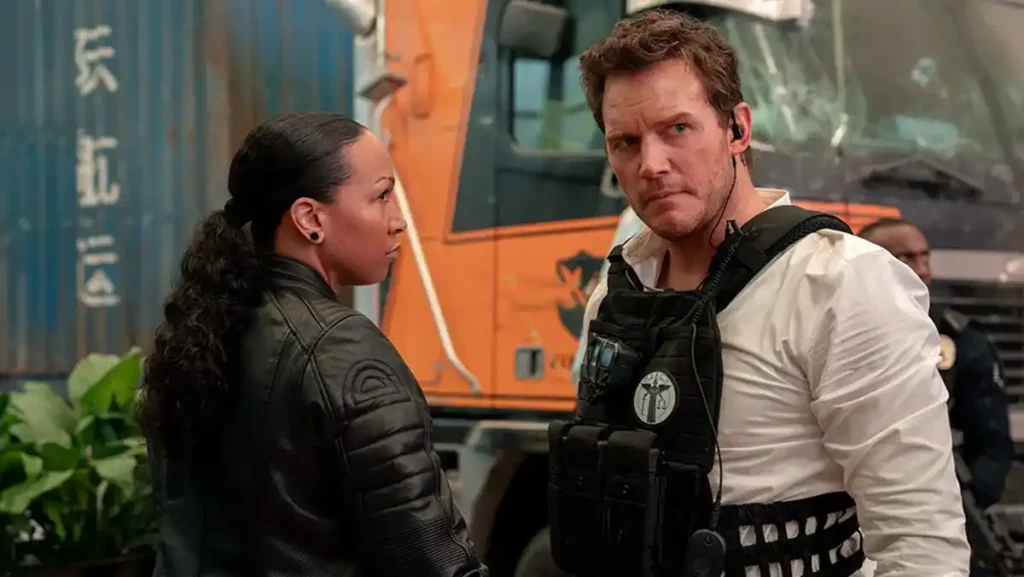
What follows is a real-time thriller in which Chris, an experienced and clearly capable detective, has to sift through the most uncomfortable secrets of himself and his family. Problematically, he’s a “recovering” alcoholic who has spent months lying to his wife about his sobriety; in the hours before her death, he was wasted, got in a violent bar brawl, and blacked out, meaning that he can’t recall whether he personally killed his wife or not. The evidence seems to suggest that he did, but that’s part of the fun. By combing through heaps of private messages, doorbell clips, drone footage, stylised crime scenes, and more, all shot in varying styles to counterbalance the relatively flat and static dynamic between Chris and Judge Maddox, he’s able to figure things out with help from his weepy teenage daughter, Britt (Kylie Rogers, Yellowstone), his LAPD partner, Jaq (Kali Reis, True Detective), and his AA sponsor, Rob (Chris Sullivan, Marvel’s What If…?).
You’d be surprised how engaging all this is. I fully expected to find Mercy ridiculous, and while I eventually did thanks to a wildly over-the-top third act that seems to break several of its own internal rules, most of the runtime is very good and effectively novel. Pratt is a little miscast, since he’s mostly called upon to emote, which isn’t his forte at the best of times, but Marco van Belle’s screenplay raises a bunch of interesting questions about privacy and automation and technology before it veers off the rails, and Ferguson, despite being bound by the same limitations as Pratt, turns in an effective performance as an emotionless program who begins to realise that human beings – and indeed the law that governs them – are a bit more complex than the sum of their social media accounts.
A weak, somewhat silly ending notwithstanding, this is a surprisingly crowd-pleasing and thrilling flick, and if the future we have to worry about is being sternly told off by Rebecca Ferguson, then I’m feeling pretty optimistic about where things are going.