Summary
The Idaho Murders: College Nightmare is meticulously arranged and impressively detailed, but its most striking feature is its abundance of humanity for both the victims and their surviving families.
For once, Netflix is pretty late to the party when it comes to covering the 2022 quadruple murder of four college students in Moscow, Idaho. Prime Video already did a good job of it in One Night in Idaho: The College Murders, which is tonally and stylistically similar to The Idaho Murders: College Nightmare, so the whole thing risks feeling old hat in true-crime terms. It certainly doesn’t help that Netflix’s usual formula of talking heads, archival footage, and on-screen embellishments to help communicate case information quickly and clearly are very much present and correct here, meaning that the three-part series, executive produced by Joe Berlinger and directed by Skye Borgman, feels like any number of other similar documentaries on the platform.
Or, at least, it would. A couple of things work in its favour, namely the sheer horror of the case, and the grounding of perspective in the surviving families and friends of those lost. Eschewing the more sensationalistic route gives The Idaho Murders a respectful contour, almost like a group-therapy session, working to provide some semblance of closure by working through the key details guided by the natural progression of the case.
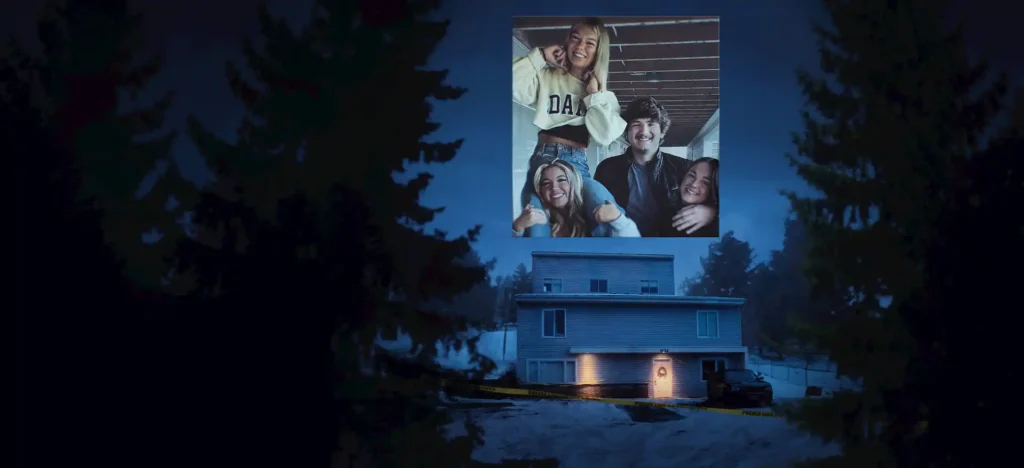
You’ll probably remember the case, of course. At 4 am on November 13, 2022, University of Idaho students Madison Mogen, Kaylee Goncalves, Ethan Chapin, and Xana Kernodle were fatally stabbed in their off-campus home on King Road. Discovered by their surviving roommates, Dylan Mortensen and Bethany Funke, all four were pronounced dead at the scene, and what followed was a glacially slow investigation contorted by social media interference and slanted coverage, making an already painful tragedy a giant mess. With true-crime at the forefront of the public consciousness, various streamers – including, most notably, Paramount+’s #CyberSleuths: The Idaho Murders, which attempted to unpack the TikTok virality of the case while it was still ongoing – felt like they were racing to gawp at a very fresh tragedy.
On this level, at least, Netflix were perhaps right to wait. Eventually, the investigation led to 28-year-old Washington State University PhD student Bryan Kohberger, who pleaded guilty in 2025 (and is now looking to reverse his plea). The long run-up has allowed Netflix to present the case in its totality, with the most credible primary sources and an insightful degree of access to family, friends, law enforcement, and official materials. It is unambiguously the most detailed, meticulously assembled account of the crime and subsequent investigation. It is also, more importantly, the one that paints the clearest portrait of the victims, digging into their personalities and lives through the perspectives of those closest to them.
With Kohberger having been convicted, The Idaho Murders: College Nightmare is afforded the space to be a tribute to the victims and an almost explanatory presentation of a difficult investigation. There’s no mystery to play up in the hopes of securing social media virality of the kind that emerged in the immediate aftermath of the crime. It’s at once both a robust procedural accounting and a deeply personal, fond recollection of lives now lost that were nonetheless once full of love and laughter. That balance is difficult to strike, but Borgman achieves it consistently.
It’s a shame, really, that this series is debuting among thumbnails so stuffed with shows so much like it. Its similarity to what came before hurts the investigatory component, which feels reiterative given how much and how widely the case was publicised, and on the back of that people are likely to miss how sensitively it’s handled and how adroitly it functions not just as an outline of the case but a memorial of sorts for its victims. It’s confident, robust documentary filmmaking with a real sense of humanity at its core, and deserves to rise to the top of a genre so often obsessed with being first over being sensitive.