Of all the ways I thought that Louis Leterrier’s Shyamalan-adjacent Netflix thriller The Last House might end, I certainly didn’t predict what ultimately happens. Granted, that’s because what happened doesn’t make any sense, but let’s not get bogged down in the details. The movie, an answer to the unasked question of what might happen if H.P. Lovecraft played Mouse Trap during a Covid lockdown, has all kinds of things going on that are worthy of some speculation, but its ending is particularly dopey, so we’re going to have to break it down to the fullest possible extent.
Allow me to walk – swim, maybe? – you through two hours of fraught pet-eating survivalism, and maybe by the end we’ll be able to answer the question of what on earth happened, even if not necessarily why.
The Gist of It
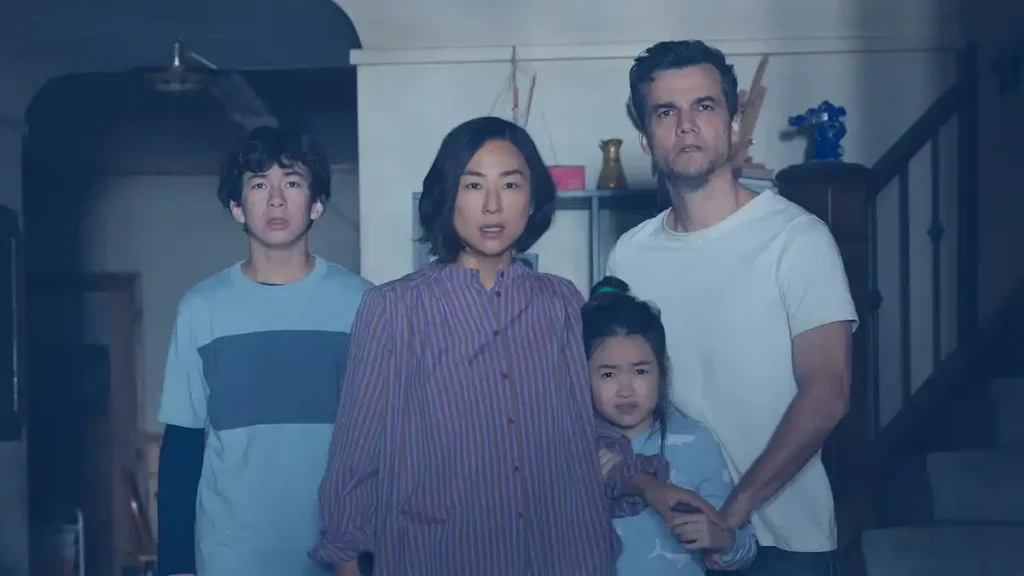
The hook of The Last House is that a Seattle family – comprising husband and wife Jason and Ann, and their two children Ruth and Graham – suddenly find themselves sealed in their suburban home thanks to a magical torrential downpour. The same fate befalls their entire neighbourhood and, it’s gradually revealed, the entire world.
The family is forced to survive using only their wits and dwindling supplies. Jason, an engineer, manages to knock together some MacGyver-style contraptions to “chimney fish”, which is to say drag animals from outside down through a crack in the chimney so that he can wring their necks and put them on the stove. This is after Jason shot the family Golden Retriever, Cassidy, and put his hacked-up remains in the freezer to keep everyone going at mealtimes, a reality tactically kept from the children. Ann, meanwhile, grows vegetables in the living room.
This goes on for five years, most of it elapsing off-screen. During that time, all the neighbours stop appearing at the windows, so the Delgado family becomes – all together now – the last house with living occupants, making them a target of the… well, we’ll get to that in more depth below.
Cthulhu?!
There’s a very watery subtext to The Last House, so it shouldn’t come as a great surprise when the “bad guys” turn out to be giant tentacled sea-monsters who, it’s later implied, were probably already lurking in the 80% of the ocean that remains unexplored. This kind of explains why they only come out during rainfall, but it doesn’t even begin to explain how they can make rainfall happen all the time, or indeed how the water becomes sentient at their behest, locking doors and windows with damp tendrils.
Ruth, the daughter, is adamant that the monsters “seem nice”, which becomes a plot point later, but there’s no evidence to support the claim. They snatch anyone caught outside, and are perfectly happy to starve human occupants in their homes until the properties eventually become flooded with seawater. In every instance we see the creatures, aside from one moment where one looks a bit pensively through Ruth’s window, they’re actively hostile. Just keep this in mind as we go.
Ruth’s point of view is that because the creatures come from the ocean and didn’t beam in from another dimension or crash-land from outer-space, this is technically their home, and they’re pretty much entitled to flood all the land and kill all the humans on this basis. It’s one of the least coherent theses for a movie I can recall in recent memory, an environmentalism metaphor wrapped up in a creature feature that turns into Home Alone at the end.
An Act of Mercy
The Delgado family eventually decides that enough is enough and attempts to ensnare one of the creatures through an extremely elaborate system of booby-traps and homemade devices, with a mind to threatening or torturing it into opening the front door. This is all occurring while the house is literally flooding as the foundations, weakened by years of constant rain, sink into a giant widening crater dropping directly into the ocean.
However, in an extremely braindead moment, Ruth implores Jason not to harm the creature, and because he decides not to stab it in the eye, it lets everyone go and instructs its buddies outside not to kill them either. At this point, for no reason that I can fathom, the monsters all decide to retreat into the ocean. The sun comes out; whatever unexplained mischief the monstrosities were up to simply ceases. This one act of mercy was apparently enough to make them rethink their entire five-year mission.
Now not under any duress, the Delgado family steal the rotting boat of an equally rotting neighbour and rename it from “Seas the Day” – a legitimately enjoyable pun they should have kept – to “Cassidy”, the name of the dog they killed and ate. They set out on the open seas, genuinely pleased with themselves, with adult Ruth’s narration reminding us that the creatures are entitled to their home here too. The same title cards that marked the passage of time throughout the movie declare that this is “Day 1” of a new life for everyone.
You’ll have noticed that nothing was explained and nothing could hold up to even the slightest amount of scrutiny. Thanks to the script not really bothering to make any effort in this regard, there aren’t even implications that we can use to infer what was really going on. There’s simply… nothing, an open expanse of changeless water with all the more interesting stuff lurking way underneath. At least it functions as a metaphor for that, if nothing else.