Summary
The Last House squanders a compelling premise on unsatisfying reveals and a messy third act. There’s water to spare, but the whole thing’s disappointingly shallow.
At once both a doomsday prepper’s wet dream and a horror movie about the potential ramifications of separating your children from their devices for too long, The Last House is one of those movies with a great high-concept premise that never manages to follow through on it with anything meaningful. It’s one of those classic Netflix offerings that will keep you rooted to the couch for an hour or so, but you ultimately won’t bother to pause when you go to pull your dinner from the oven. And animal lovers needn’t apply; just take my word for that.
Shot in the UK but set in suburban Seattle, the movie, directed by Louis Leterrier (Fast X, Lupin), might function as a post-pandemic metaphor playing up our fear of isolation and gradual resource degradation, but that’s probably giving it too much credit. It’s more about what happens to the family unit under extreme emotional and situational duress, helped along by the fact that none of the family is especially likeable and you’ll want all of them to die. Even that facile, slasher-like pleasure takes ages to arrive, though, since so much of the movie, especially in its early-going, is about mystery-building and survivalist logistics, so you’ll have to wait for a sloppy third act for the real peril.
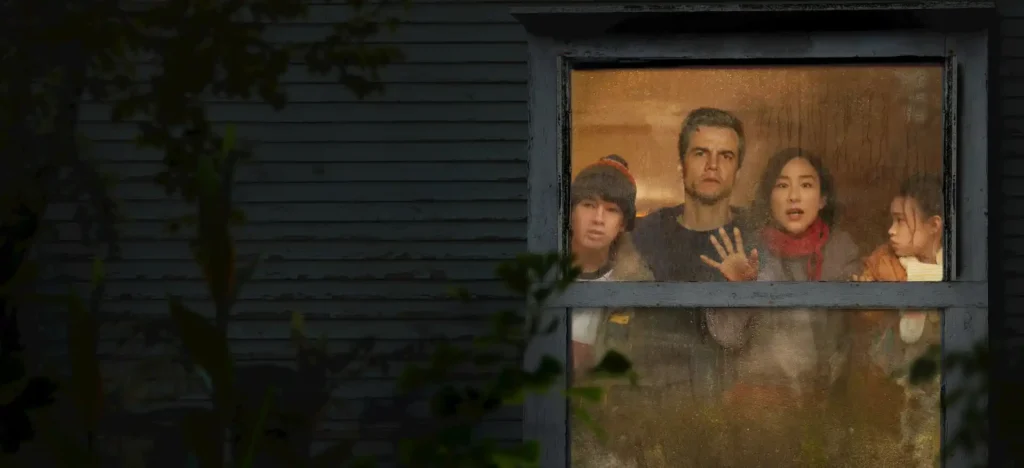
But we’re getting ahead of ourselves. The admittedly arresting premise finds Jason (Oscar-nominated Wagner Moura, Star Wars: Maul — Shadow Lord), his wife, Ann (Greta Lee, Toy Story 5, The Morning Show), and their children Graham (Noah Alexander Sosnowski; Gabriel Barbosa) and Ruth (Riley Chung; Emma Ho), trapped within the walls of their everyday home after a torrential downpour creates a mysterious, inescapable boundary around the property. The doors and windows can’t be opened. Power could go out at any moment. Food supplies are scarce. And whatever has caused this soggy scenario seems to be lurking outside, perhaps considering making its way in.
In the early going, the horrors are relatable. Imagine your only form of entertainment being your dusty DVD collection. Imagine trying to convince the kids to eat their vegetables when vegetables are the only things to eat. There’s a fairly arresting grimness to all this, too, despite the lighter moments of togetherness that define these portions. One minute you’re trying to explain how Santa can still get up and down the chimney, and the next you’re trying to explain why the kindly old couple across the street aren’t coming to the window anymore.
The longer all this goes on – days transition to months and years, with the production design shifting to emphasise the passage of time – the more intriguing the movie’s strain of maker-nerd energy becomes. Jason is an engineer, so he keeps MacGyvering solutions to the food problem, the highlight being utilising a crack in the chimney to create a sort of pulley-based fishing system. Ann, meanwhile, reuses food waste to create sustainable vegetation. At some point, though, you realise that there’s nowhere else for this premise to go without opening the door – quite literally – to much sillier ideas, namely “spooky” villains that look like they wandered off the set of a Pirates of the Caribbean movie.
The Last House wants to be taken much more seriously than it ends up being. You can tell, because every time it wants to create the impression of grown-up trauma, it kills an animal, which feels a bit cheap after a while, and will certainly put a section of its potential audience off. But it also wants to have an all-action third act that turns into a chimeric fusion of Home Alone, The Shape of Water, and the board game Mouse Trap, which isn’t a sentence I ever thought I’d write. Character arcs – particularly one of the kids’ – are basically abandoned when it would have been more interesting to see them through to a darker conclusion, and the script – from Matthew Robinson, who wrote Love and Monsters – is sometimes so po-faced that it becomes actively silly.
There’s just little to recommend here. The creature design is woefully uninteresting, the orchestration of the big climactic set-piece is confusing, the emotional payoff makes less than no sense, and even the performances are inconsistent. Moura is game, but the kids are very average, and even Greta Lee succumbs to trying to elevate a thin character by playing her way over the top. People will watch it in droves because it’s compelling on its face, but it ends up being disappointingly – and ironically – shallow.