
Summary
Even by Harlan Coben’s usual ridiculous standards, Lazarus is illogically plotted and paced, too repetitive by half, and ultimately disappointing even as a brain-dead binge.
The work of Harlan Coben is perfectly suited to our current era of relentless home entertainment, where audiences swallow stories wholesale and barely have time to digest them before they’re tucking into a second course. This is perhaps just as well for Coben’s TV career, since everything he’s responsible for – we’re ten adaptations deep into a multi-year, multimillion-dollar Netflix deal – is designed to be consumed in this feverish, thoughtless way, in the hopes that his ridiculous thrillers somehow pass by without scrutiny. Lazarus, his Prime Video original conceived from scratch with writer Danny Brocklehurst, is this tendency taken to an almost perverse extreme.
Brocklehurst collaborated with Coben on stuff like Safe, The Stranger, and Fool Me Once, the latter two both starring Richard Armitage, whose work with Netflix – including my all-time favourite, Obsession, in which he tries to have sex with a bed – is chosen as if his agent is pulling some kind of elaborate long-term prank. So, you might think you have the measure of Lazarus already, which, to be fair, you probably do. But it’s a cut above even those titles in the realms of ridiculousness it’s willing to plummet to, with every increasingly preposterous twist existing only to encourage a weary viewer to play the next episode, not to make any logical or dramatic sense.
The frustrating thing is that you will play the next episode. It’s impossible not to, in the same way people can’t help but crane their necks to assess the damage in multi-car pileups. In a show capable of just about anything, plot-wise, you have to find out what happens next. Trying to figure out whether Bill Nighy (The Beautiful Game, Role Play, The Man Who Fell to Earth) is a ghost is the tip of an iceberg, almost entirely submerged in an ocean of semi-supernatural nonsense, where psychiatric literature teleports, ghouls cross boundaries of space and time, skeletons are hidden in walls, and Sam Claflin (Me Before You, Daisy Jones and the Six, Book of Love) is having a breakdown.
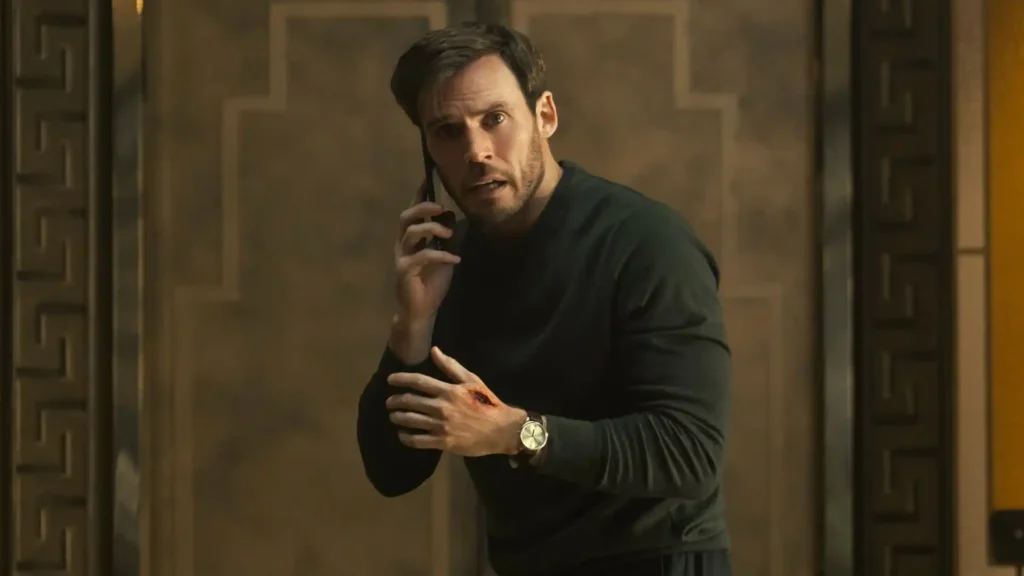
Claflin is playing, I kid you not, a man literally named Joel Lazarus. I was convinced it’d be some sort of nickname or code, but no, that’s what he’s actually called. “Laz” for short. Like his father, Dr. Jonathan Lazarus (Nighy), he’s a forensic psychiatrist, partly to follow in dad’s footsteps, but also because he discovered the murdered body of his sister, Sutton (Eloise Little), when he was younger and never got over it. Since Harlan Coben has never dreamed up a dead relative whose death he couldn’t theatrically tie into a present-day plot, when Jonathan suspiciously takes his own life, leaving behind a note that eerily reads, “It’s not over,” accompanied by a quick sketch of a three-legged stool, Laz begins to suspect that the two events might be connected.
This is the basic framework of Lazarus, but it’s not the hook. That arrives a bit later, when Laz, mooching around his father’s office, entertains one of his patients so frazzled by her issues with her partner, Neil, and an apparent stalker, that she doesn’t even notice Laz isn’t his dad. After unburdening herself, she leaves, and Laz subsequently discovers that she stopped seeing his father in 1999 and was murdered shortly thereafter. Huh?
There’s your hook, then – Laz can see ghosts connected to his father who give him clues leading to a series of interlinked cold cases, all ultimately looping back to Laz’s own unaddressed trauma. For Coben, this quasi-supernatural gimmick is pretty unusual, but it manifests as a lazy writer’s conceit whereby he can make his stories even knottier than usual without having to actually expend energy on sensible plotting. The ghosts are mostly used as delivery systems for either horror-adjacent shocks or information that the characters would have no other way of knowing, and it creates very circuitous pacing where Laz has to keep reconvening with the next spirit every time he hits a wall in the case. It runs for six episodes, all comfortably under an hour, but around the midpoint, it starts to feel like you’ve been watching Lazarus all your life.
In a sense, this is because you have. The basic dramatic principles are those shared by a thousand other thin thrillers that are, functionally, a series of cliffhangers threaded together by whatever contrivances will get us from one to the next. The show’s more corporeal elements attempt to play by the same loose rules as the ghostly shenanigans, to often head-scratching effect, with Laz’s best friend Seth (David Fynn) just happening to be a police officer willing to flout the usual procedures to help Laz out because he fancies his surviving sister, Jenna (Alexandra Roach, No Offence). Everything and everyone is a means to an end. This is lab-grown storytelling in its most fake-feeling form, designed explicitly to keep you watching through morbid curiosity and confusion. At the very least, it doesn’t waste too much of your time.
RELATED: