Summary
Pluribus was already rivetingly original entertainment, but in “Pirate Lady,” it evolves into true can’t-miss TV of an extremely ambitious scope.
Even before its release, Pluribus was being hailed as proper event television, the kind of watercooler show we don’t get anymore from the man responsible for two of the very finest watercooler shows ever conceived. That level of hype is always a little suspect, especially when it’s based on nothing but name recognition, since so much of the show’s nature was kept tactically under wraps. The premiere was confounding, but great, as most people predicted it would be. But it’s in a much more expansive and ambitious Episode 2, titled “Pirate Lady”, that the show really flexes its muscles and evolves from impressively competent four-star mystery to unequivocally can’t-miss five-star brilliance.
You can tell from the beginning, which is weird, since the cold open is completely, deliberately inscrutable, nothing to do with anything we’ve seen thus far. But that’s the point. From the information we’ve already gleaned, we can figure out what’s happening, more or less. The hive mind is collecting all the dead bodies that have accumulated during the takeover – Taffy did warn the clean-up would be unpleasant – and unceremoniously loading them into buses. Most people would leave it there, the point having been proved; this bit being set in a Middle Eastern city, not in Albuquerque, proves the issue is global. Job done.
But Gilligan isn’t content with that, so he tracks our point-of-view character in this sequence into a plane, across to New Mexico, and through an identity change. He’s not only fleshing out the scale of the alien operation and establishing its oddly polite underpinnings, but also building an appropriate emissary for their point of view. She becomes an avatar through which plot info can be dispensed to the audience, and Carol can be folded more elegantly into the larger story. It isn’t very showy, but it’s such a lovely sequence of a kind you only get in shows that know exactly what they’re doing.
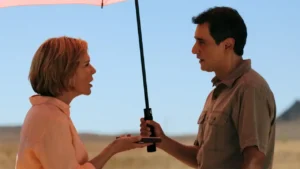
And it allows Pluribus to riffle through genres, too. There’s nothing funny about this opening, but by the time Zosia presents herself to Carol, who is digging a grave for Helen in her backyard, the tone is unmistakably comedic. There’s a funny bit where Zosia offers her a bottle of water and Carol upends the contents onto the grass. The awkwardness is all intentional. But it’s also underpinned by a burgeoning sense of horror that Carol and the audience are experiencing together. The more Zosia reveals, the harder it is to swallow, for Carol and us both. A lot of it still doesn’t make a great deal of sense yet, but the human terms are easy to grasp. Carol’s immunity doesn’t just make her resistant to the hive, but it also makes her, in a roundabout way, a mass murderer.
Carol wasn’t happy even at her peak, and was openly snooty about the people who read her books, but there’s a vast difference between judging someone’s literary taste and being responsible for their deaths. And she is responsible, since her own emotions, when unchecked, are what cause the infected to have their seizure spells, and what happens to one of them happens to them all. None of the deaths were intentional, apparently, but they happened anyway, to the tune of several hundreds of millions. It’s a tough pill for Carol to swallow – likewise for the audience, who are understandably grappling with the idea of the invaders’ apparent pacifism when Zosia has been chosen as an envoy purely because she looks like the character in Carol’s fantasy series, who was originally conceived as a woman. Since only Carol and Helen knew that, the aliens, whatever their claims to the contrary, clearly aren’t above using the harvested memories of the dead to manipulate their loved ones.

Karolina Wydra in Pluribus | Image via Apple TV+
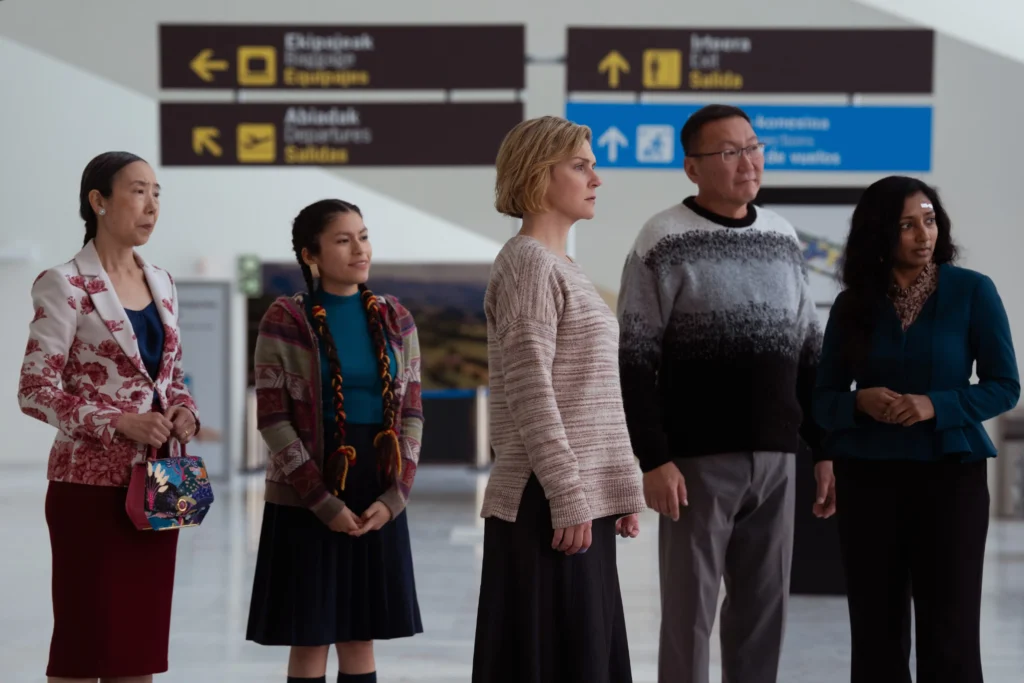
But despite being appalled by these ideas, Carol can’t resist finding out more about why she’s immune, and the other people who can also make that claim. Pluribus Episode 2 introduces several of the other lucky winners – a cosmopolitan grab-bag of international caricatures, all responding differently to their newfound circumstances – and spends a lot of time allowing them to simply converse. This, too, is explicitly comedic in its general vibe, at least, of course, until it isn’t.
Otgonbayer, Xiu Mei, Kusimayu, Laxmi, and Koumba Diabaté all represent different takes on the predicament. The latter, for instance, has realised that the aliens will provide him with pretty much anything that he wants and treat him like a king, so he’s making the most of that, which is perhaps why his viewpoint is leaning more towards the utopian side of things, citing the sudden irrelevance of skin colour and freedom of formerly captive animals as clear upsides. But that means giraffes eating the leaves from Xiu Mei’s tree, so it’s six of one and half a dozen of the other. But Carol still feels slightly apart. She’s the only one who seems to realise that the path to lifelong contentedness is littered with a lot of sacrifices that these people don’t seem to realise they have made. The millions of dead, for instance. The abandonment of personal freedoms. It certainly seems like the aliens – who we learn are called Celtiberians – are trying to use outlandish amenability to pamper the non-conformists into a different kind of submission. Carol sees through it.
But the most compelling aspect of the show thus far, at least for me, is how Carol being right is in itself a problem. She’s righteously furious about what’s happening, but her fury is contagious, and it kills people – of the 886,477,591 human casualties of the invasion thus far, Carol’s anger is responsible for about 11 million of them. She’s suddenly the most prolific mass murderer in history. But how can she simply be okay with the idea of submitting to the hive? The divide causes Carol to fall out with most of the English-speaking nonconformists, but every time a new disagreement emerges, more bad things happen.
Where Episode 2 of Pluribus ends is, I think, the most interesting juncture yet. Koumba has decided to take his newfound luxury lifestyle to the next level by ingratiating Zosia into the supermodel harem he now travels with, something which, apparently, he needs Carol’s permission to do. But it isn’t clear whether or not Zosia can consent to this; if she is forced to choose, there will doubtlessly be consequences. Carol would prefer not to engage with the idea, which in her mind boils down to Koumba wanting a sex doll and Zosia being happy to become one. But in the end, it becomes obvious that Zosia is having second thoughts. Carol might be able to break through the hivemind’s influence and expose the person underneath. But what that might look like is anyone’s guess. If nothing else, based on these first two episodes, it’ll be remarkable fun finding out.
RELATED: