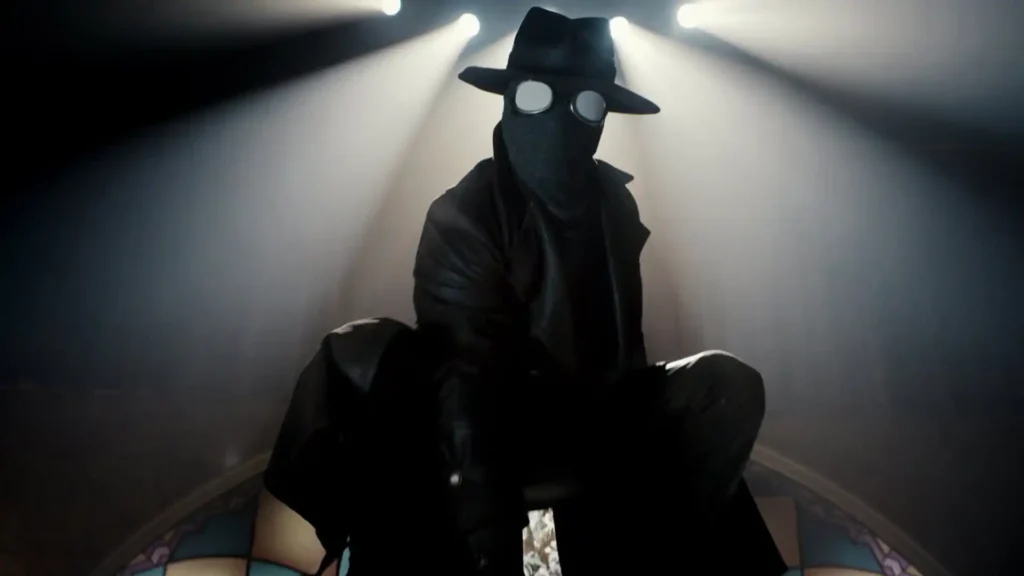
The obvious selling point of Spider-Noir is, unavoidably, Nicolas Cage. In his first proper TV role, he plays Ben Reilly, aka “The Spider”, a private eye in a version of 1930s New York built from old cliches and cast-offs from Hollywood film sets. The clue being in the title, noir films from the late ‘40s and ‘50s provide a lot of the aesthetic inspiration, so Prime Video and MGM+ have elected to stream two versions of the eight-episode first season, one in monochrome black-and-white, and the other in full technicolour. But which should you choose?
Needless to say, whichever. The choice is ultimately yours; you’re free to consume media however you please in the comfort of your own home, and it isn’t that big of a deal, since both versions of the show are functionally identical otherwise. But there is a “right” answer, in my estimation, or at the very least an answer that was clearly intended to be chosen by the vast majority of viewers. And that answer is undoubtedly the classic black and white.
I’m hesitant to be “that guy”, the kind of elitist snob who tells people how they should be enjoying themselves. Understand, then, that I’m making a point about Spider-Noir itself, not about the audience’s particular sensibilities. This is, fundamentally, a show designed to evoke the classics, stuff like Double Indemnity and The Big Heat. It’s full of fedoras and trench coats, cigar smoke and canes, glamorous cabaret clubs and steam curling from street vents. In terms of mood and tone, black and white just works.
But there’s more to it than that. Black and white and colour productions aren’t filmed the same way. Having access to a full palette changes the way shots are framed and scenes are lit. This is why a colour movie – or indeed a video game – presented in black and white looks like exactly that; it’s a nice novelty, but it’s an imitation of the original. The same is true in reverse. If you suddenly inject colour into a black-and-white production, a slightly off-kilter quality emerges. Something feels wrong.
There’s no doubt that Spider-Noir was shot with black-and-white in mind. It’s framed and lit just so, with the right mood being built through contrast and angles. Just like how Reilly sometimes uses the negatives of photographs he has taken as a bargaining chip, so too does the shadow in a composition tell just as much of a story as the light. It communicates feeling and, often, meaning. It helps with characterisation and tone. The intended experience is black-and-white, and, often, the intended experience is the one you’re better off having.
The show isn’t subtle about leading you in this direction. The marketing looks better in black-and-white, the opening credits are monochrome even if you opt for the colour version, and the fact that there’s even an option when colour is so standard itself builds allure around the more novel aesthetic. You’re being railroaded, which begs the question of why colour is even an option in the first place. You’d need someone else to tell you that, but it’s easy to imagine it’s simply a concession to avoid leaving stubborn viewers on the table (much like how great shows that would ordinarily do extremely well have trouble securing a foothold if they’re subtitled – Chief of War, I’m thinking of you).
At the very least, though, Spider-Noir has done its best to make the colour option distinct and compelling. You’re still losing a lot of dynamism, but you’re replacing it with a characterful, oversaturated look that helps to sell the innate discordance of a hard-boiled crime thriller having to veer into outright superhero territory occasionally. It’s sometimes difficult to even hear the word “superpowers” being spoken aloud in such a serious context; in a way, the inherent silliness of the Spider as a conception is easier to relate to in exaggerated, unreal-looking colour.
But that doesn’t mean that colour is a better option, just a viably different one. I’d still insist that black-and-white is the better choice, and I’m sure that Nicholas Cage’s Humphrey Bogart impression would likely agree. Fully committing to the bit helps Spider-Noir feel of the film noir genre, not just a nostalgic, gimmicky callback to it. The show’s visually distinct either way, which is more than most can claim, but ultimately for different reasons, not all of which work as well with the underlying artistic objectives.
As I said at the top, though, it’s ultimately your decision. Do whatever you like. But if you’re curious, maybe err on the side of black-and-white. Fully immerse yourself in the vibe the show is going for, and you’ll probably have a much better time overall. I did, anyway.