
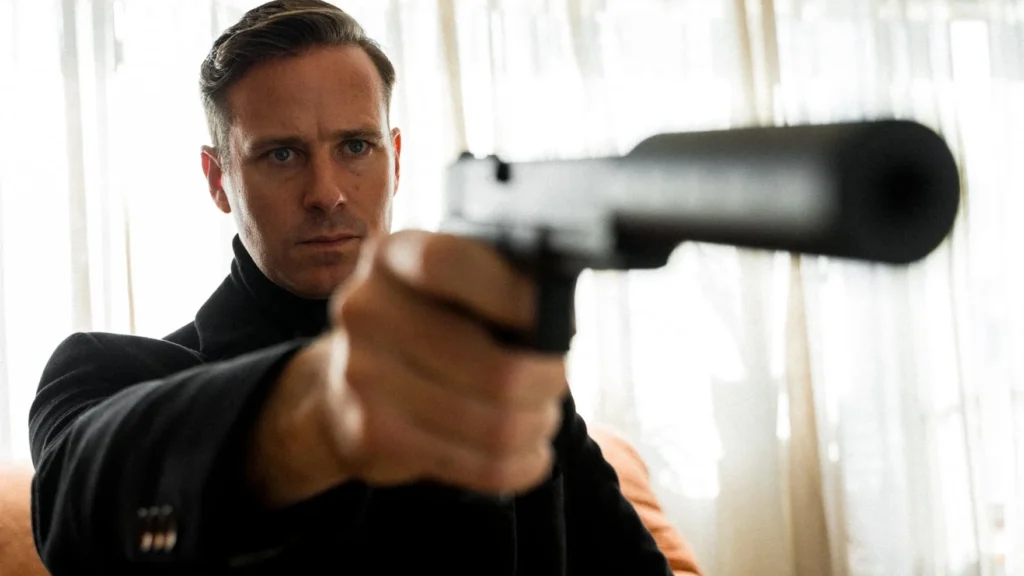
Citizen Vigilante was already high-profile long before its release, bringing back controversial actor Armie Hammer under the direction of notoriously provocative filmmaker Uwe Boll. While the film opened in the US and other territories in June 2026, German audiences will be unable to see it. However, it was not banned by a government decree; instead, the FSK (Germany’s film rating body) withheld an age rating entirely (“Kein Kennzeichen”), creating an effective legal distribution block.
To summarize the premise as simply as possible, the story follows a man who loses his wife to a violent crime committed by an immigrant. He subsequently goes on a social-media-fueled killing spree, targeting migrants and corrupt judges. The premise itself is disturbingly provocative; our own review on this site argued that the film is not only terrible, but dangerous. Other critics have similarly described it as a politically charged power fantasy.
So, how does this narrative context relate to Germany, and why did it lead to the film being blocked?
1. Germany’s Stance on Vigilantism
Firstly, Germany maintains a strict legal stance against vigilantism (Selbstjustiz – taking the law into your own hands) in media. The film depicts a protagonist who responds to a personal tragedy by launching a murderous spree that the narrative frames as a heroic, justified act.
2. Incitement and the “Immigrant Other”
Secondly, the film heavily flirts with incitement and the demonization of the “immigrant other.” Citizen Vigilante features explicit, targeted violence that conflicts directly with Germany’s stringent laws against hate speech and the incitement of violence (Volksverhetzung).
Because the plot focuses on a character mass-murdering immigrants and corrupt officials within a real-world political context (migration in Europe), regulators argued that the film borders on inciting hatred against a specific demographic – especially since these actions are celebrated within the movie’s own universe.
3. How the FSK System Works
Finally, these factors interlock to trigger Germany’s strict youth protection laws (Jugendschutzgesetz). In Germany, receiving “No Rating” results in a total block on public theater screenings and retail sales. If a piece of media glorifies violence to an extreme degree, risks desensitizing viewers, or threatens to disturb public peace, the FSK has the authority to withhold a rating entirely.
The Potential Fallout Surrounding the Censorship Debate
The fact that the film has been effectively banned by a major European country has only added to the controversy, fueling ongoing debates regarding European censorship and free speech. The director, Uwe Boll, has publicly claimed that the FSK is using “youth protection” as a political pretext to censor a film that addresses European migration – a topic that has driven political division for decades and remains a fixture of the news cycle.
While Boll defends Citizen Vigilante as merely an action-thriller, the FSK viewed it strictly through the lens of public safety risks.
Ultimately, the situation puts Germany’s legal framework in the spotlight, highlighting a system where public order and protection against hate-fueled violence are prioritized over artistic freedom. Beyond the immediate controversy, there is a bigger picture to consider. For political commentators, this situation serves as a textbook example of the cultural divide between American concepts of free expression and European media regulation. As the debate continues, Germany’s decision to block the film will likely only deepen the division surrounding these hot-button topics.
RELATED: