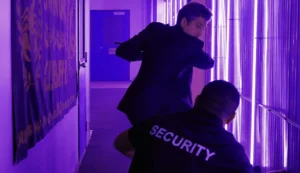
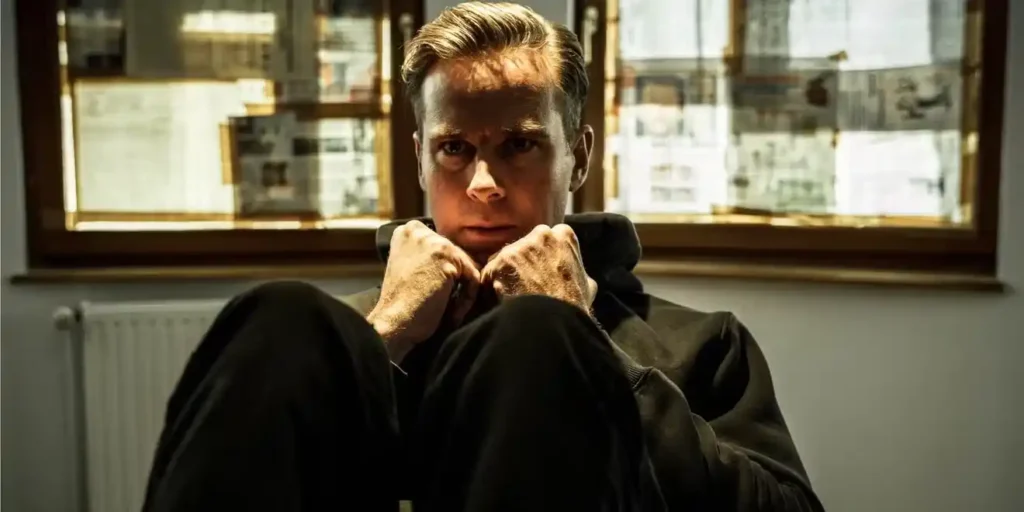
While the selling point of Citizen Vigilante, at least for its target demographic, is undoubtedly all the Muslim murdering, it’s undoubtedly a fascinating case study in several respects. It’s a legitimately illustrative example of how censorship can fuel cult marketing — it was effectively banned in Germany — and how social platforms, specifically X, can function as an indie distribution hub. It’s a rubric for how talentless filmmakers can sustain relevance by pitching politically contentious propaganda at gullible audiences. But it’s also a prime example of how a thoroughly cancelled, seemingly unhirable actor can make a career pivot that catapults them back to the forefront of the public consciousness, such is the case with self-confessed cannibal Armie Hammer, who stars in the movie as murderous landlord psychopath, Sanders.
Hammer isn’t the first person to be blacklisted from the traditional studio system. In his case, a string of leaked text messages and sexual assault allegations made him essentially unhireable, despite no criminal charges being filed. But many more actors have been blackballed for not just bad behaviour, but also addiction, legal troubles, and PR disasters. Exclusion requires a change in approach, which often means the obscure indie circuit, exploitation films, or singular passion projects. Results can be mixed. For Hammer, he chose a comeback vehicle that in many ways mirrored his own ostracisation. But we’ll get to him in a minute.
The Long Way Around
Many actors possessed of genuine talent and charisma have become Hollywood pariahs, often through their own conduct, forcing a period of exile during which they essentially have to make their talents impossible to ignore, and reassure filmmakers and insurance companies that they can be relied upon.
Perhaps the most notable example is Robert Downey Jr. It takes an effort to remember this, but in the pre-Iron Man days, major Hollywood studios declared him pretty much uninsurable on account of a very public drug addiction, multiple arrests, and stints in rehab and prison. He was forced to rebuild his career by reestablishing his artistic credentials, starring in indie and cult neo-noir projects, most notably Shane Black’s Kiss Kiss Bang Bang. The film became a cult hit, and it was Downey Jr.’s performance in it that compelled Jon Favreau to hire him as Tony Stark.
Natasha Lyonne had a similar trajectory, experiencing early success in American Pie, struggling in the mid-2000s due to addiction, legal troubles, and health issues, and having to rebuild in underground theatre and cult films. She developed a very specific and unique screen persona that she rolled into her Orange is the New Black role and then into Russian Doll.
Sometimes the circumstances are less salacious but equally damning, as with Nicholas Cage, who essentially ostracised himself by trying to address crippling financial debt by saying yes to basically any straight-to-DVD script that came his way. However, despite the quality of the material, Cage always treated it like high art, parlaying his arch, slightly unhinged screen persona into a run of darling indie projects and, eventually, back into the mainstream, his integrity intact.
The Exploitation Effect
A popular blueprint for cancelled actors is to target exploitation cinema, the kind of projects where lingering toxicity can be weaponised as part of a movie’s countercultural spirit. Robert Rodriguez would famously cast actors who had been shunned by mainstream media, including several notable examples.
When Lindsay Lohan was at the height of her infamy due to severe substance abuse issues and legal troubles, Rodriguez hired her as a gun-toting nun in Machete. It was a minor role, but it was deliberately salacious and enjoyably self-aware, reminding the public that Lindsay Lohan was, contrary to public opinion, very much still out there.
Similarly, Machete Kills, the sequel, had roles for both Charlie Sheen, who had an extremely public meltdown after being fired from Two and a Half Men in 2011, and Mel Gibson, who had been exiled from Hollywood after a string of bigoted tirades and domestic abuse scandals in the early 2000s. While it can’t be said that Sheen’s career has ever quite made it back to its original peak, Gibson, while still considered too risky in some circles, has helmed some high-profile studio-backed projects since then, notably Hacksaw Ridge.
The Easy Way Out
By agreeing to helm an Uwe Boll picture, especially one with extremely contentious politics that would almost certainly be weaponized by the far-right, Hammer proved that he was happy to be in the conversation — and earn a few quid — at the expense of burning any remaining bridges he might have had left in the mainstream. He chose a project so radioactive that he’ll now become the go-to guy for incendiary conservative propaganda (including a potential sequel).
There are eerie parallels between the movie and Hammer himself. The championing of grassroots social media in lieu of traditional news media, both in-universe as a way to tacitly frame the protagonist as the hero and in reality to get the movie sold, reflects what Hammer is doing with his own career by taking the route of a morally bankrupt film made by an unscrupulous provocateur.
Hammer’s approach to worming his way back into work was not to prove his bona fides and reliability in cult projects, but to tether himself to a button-pushing mess so that he’d be in the centre of the ensuing firestorm. Through a character who’s violently railing against the system and taking matters into his own hands, Hammer looks to express his own frustrations at being suppressed. If Boll got one thing right with Citizen Vigilante, it was casting Hammer in it, but not for particularly good reasons.
RELATED: