
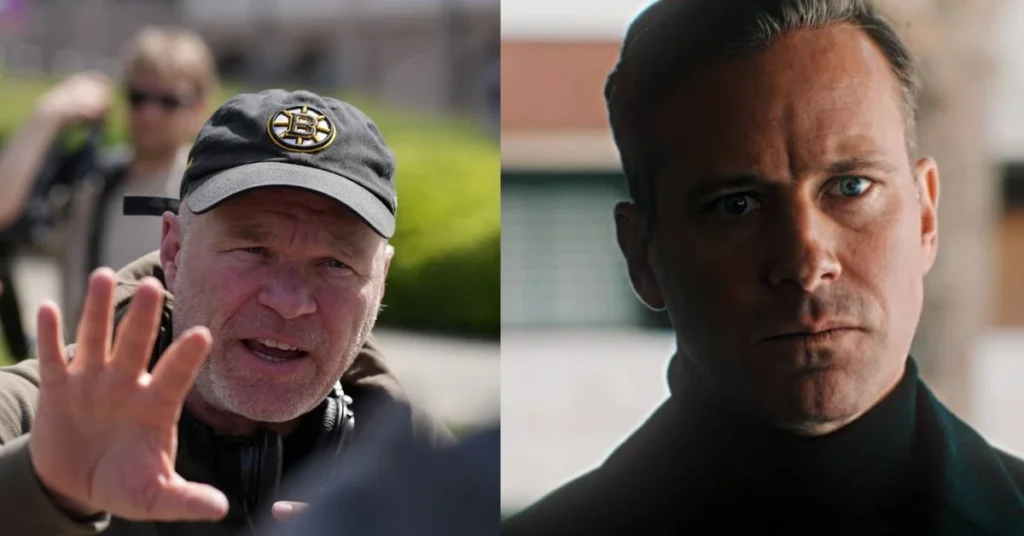
Taking away the subjectivity of film criticism, mathematically and by the law of averages, Uwe Boll is bad at making movies. However, he is clearly a shrewd businessman – judging by his recent infamous film, Citizen Vigilante, which could easily be argued as a pure grift. If you assess his filmography scientifically, it spans over 30 directed movies, resulting in some absurdly low average scores*:
- Average Rotten Tomatoes Score (Tomatometer): ~10% to 12%
- Average IMDb Score: ~3.5 / 10
*Average scores collated on 30th June 2026
It’s worth noting that his averages are weighed down by his mid-2000s video game run. His “Hall of Shame” list cemented his reputation and is widely seen as the absolute bottom of the barrel:
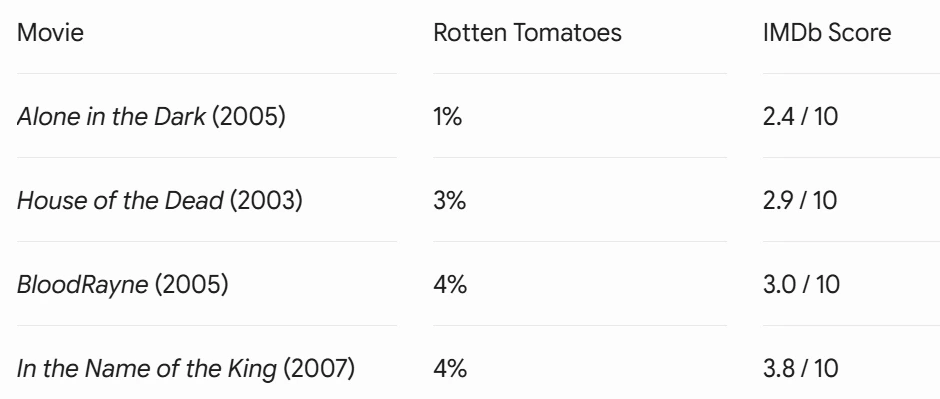
Uwe Boll’s lowest rated movies
Alone in the Dark even spent a long time on Rotten Tomatoes’ official list of the 100 worst-reviewed films of the century. However, while he has a terrible reputation, he isn’t completely devoid of talent.
Stepping away from video game adaptations actually benefited the director. When he decided to delve into grittier, more violent political films, he earned some respect. Take 2009’s Rampage, for example: a dark thriller about a mass shooter that holds a 4.5/10 on IMDb and surprisingly spawned two sequels. Then there’s Darfur (2009), a handheld drama set in Sudan. This is probably his objectively “best” film, holding a 5.6/10 on IMDb. Without humoring the maths too much, this is practically a masterpiece by Uwe Boll standards.
But these statistics are mere receipts for a wider context. I suspect Uwe Boll does not care about criticism because he was able to survive terrible numbers regardless.
Let’s Talk About the German Tax Loophole
Before the law was changed in 2006, Germany had tax provisions set up to encourage investment in the arts. If the question is, “How did a man incapable of making a good film keep getting millions of dollars to make more?” – well, the German tax loophole brings us closest to the answer.
German investors could write off 100% of their investment in a film production against their income tax. Crucially, tax was only expected on the profits the movies made. So, if a movie bombed, the investors could use the loss to engineer a lower overall tax burden.
Uwe Boll realized this German tax loophole worked heavily in his favor. He could guarantee his investors a financial win either way: through box office profit or through tax savings, depending on whether the movie made money or a loss. It could be argued that making “good” movies was never the goal here; financial engineering was simply prioritized over scripts and artistic quality.
Intellectual Properties Turned Gamers Against Him
Uwe Boll could have just made standard bad movies, but he decided to make bad movies out of beloved video games – which was not the wisest decision for his reputation. By creating objectively awful video game adaptations, he turned millions of passionate gamers against him.
This led to a relentless wave of negative criticism. For instance, 2003’s House of the Dead became infamous for randomly inserting actual gameplay footage into the middle of live-action scenes. In 2005, he released Alone in the Dark, which is widely considered one of the worst films ever made because it completely misunderstood the tone of the game.
Even when he secured top-tier talent like Ben Kingsley (Wonder Man) and Jason Statham (Shelter) for BloodRayne (2005) and In the Name of the King: A Dungeon Siege Tale (2007), backed by decent budgets, the productions were deemed incoherent and unwatchable.
Is Uwe Boll a Troll?
Especially after the release of Citizen Vigilante – and his insistence that a sequel is coming after it dropped on X for free – I do wonder if Uwe Boll just loves trolling the film industry. I’ve seen him featured on podcasts, and he seems genuinely proud of the reaction to his Armie Hammer feature, regardless of its heavy political implications. He thrives on bad PR, reminiscent of YouTubers who conduct outrageous pranks in public just for the engagement.
Uwe Boll clearly has thick skin, which, bizarrely, has granted him an inadvertent legendary status for how he handles backlash. Boll loves playing the villain.
This goes back two decades. In 2006, after facing bad review after bad review, he issued a public challenge, inviting film critics to Vancouver to fight him in a legally sanctioned, televised boxing match.
The fun part? The critics didn’t realize that Uwe Boll was a legitimately trained amateur boxer. He beat all five critics he faced in the ring convincingly, turning their feud into a massive PR stunt.
However you feel about Uwe Boll – whether he hurt your feelings as a gamer, pissed you off as a film critic, or offended you with his politics – it’s clear he’s an interesting personality. He appears entirely immune to cancellation, even after releasing a film deemed dangerous. But the maths do not lie. Uwe Boll is bad at making movies; there’s really no other way to look at it.
Either way, I’m sure he does not care.