Summary
Little Brother won’t be winning any awards, and it’s unashamedly the type of low-brow R-rated comedy you’re probably imagining, but it has an earnestly empathetic streak that helps to elevate it.
Netflix’s Little Brother is an unashamedly silly movie, and given the R-rating, I must confess to having entered it expecting the John Cena equivalent of Prime Video’s Balls Up. But I found myself pleasantly surprised in a lot of respects. Sure, it’s a slapstick-y and intermittently profane knockaround that picks some pretty low-hanging fruit, comedically speaking, but it’s also threaded with surprisingly earnest sentiment and infectious ideas about found family and brotherly love. I may have even gotten a little misty-eyed at one point. In a John Cena movie!
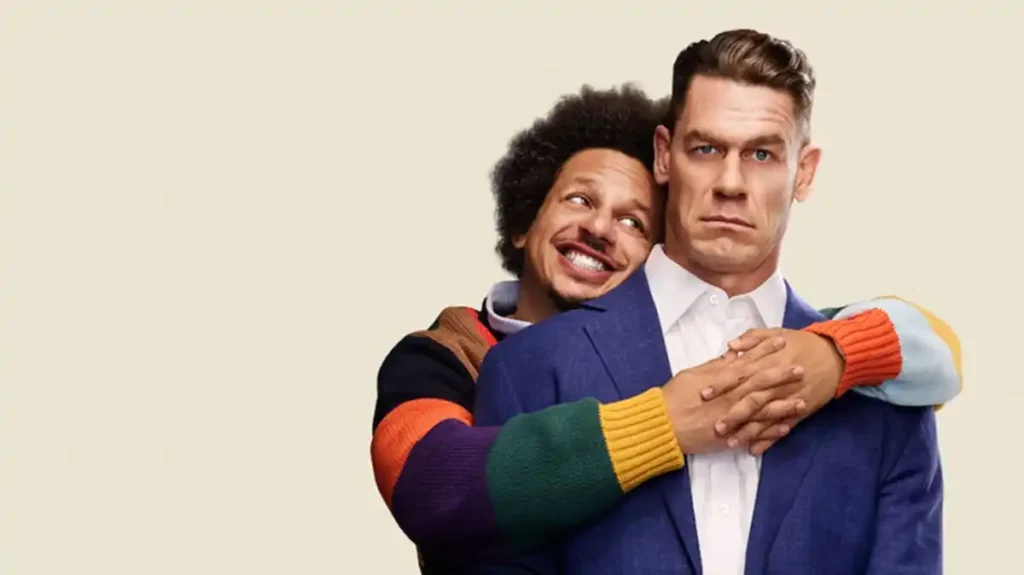
But that’s kind of the point. Cena undeniably has a lane. He’s never going to win an Oscar, but he’s pretty okay with that, and he knows that the best use of his cinematic time is to play arch versions of himself alongside someone who complements his attributes. Director Matt Spicer (Dollface) and co-writers Jarrad Paul and Andrew Mogel know that securing Cena is one thing, but the real magic only happens when he has the right co-star to reflect his light.
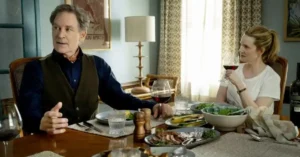
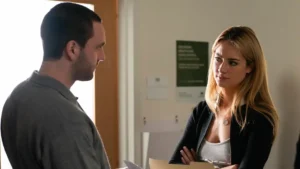
Cena’s playing Rudd Landy, a hulking realtor who has enjoyed a fair amount of success already but is obsessively pursuing a role on a reality show called NYC Hustlers, a send-up of the spate of soapy property shows that litter streaming services – especially Netflix – these days. He isn’t hurting for money, but he is hurting for the limelight that has been stolen from him by his much more successful older brother, Josh (Chris Meloni, Captain Fall), ever since the two of them were kids. And Rudd’s obsessive careerism has left his wife, Deirdre (Michelle Monaghan, The White Lotus), and their teenage sons (Bryce Gheisar and Pilot Bunch) feeling neglected and overlooked.
You have all the right constituent parts of a classic Cena vehicle here. He has the build, the hot wife, the suits, and the general demeanour of a minor bro-God, but the latent insecurities and emotional softness of the more nuanced figure that Cena is particularly good at portraying. When Josh upstages Rudd by donating ten times his offering at a gala for Deirdre’s charity, you end up feeling sorry for him intuitively, despite the fact that his own $10,000 donation suggests he’s doing pretty well for himself.
Rudd’s counterpoint in this movie is not his actual brother but Marcus Pinchel (Eric André, Ironheart), an eccentric orphan he once briefly mentored during a social outreach program that he thought would bolster his college application. Marcus has been battered by the system, ping-ponged between foster families and mental health facilities, and begins the movie homeless and adrift. Despite his circumstances, though, he seems much happier with his lot than Rudd is, but he also wrongly believes that he and Rudd have a tight relationship thanks to back-and-forth emails that have actually been handled by Rudd’s assistant, Mia (Sherry Cola, Shrinking), without his knowledge.
It’s because of this that Marcus makes his way into Rudd’s life to resume being his little brother full-time, much to Rudd’s chagrin, at least until he realises that he can leverage the relationship to further his reality TV career. Rudd’s selfishness is matched by Deirdre’s, a scathing send-up of the performative empathy that privileged people sometimes adopt to feel less bad – or make other people think less badly – about their own moneyed circumstances.
To be clear, Little Brother isn’t a preening message movie. It’s full of scatological and sexual humour and outright slapstick, a lot of it fairly ridiculous, and it’s very proud of finding ways to live up to the R rating while also remaining chaste enough not to come across like it’s trying too hard. But it is underpinned by real issues and ideas, and it isn’t shy about those, either. It has a few things to say about the racial and economic inequalities of the United States and the psychological realities that they propagate, particularly for the people who fall through the cracks of gutted systems ostensibly intended to help reduce the very iniquity that they inadvertently worsen. And it’s very resolute in the idea that empathy, authentic human connection, and family, either found or biological, are the most important qualities in a world that draws no distinction between personal and private lives as long as they can be commodified and sold to the masses.
I’d be lying if I said that Little Brother really did anything with these ideas, but it’s nice that they’re there either way. There’s something innately likeable about this movie that stems from its instinctive understanding that people, no matter how eccentric or self-serving on the face of it, are fundamentally predisposed to affection and kindness, and that even the biggest divisions and the worst of circumstances can be overcome through providing people with the affection and approval they’re seeking. In such a cynical media culture, that’s worth paying attention to. And as an added bonus, you get to see John Cena sell a Michelle Monaghan rimjob with the same selfless commitment that made him so beloved as a pro-wrestler. Sure, he might not ever win an Oscar. But he’s definitely the star a movie like this needs.