
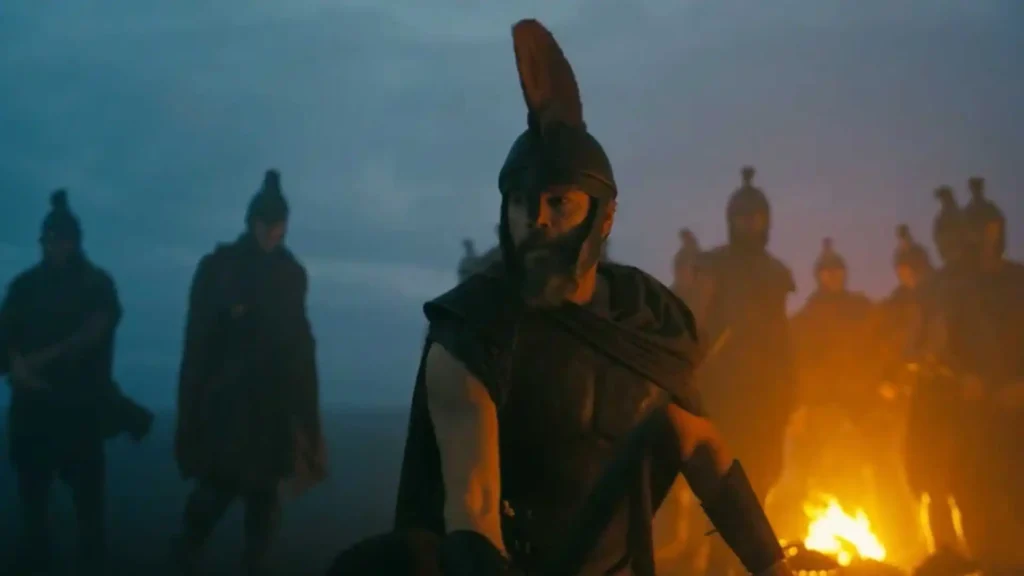
The Odyssey is quite the journey. Christopher Nolan’s adaptation of Homer’s epic poem is an extraordinary movie, a bombastic, visually remarkable, thematically rich modernisation of one of the greatest stories ever told. It has also been met by one of the most absurd, disingenuous cultural blowbacks I’ve ever had the misfortune of witnessing. Testament to the brilliance of Nolan, though, of whom I haven’t always been the biggest fan, most of the things that were perceived as fatal flaws end up being deliberate, careful choices made in service of a more layered interpretation of the original text.
And, for whatever reason, a lot of people aren’t getting it. Sure, much of the criticism is inherently performative and inauthentic, but I’ve seen otherwise reasonable people missing what I thought were rather obvious points. As is Nolan’s way, there’s definitely some ambiguity, but most of the ideas are very legible and weave together in satisfying and logical ways. For fun, and because I’m still thinking about the movie, and because I feel like some folks really do need a few concepts broken down, I’ve decided to lay it all out as clearly as I can.
Zeus’s Law
By far the most important concept to grasp in The Odyssey is the idea of Zeus’s Law, or the Golden Rule, or xenia. At its most fundamental, this is the idea of ritual hospitality. In other words, treat people how you would want to be treated, taken to something of an extreme.
While this is typically a rather Christian idea, the Greek version justifies the hospitality not on moral grounds, but on practical ones. The person you’re hosting could be a god in disguise, which is pretty common in mythology. The whole thing’s a “better safe than sorry” approach that has morphed into a defining cultural principle.
It’s Zeus’s Law, for instance, which prevents Telemachus and Penelope from forcibly removing the bawdy suitors from their home. It’s how the ancient Greeks survived as isolated city-states, where washing ashore and seeking shelter in strange climes were very common occurrences. And it’s the violation of this law that underpins Odysseus’s character arc, not to mention the fall of the Bronze Age.
The Sacking of Troy
With Zeus’s Law in mind, the sacking of Troy takes on a new relevance. In many ways, the origins of the Trojan War itself were a violation of the Golden Rule, since the Trojan prince, Paris, stole away with Menelaus’s wife, Helen, while under his roof. But from the perspective of Odysseus, the great betrayal comes in the form of the famed Trojan horse.
Troy was virtually impregnable, and the only way that Odysseus could convince the city to open its gates was to present a giant horse in the guise of a gift. Odysseus and an elite cadre of his men were hidden inside. The Trojans dragged the horse within the city gates, and then the Greeks broke forth from its belly, raping and pillaging their way through the city, committing innumerable atrocities on the way.
To Odysseus, this ruse, while the only way to sack the city after spending a decade on the beach unable to breach the walls, is the ultimate violation of Zeus’s Law and causes a profound knock-on effect throughout Greek culture. This is also what he believes to have led to his “cursed” journey home, a penance paid to Athena and the other gods, such as Poseidon, after blinding his son, Polyphemus, for the transgressions that the Greeks had to commit in order to win the war.
Odysseus’s Return to Ithaca
As mentioned, it’s the Golden Rule that prohibits Odysseus’s son, Telemachus, and his wife, Penelope, from expelling the suitors. The point of Odysseus’s return is that he can expel the suitors, since he is already “fallen” after having violated Zeus’s Law in the first instance. In a way, it’s an act of deliberate self-sacrifice, which is why he insists that Telemachus plays no part in the killing of the suitors.
In this way, Odysseus enables Telemachus to take the throne of Ithaca in a more traditional, non-cursed way. Odysseus himself, meanwhile, is exiled, but he’s happy to leave and sail West with Penelope to honour his fallen men. On the way, they discuss how their exploits will be recounted in songs, since writing will fall out of favour in the dark ages following the Bronze Age, the end of which is implied to have been brought about by the Greeks violating the Golden Rule.
The Sea Peoples
In Odysseus’s long absence, rumours of the savage “Sea Peoples” begin to circulate about marauders who come ashore and sack settlements in violation of the Golden Rule. They’re presented as an existential threat, villains who don’t play by the rules of the Greeks and the gods.
When Odysseus finally returns to Ithaca, he confesses to Penelope that he and his men are the Sea Peoples. On their way back home, they stopped off in various places, plundering and pillaging, creating their own legend.
In other words, the greatest threat to Greece was, in fact, the Greeks. The barbarians were already inside the gate. Breaking Zeus’s Law in Troy led to it being broken elsewhere, breaking down the sanctity of hospitality across all of Greece. Fittingly, by the time Odysseus returns home, the suitors have already begun to turn on their hosts more flagrantly, a process that gradually took place throughout the entire movie to reflect Odysseus’s long journey and the burgeoning reputation of the Sea Peoples that he inadvertently cultivated during his journey.
Athena
In the original telling, the Greeks in general, and Odysseus specifically, are favoured by the gods, or at least by Athena, whom Odysseus sees regularly in the form of Zendaya. However, the end of the movie also reveals that the person Odysseus is really seeing is a priestess of Troy who was beheaded during the sack, at the same time that a statue of Athena was also beheaded. In Odysseus’s PTSD-afflicted mind, he has linked the two together. The encounters that were originally perceived as divine intervention were, in fact, manifestations of his trauma.
This creates some ambiguity around Athena, and whether she really was presenting herself to Odysseus or was simply a figment of his addled imagination remains unclear. But this, too, links to the Golden Rule, since the idea there was always that anyone under your roof could be a god in disguise. By explicitly imagining Athena as a real person whose death he felt responsible for, Odysseus was drawing a clear parallel between humans and gods, just as the Golden Rule does.

Matt Damon and Zendaya in The Odyssey | Image via Universal Pictures
Sinon
One of the most needlessly “controversial” aspects of The Odyssey was the casting of Elliot Page, who, for some reason, people assumed was playing the famed Greek warrior, Achilles. Page is actually playing a totally different character named Sinon, who is important for totally different reasons.
Again, it’s to do with the Golden Rule. When Odysseus agreed to go to war at Agamemnon’s behest, he held a lottery to raise an army fairly, and Sinon ended up being included thanks to the manipulations of Robert Pattinson’s cowardly, villainous Antinous. The criticism of Page not exactly being built like a Greek warrior is entirely the point – Sinon is not a warrior and never should have been at war in the first place.
However, to sell the illusion of the Trojan Horse being a gift, Odysseus had to allow Sinon to believe that and keep him in the dark about its true intentions. The Trojans killed Sinon instantly, even though they accepted the gift, so Odysseus had to essentially sacrifice his cousin, who never should have been there in the first place, to violate the Golden Rule. The compounding effect of this trauma is absolutely central to Odysseus’s character arc.
Helen of Troy
On the subject of stupid controversies, people were also moaning that the casting of Lupita Nyong’o as Helen of Troy was somehow a problem since she wasn’t “beautiful” enough to qualify. This is absurd on its face, since Nyong’o is famously strikingly beautiful, but it’s something else that Nolan also actively addresses in the text.
Before going off to war, Odysseus explains to Penelope that Helen is simply being used as a pretext by Agamemnon to sack the rich city of Troy and control the valuable trade routes. Her beauty, central to the more romantic idea of the conflict, has nothing to do with it. Her face didn’t launch a thousand ships – they’d have been on their way regardless.
Nolan is making the same point in having Helen and her half-sister Clytemnestra be literal twins. Helen isn’t a unique, singular beauty – there’s someone else who looks exactly like her. It’s deliberately undermining the more fanciful notion in exchange for something more cynical and grounded, an approach that Nolan takes repeatedly across the entire movie.
RELATED: