Summary
Passenger is a lowest-common-denominator schedule-filling horror movie rendered all the more uninteresting by more novel recent efforts.
There are some rides you’ve been on too many times, and Passenger is one of them. A go-nowhere horror movie clearly intended to pad out Paramount’s release calendar, the presence of talented Norwegian director André Øvredal and the marketing might of a great trailer will presumably lure a few genre fans onto a road to nowhere. Flanked on all sides by better, more novel horror brought to life by former YouTubers – Curry Barker’s Obsession, on the one hand, and Kane Parsons’ Backrooms on the other – Passenger feels frustratingly out of date, with Øvredal stuck in the driver’s seat of a vehicle being fed through the studio system’s whirring machinery.
Puns aside, there’s a decent idea here. According to an oft-repeated statistic, out of the 130 million people that go on road trips in the U.S. every year, 15,400 of them are never seen again. The movie creates a demonic reason for the disappearances, attaching them to an internal mythology that imagines a lone car on a lonely stretch of road as a moving haven – but also, potentially, a target for unknowable dark forces.
See? Good idea. And an opening sequence, spoiled almost in its entirety by the trailer, sells the premise enough that the movie’s early-going is perfectly fine. Tyler (Jacob Scipio, Maintenance Required) and his girlfriend Maddie (Lou Llobell, Foundation) have decided to throw off the shackles of urbanity and embrace van life, travelling the U.S. in a renovated camper. But the off-the-grid nomad lifestyle wears thin rather quickly, a process made more urgent by the increasingly obvious realisation that their vehicle of choice has been targeted by a demonic entity haunting those who stop on the road at night.
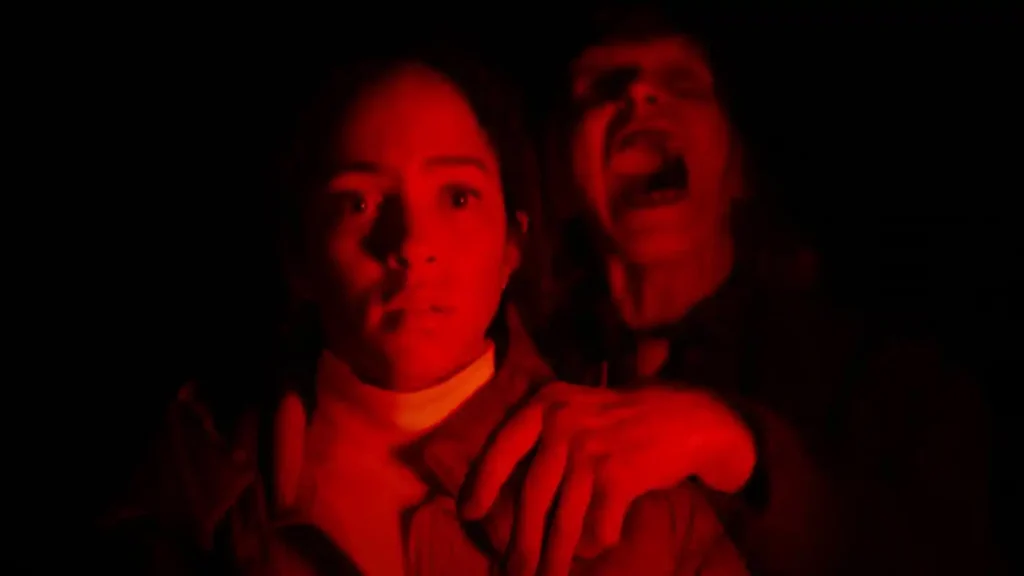
This is all part of a vaguely religious mythology helpfully explained by Diane (Melissa Leo, The Equalizer 2), a character who shows up out of nowhere entirely for exposition purposes. But the lore never really takes. It’s a thinly-defined set of rules bound by something called the “Hobo Code” – should that be “Unhoused Code”, these days? – and repurposing Christian iconography to nebulous effect. I must confess to having understood very little of what happens in Passenger, but that’s as much my fault as it is Øvredal’s, since he doesn’t seem to know what to do with it either. The solution is mostly just a string of jump-scares, none of which are even close to as effective as the couple in the cold open, which is the best stretch of the movie by a considerable margin.
Given its old-school vibe, this is a movie that can’t help but feel dated, the latest in a long line of vehicular horror flicks that have sought to play up the terrifying loneliness of the open road and/or the claustrophobic intimacy of a sealed vehicle. Passenger doesn’t do a great job of either, failing to really situate us as passengers ourselves, but it also fails on more basic levels. The script, from Zachary Donohue and TW Burgess, does a really half-hearted job of characterising the leads and fleshing out their relationship, and in a movie where the only tension comes from what might happen to them, not caring either way is a bit of a deal-breaker.
Horror is endlessly adapting and evolving, and the contemporary strain of do-it-yourself filmmaking is threatening to leave movies like this behind, perhaps with their thumbs upturned and their arms extended. With the money and attention seemingly moving elsewhere, though, it’s unlikely anyone, even Paramount, will pick them up for much longer.