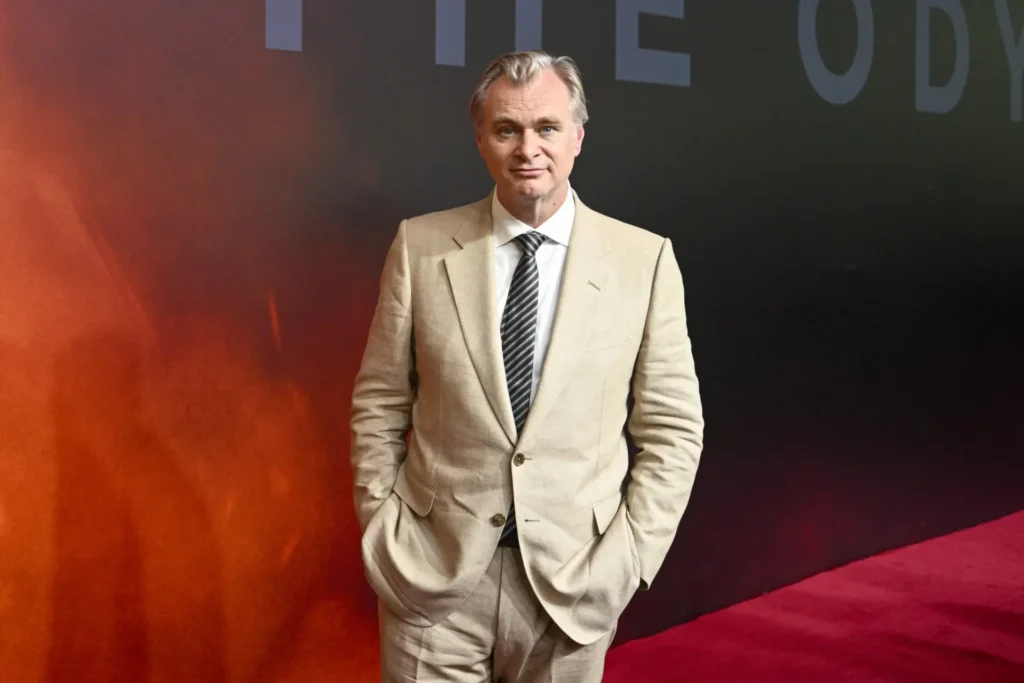
2020 and 2021 were challenging times for Christopher Nolan. He had directed the highly ambitious film Tenet following the successes of Interstellar and Dunkirk. The pandemic came at an untimely moment for his career. Before the virus, Nolan had reached a status where anything he wanted from a studio to fulfill a cinematic vision was approved; his trajectory to cement himself as the definitive film director of our time was sealed. Yet fate dictated that his preferred viewing method for cinema would be logically questioned for commercial reasons.
Warner Bros., in blunt terms, botched their handling of the film. Nolan was dissatisfied with how Tenet was distributed, especially since it was rushed to HBO Max amid uncertainty about global theater closures. Nolan wants his films to be experienced in the grandest way possible: IMAX. This misstep cost Warner Bros. dearly, as Nolan moved his projects to Universal Pictures, resulting in the massive box office successes of Oppenheimer and The Odyssey. The grave mistake Warner Bros. made when they decided to push Nolan away for short-term cash isn’t talked about enough. In retrospect, their long-term vision was appallingly lacking.
“As Nolan Intended”
Culturally, Christopher Nolan was also facing challenges before Oppenheimer. Critically, he had his doubters – in some ways, he was even mocked. Some critics reveled in the delight of not watching Nolan’s films in IMAX. The joke of “I’ll watch Interstellar on my smartphone while on the toilet, as Nolan intended” became a viral meme. Nolan’s steadfast adherence to his principles was met with arrogance. It did not help, of course, that much of the world had given up on cinema as streaming services surged while everyone remained indoors. Critics argued that a film should be judged regardless of format. While true to an extent, there is a subjective measuring stick we have to confront.
Oppenheimer was the turning point. A film documenting America’s building of its first nuclear weapon reignited public intrigue. If you placed Nolan’s career on a timeline, this was the film that changed everything – not just because of the accolades it achieved, but because confidence in cinema returned. People were willing to pay for a ticket again. Suddenly, studio executives saw that non-franchise films could still guarantee success – an industry dream. Following a $1 billion box office run, the director was once again able to command whatever he wanted: cast, crew, production budgets – anything. Ironically, Oppenheimer was released alongside Barbie, a massive franchise in its own right, sparking the cultural phenomenon known as “Barbenheimer.” You can’t help but smile at the irony. Before the now-famous “Barbenheimer” phenomenon, theaters were struggling with formulaic, big-budget blockbusters, sparking fears that the traditional cinema experience was dying. Even back during the pandemic, the release of Tenet was such a pivotal moment for moviegoing that Tom Cruise famously filmed himself returning to a theater to see it, paying respect to Nolan’s unwavering commitment to the big screen.
Ambition on a Grand Scale
This brings us to The Odyssey. Admittedly, I was taken aback to learn that this would be Nolan’s next project after Oppenheimer. The latter felt highly ambitious, but The Odyssey felt like the first time Nolan might actually be undone by his own ambition. And make no mistake – while it is well within Nolan’s skillset, the visual style, production scale, and sheer technical ambition required to shoot The Odyssey on IMAX film cameras in 2026 is no mean feat. Balancing Homer’s complex myth with a commitment to practical filmmaking over CGI is a monumental undertaking. The sheer audacity of what he is attempting to achieve makes seeing the film in a theater a non-negotiable. Homer’s epic poem has been translated many times (my personal favorite being Emily Wilson’s), but in each interpretation, there is a recognition that the story derives enjoyment from its imperfection. There is no way to render the narrative 100% tight and concise. Yet, considering Nolan’s obsession with rules (Zeus’s law), time (recounting legendary tales, Telemachus leaving Ithaca, Odysseus’s return), and narrative structure, it becomes clear why he was drawn to directing a film that builds toward a crescendoing event (the bloody banquet) shrouded in uncertainty and vagueness.
The Odyssey was a success before it even had an official release date, driven by pre-ordered tickets. In the UK, IMAX 70mm screenings sold out almost instantly. When I checked the day after a regular IMAX screening, every single ticket for the BFI IMAX was sold out through the middle of September.
I watched The Odyssey a week after its release, expecting a quieter theater. Every single seat, including the front row, was taken. The last time I saw that? Oppenheimer. I looked for a second viewing over the following three nights – sold out.
Remarkably, Christopher Nolan’s resilience has paid off. His stubbornness proves a salient point: audiences will gladly spend an evening watching a three-hour film if it offers serious cinema. In a world where convenience reigns supreme, there must be a compelling reason for casual viewers to visit a theater. On the evening of my viewing, it was plain to see that this is the path forward: serious, uncompromising directors making serious films in their intended formats.
There is a reason why Interstellar is re-released in IMAX every year. There is a reason why Oppenheimer and The Odyssey will follow the same trend. And there is a reason why, when Nolan announces his next project, limited IMAX 70mm screenings will sell out before a release date is even finalized. You have to give audiences a reason to care. Nolan’s filmography has become event cinema, creating a strategic nightmare for top studio executives: how do you compete with an auteur like Nolan, who can compel a studio like Marvel to push back the release of Spider-Man: Brand New Day by a week just to avoid him?
Converting the Critics
From a critical standpoint, Nolan has proven his point as well; mocking the director for his purism lacks conviction now. If you choose to watch The Odyssey without the context of its intended format, have you truly watched it at all? Five years ago, arrogant critics would have laughed at me for having the audacity to say that. But I’m being deadly serious. Watch Oppenheimer, Interstellar, and The Odyssey at home, and then watch them in IMAX – the experiences are vastly different, subjectively. If these films are re-released in theaters every year, is there really any need to watch them on a smaller screen at home?
Nolan’s resilience has perhaps made a purist out of me, too. Admittedly, I’ve found myself laughing at the social media cesspit, where political fanatics attack the director over minor casting choices. You have an entire ancient epic, and apparently the crux of the outrage is the casting of Black actress Lupita Nyong’o in her dual role as Helen of Troy and her twin sister Clytemnestra. To me, this only underscores Nolan’s triumph: the debate is no longer about his technical purism or sound mixing; it’s about his casting choices. Success inevitably attracts detractors.
The question remains: should present and future Nolan films be judged strictly on the full, intended cinematic experience? There is a compelling case to be made that the answer is a resounding yes. To watch a Nolan film passively at home misses the point – it is a rejection of the full theatrical experience. Cinema depends on it. To ensure we foster a new generation of ambitious filmmakers willing to challenge studio heads and preserve the purity of the art form, we must champion the directors we have now. Not just to save cinema, but to sustain it.