You know a good movie monster when you see one. The Predator! The Xenomorph! The Pale Man! Even those spindly Death Angels from A Quiet Place qualify, which is fitting since that movie is probably the closest analogue to Louis Leterrier’s woeful Netflix thriller, The Last House. The creatures in this movie, though, are wildly uninteresting both visually and thematically, an oversight significant enough to sink a story that was already taking on water from around the midpoint.
Even by the end, there isn’t a great deal of explanation for what these creatures are or where they come from. What we mostly have to go on is inference; errant lines of dialogue and little design details from which we can hopefully fill in the blanks and create a clearer picture. We’re going to try and do that now for the benefit of those curious, but don’t expect too much given how scanty the movie itself is with the details.
What are the creatures in ‘The Last House’?
At a glance, the creatures look like something you might see in a Pirates of the Caribbean movie. They’re full of scales and tentacles, and while they can walk upright like humans, they tend to float along on the tentacles, creating the impression of a sort of train behind them. They’re not aliens – instead, they’re ancient, ocean-dwelling creatures.
This is a pretty generic rendering of what sea creatures would look like. They do come alive a bit underwater, design-wise, but they’re still fundamentally fish-monsters, looking and behaving in pretty much exactly the way you’d expect fish-monsters to look and behave. Apparently, production designer Kevin Jenkins knocked the design together in just a couple of attempts, and you can very much tell.
At the very least, the creatures are largely practical, rendered with the help of a suit and a puppeteer before being finished off with VFX in post, so there is a tactility to the creatures that doesn’t work too badly.
Where do the creatures come from?
To give an honest though uninteresting answer, the creatures come from the ocean. They also return to the ocean at the end of the movie. The implication is that they were always there, living peacefully, but humanity’s cavalier approach to environmentalism compelled them to emerge onto land and begin to take over.
By reversing the core dynamic of an invasion movie by revealing that we, the humans, are the invaders, The Last House thinks it’s making a clever point. But it undermines it constantly by trying to have its cake and eat it, and the motivations of the creatures don’t really make any sense. They come onto land and inhumanely starve – or actively just murder – the human population, flooding all of the dry land, and yet the ultimate message of the movie is that we should show the creatures kindness, since they live on Earth too. It’s a fundamentally broken idea.
What’s all the magic rain about?
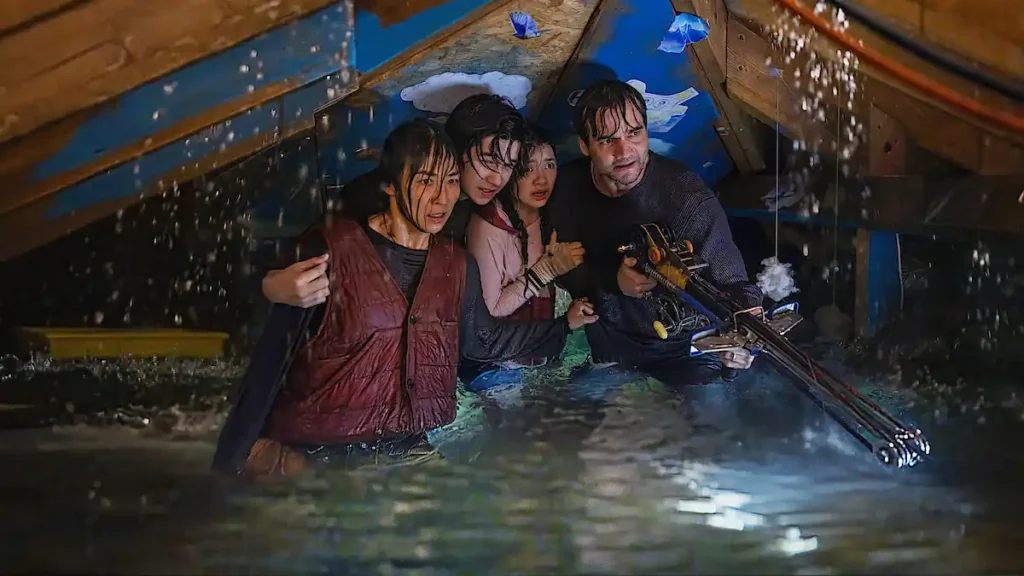
It’s repeatedly clarified throughout the movie that the creatures have a kind of supernatural affinity with water. A torrential downpour creates a kind of magical barrier around the house, which is why the Delgado family can’t escape, and on multiple occasions we see rainwater display sentience, or at least be controlled telepathically by the creatures, being used to grab things and open doors and such.
None of this is ever explained. Sorry about that.
What’s the metaphor?
Despite resembling a post-pandemic lockdown movie for much of its runtime, The Last House is really an argument in favour of living peaceably alongside nature and treating the natural world – especially the oceans – with respect.
There are multiple allusions to this throughout the movie, including rubbish-strewn shorelines and the unsubtle fact that Jason Delgado is a fisherman. We also see how the family are unable to free themselves using Jason and Ann’s strategies. The creatures ultimately poison their soil to prevent them from growing crops, and Jason’s efforts to “chimney fish”, using a MacGyver contraption to ensnare wildlife outside and pull it into the house through a crack in the chimney, aren’t sufficient to keep the wolves from the door.
The only solution is the one espoused by Ruth – communication and mercy. Early in the movie, she had determined that the creatures “seemed nice”, based on nothing at all, and she goes on to render multiple predictions through her art and oblique statements. Ultimately, it’s her insisting that Jason spare the creature they capture that allows them to escape, since the creatures respond in kind by letting them go.
As we mentioned earlier, though, this happy-clappy message of coexistence is fundamentally stupid given that the creatures clearly intended to kill everyone, and mostly succeeded in doing so. Either way, though, I probably won’t be going fishing any time soon.