Summary
A more assured follow-up in just about every way, Avatar: The Last Airbender lightens the exposition load in Season 2, improves the action and visual effects, and digs more confidently into the character dynamics.
It’s impossible to talk about Avatar: The Last Airbender without also talking about One Piece. Both are live-action adaptations of extremely beloved and long-running anime series streaming on Netflix. Both boast impressive production design and surprisingly compelling visual effects to evoke the source material as closely as possible while still making smart, necessary concessions. Both made it to Season 2 and are likely to continue beyond that. And both are much better than anyone expected them to be.
The evolution between seasons is similar, too. The previous outing of Avatar was saddled with oodles of exposition, a nervousness to the performances, and a plasticity to the action that often conspired to undermine it, even if the endlessly compelling undercurrents of the world and the characters still came through. This seven-part follow-up isn’t immune to the occasional explanation of aspects of the worldbuilding outright, sometimes at distracting length, but for the most part, the hard work has already been done, and despite a lengthy two-year gap between seasons, the narrative stakes are clear and concise.
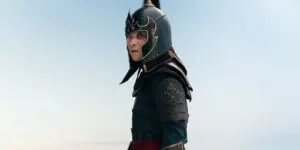
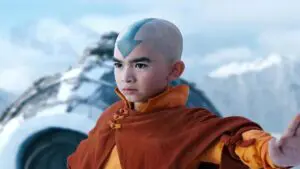
After the climax of the first season, Aang is still on the same path. The evil Fire Nation, led by Fire Lord Ozai (Daniel Dae Kim, Butterfly), is continuing to rampage through the world, subjugating every community they find while hunting for Aang (Gordon Cormier, The Stand) and his allies. Aang has mastered the elements of air and water, but still needs to learn how to “bend” earth and fire to properly embody his status as the mythical “Avatar”, an all-powerful peacekeeper who keeps the various rivalrous nations in check. This gives the early season some shape, as Aang is on the lookout for an earthbending teacher, which leads him to beloved character Toph (Miyako, Beef), who quickly joins the ranks.
More pressing matters threaten to take over, though. Sozin’s Comet, the celestial body that was used to wipe out Aang’s people, is due to make another pass, and in so doing, it’ll increase the power of the firebenders by an order of magnitude. This compels Aang to detour to Ba Sing Se, the walled capital of the Earth Kingdom, to enlist the support of the Earth King and his oblivious armies in the coming battle. It’s a useful ticking-clock device, even if the season’s time in Ba Sing Se is undermined by some predictable plot turns that take too long to get to, given how obvious it is that they’re coming.
It isn’t just Aang that we have to worry about, though. His staunchest allies, brother and sister Sokka (Ian Ousley, Physical) and Katara (Kiawentiio, It: Welcome to Derry), are also along for the ride, and bring their personal problems with them. The former is still smarting from a recent loss, which is preventing him from pulling the trigger on an open-goal romance with Kyoshi Warrior Suki (Maria Zhang), and the latter quickly begins to adopt a crime-fighting vigilante alter-ego, which ends up being a surprisingly common theme.
Smartly, Season 2 of Avatar: The Last Airbender also spends plenty of time on the villains and the antiheroes who emerged from the embers of the Fire Nation in the first season. Ozai’s lunatic daughter, Azula (Elizabeth Yu, May December), very much takes on Big Bad responsibilities with her two personal henchmen, Mai (Thalia Tran) and Ty Lee (Momona Tamada, To All the Boys: Always and Forever). But perhaps the most compelling arc continues to be Zuko’s (Dallas Liu, Shang-Chi and the Legend of the Ten Rings), who is on the run with his uncle, Iroh (Paul Sun-Hyung Lee, Ahsoka, The Mandalorian), both having been brand
ed traitors. Zuko’s still adamant on hunting down Aang for his own personal reasons, but the growing disillusionment that these two begin to feel for Ozai’s regime and their own parts in it provides a degree of satisfying moral complexity that you don’t really get from the uncomplicated heroics of Aang and the others.
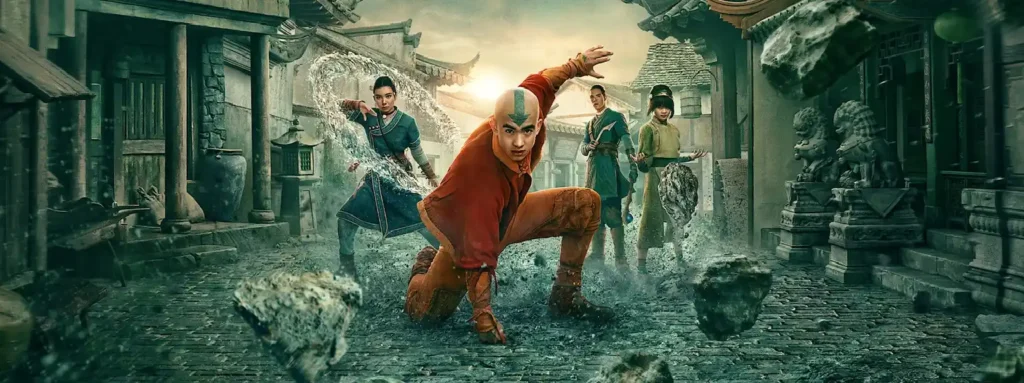
This show continues to exist in a world of vivid imagination brought to life by impressive visual effects and solid fight choreography, and the way the elemental bending is worked into the action remains surprising and satisfying in equal measure. Some saggy middle stretches — not helped by what are, in my estimation, overlong episodes — don’t detract too much from the overall shape of the story, which feels suitably epic without losing the sense of earnest coming-of-age character that really resonates. It’s an impressive and engaging work of action-fantasy with real charm, one that, more importantly, learned all the lessons it needed to from the freshman effort.
RELATED: