Summary
The Abandons is a mess on every level. It’s engaging enough as a stripped-down frontier drama, but it’s hamstrung at every turn by preposterous dialogue and the visible seams of a troubled production.
It’s no secret that Kurt Sutter (Southpaw) parted ways with his Netflix Western The Abandons close to the end of production, citing “creative differences” that are so comically evident in every fibre of the half-finished product that you have to wonder how he stuck around as long as he did. Even the season order is all over the place. What was once a feature-length premiere is now two ho-hum scene-setting instalments cleaved artlessly in two, and what was once a ten-episode epic now runs for seven, all at wildly inconsistent lengths with several abrupt endings and ungainly lurches. The whole thing’s a mess.
I raise this for several reasons, but mostly as a reminder. The shows you watch – especially if they’re airing on streaming platforms, and double-especially if they’re airing on Netflix, which is endlessly making a play to become the only streaming platform in existence by subsuming all the others and pumping out bespoke versions of their biggest IP – are rarely the shows the talented creatives responsible for them wanted to make. I have no doubt that Sutter wanted to do something cool with The Abandons. Correction: He did do something cool, albeit only very intermittently, because the mandate of these big releases seems to be appeasing as wide a demographic as possible. And that means planing away every rough edge until what remains is as glossy and safe and starry as possible.
And so it is we have the soapy family theatrics of Yellowstone mixed with the grit and grime of American Primeval, led by two very recognisable franchise-carrying stars. It’s why we have the Deadwood-style looming threat of a famous super-capitalist – there are endless mentions of “Mr. Vanderbilt” – and every American archetype you can wave a six-shooter at. The Abandons is intended to be familiar and unchallenging as much as it is entertaining, but given how cobbled-together and thin the whole thing feels, it’s a wonder it’s entertaining at all.
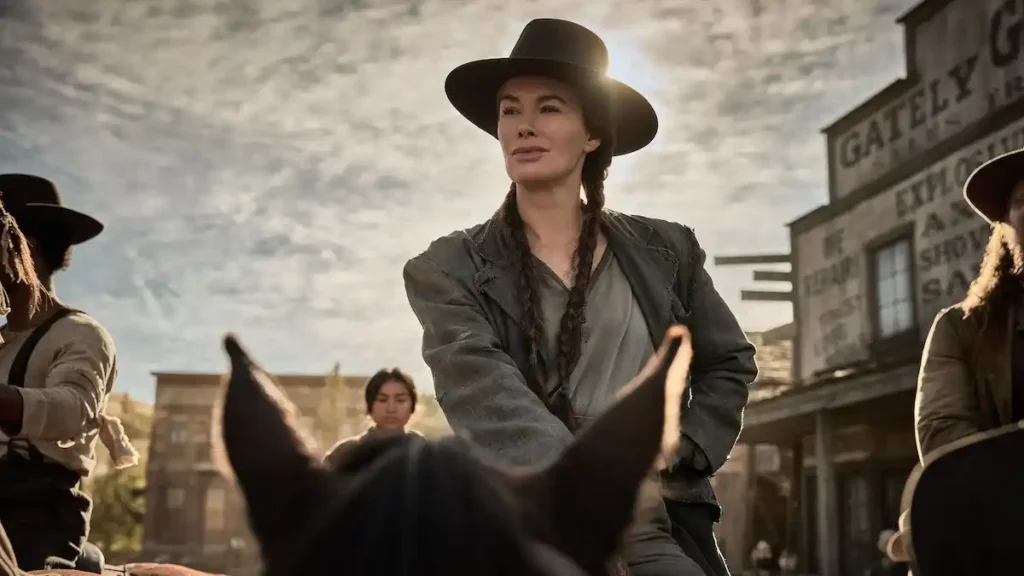
It is, though, almost in spite of itself. It helps that the plot is divided across pretty neat moral faultlines. There’s a land dispute at play, as there always is, with Constance Van Ness (Gillian Anderson; The Pale Blue Eye, The Salt Path, Sex Education), the widowed matriarch of a cutthroat mining dynasty, trying to tap a rich vein of silver beneath Jaspers Hollow, a tight-knit community of four bickering families, one of whom is led by Fiona Nolan (Lena Headey; Wizards: Tales of Arcadia, Beacon 23, Game of Thrones), a no-nonsense cattle rancher with a found-family of troubled orphans who believes the land was bequeathed to her by God and refuses to sell. There’s no ambiguity about which of these two we’re supposed to be rooting for. Constance is ice cold at all times, and Fiona is capable of violence but utterly righteous.
The kids follow suit. The eldest Van Ness son, Willem (Toby Hemingway), is immediately introduced as a provocative racist rapist, and one of the key inciting incidents is him attempting to force himself on one of Fiona’s orphans, Dahlia (Diana Silvers; Lonely Planet, Ma, Ava), which takes a fatal turn and forces Fiona and her neighbours to really unite against Constance’s varied efforts to displace them. The orphans are all broody and pious and protective of one another, and the only real inter-clan crossover is Constance’s decent daughter, Trisha Van Ness (Aisling Franciosi; The Unforgivable, The Nightingale), being oddly drawn to Dahlia’s brother, Elias (Nick Robinson; Shadow in the Cloud, Love, Simon, Maid). But Trisha also has a bit of a thing for Roache (Michiel Huisman; Echo 3, Kate, Rebel Moon), an outlaw Constance hires mostly as a way to check the obligatory “outlaw” box on the Old West character bingo sheet. Others include Albert (Lamar Johnson; The Hate U Give, The Last of Us), an educated Black man, several Indigenous characters like Lilla Belle (Natalia Del Riego) and members of the local Cayuse tribe, and Fiona’s lifelong Irish-Catholic pastor mentor, Father Duffy (Timothy V Murphy; American Siege, Broil).
Sutter – or whoever – isn’t content to just peddle these broad archetypes in lieu of a three-dimensional story about people who resemble complex human beings. No, he also has them communicate in extremely bizarre dialogue, an attempt at a kind of heightened speech that can’t pass for organic but isn’t flowery and lyrical enough to constitute anything more Shakespearean. Even if the characterisations weren’t so flat, it’d be extremely difficult to buy into confrontations between these characters when everyone speaks like they’ve read the words in the script but are having to figure out the order they should be spoken aloud on the fly.
The Abandons proceeds in this way across seven messy episodes to a cliffhanger conclusion that is obviously panhandling for a sequel, which feels a bit rich considering the plot is an assembly of the most played-out Western tropes and character beats possible, and not a single surprising thing happens in the entire runtime. People will like it all the same, since it goes down in a single binge without issue, and you’ll end up invested regardless because the stakes are so obvious and so simplistic. But it’s hard not to imagine what kind of show The Abandons might have been if Kurt Sutter had been left alone to make it.